Anger is one of the strongest human emotions. We all feel it—sometimes quietly, sometimes like a storm ready to explode.
But when writers try to describe anger, they often use the same boring words: mad, upset, or furious. These words tell the reader what a person feels, but they do not show the emotion.
This is where similes become powerful.
Similes help readers see and feel emotions through clear comparisons. When someone is described as “angry like a volcano ready to erupt,” the reader instantly imagines heat, pressure, and danger.
A simple feeling suddenly becomes vivid and memorable.
In this guide, you’ll discover 27+ creative angry similes that make writing more expressive.
Whether you’re writing stories, essays, poems, or dialogue, these examples will help you describe anger in ways that feel natural, fresh, and engaging.
By the end, you’ll also learn how to create your own similes, avoid common mistakes, and practice using them with simple exercises.
What Is a Simile? (Quick Clear Definition)
A simile is a comparison between two different things using the words “like” or “as.”
Writers use similes to make descriptions more vivid and easier to imagine.
Example:
He was as angry as a thunderstorm.
Quick List – Most Popular Similes for “Angry”
- Angry like a volcano ready to erupt
- Angry as a raging bull
- Angry like a storm breaking the sky
- Angry as a bear disturbed from sleep
- Angry like boiling water
- Angry as a lion protecting its cubs
- Angry like thunder before rain
- Angry as a hornet in a shaken nest
- Angry like fire spreading through dry grass
- Angry as a barking guard dog
Complete List of Similes for “Angry” (Grouped by Meaning)
Funny & Lighthearted Angry Similes
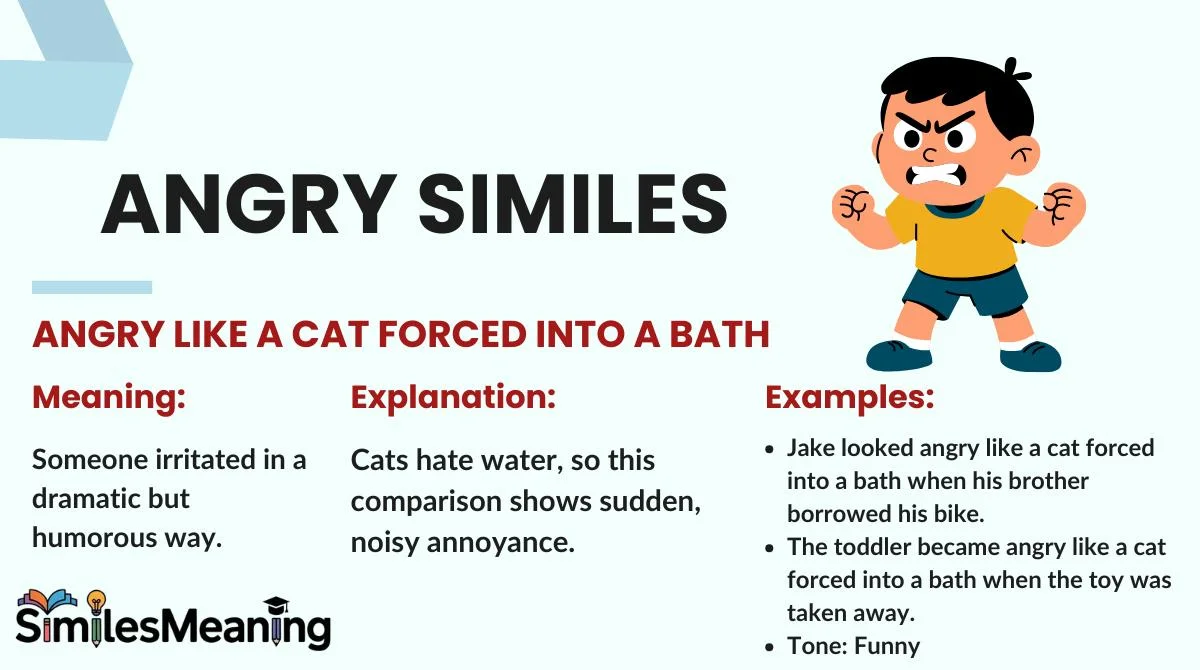
Angry like a cat forced into a bath
Meaning: Someone irritated in a dramatic but humorous way.
Explanation: Cats hate water, so this comparison shows sudden, noisy annoyance.
Examples:
- Jake looked angry like a cat forced into a bath when his brother borrowed his bike.
- The toddler became angry like a cat forced into a bath when the toy was taken away.
Tone: Funny
Angry as a buzzing mosquito near your ear
Meaning: Small but very annoying anger.
Explanation: A mosquito keeps bothering you even if it’s tiny.
Examples:
- She was angry as a buzzing mosquito near your ear after losing the game.
- Tom stayed angry as a buzzing mosquito the whole morning.
Tone: Casual
Angry like a kettle screaming on the stove
Meaning: Someone loudly complaining.
Explanation: A boiling kettle whistles loudly when pressure builds.
Examples:
- He sounded angry like a kettle screaming on the stove during the argument.
- Mom became angry like a kettle on the stove when the kitchen was messy.
Tone: Funny
Angry as a dog guarding its bone
Meaning: Protective and unwilling to share.
Explanation: Dogs defend their favorite things strongly.
Examples:
- She grew angry as a dog guarding its bone when someone touched her project.
- The child became angry as a dog with a bone when his toy was taken.
Tone: Casual
Angry like a toddler denied candy
Meaning: Dramatic, emotional anger.
Explanation: Children react loudly when they don’t get what they want.
Examples:
- He acted angry like a toddler denied candy when the plan changed.
- Sara looked angry like a toddler without sweets.
Tone: Funny
Emotional & Deep Angry Similes
Angry like a storm building on the horizon
Meaning: Anger slowly growing stronger.
Explanation: A distant storm quietly gathers power before it breaks.
Examples:
- His silence felt angry like a storm building on the horizon.
- The room grew tense as her mood became angry like a coming storm.
Tone: Serious
Angry like fire in a dry forest
Meaning: Anger spreading quickly and dangerously.
Explanation: Fire in dry trees spreads fast and becomes uncontrollable.
Examples:
- Rumors made the crowd angry like fire in a dry forest.
- His temper burned like fire in dry woods.
Tone: Dramatic
Angry as thunder shaking the sky
Meaning: Loud, explosive anger.
Explanation: Thunder is powerful and impossible to ignore.
Examples:
- His voice sounded angry as thunder shaking the sky.
- The coach shouted like thunder after lightning.
Tone: Dramatic
Angry like waves crashing against rocks
Meaning: Repeated bursts of anger.
Explanation: Ocean waves strike rocks again and again.
Examples:
- Her words came angry like waves crashing against rocks.
- His frustration rose like waves against the shore.
Tone: Poetic
Angry as a wounded tiger
Meaning: Fierce and dangerous anger.
Explanation: A wounded animal fights harder to protect itself.
Examples:
- The warrior stood angry as a wounded tiger.
- He looked angry like a hurt tiger ready to strike.
Tone: Serious
Dramatic & Intense Angry Similes
Angry like a volcano about to erupt
Meaning: Extreme anger ready to explode.
Explanation: A volcano builds pressure before bursting violently.
Examples:
- She stood angry like a volcano about to erupt.
- His silence felt like lava waiting to burst.
Tone: Dramatic
Angry as a raging bull
Meaning: Wild, uncontrollable anger.
Explanation: Bulls charge when provoked.
Examples:
- The crowd became angry as a raging bull.
- He stormed into the room like a raging bull.
Tone: Intense
Angry like lightning striking a tree
Meaning: Sudden and explosive anger.
Explanation: Lightning strikes quickly and powerfully.
Examples:
- His reaction came angry like lightning striking a tree.
- She snapped like lightning in a storm.
Tone: Dramatic
Angry as a hornet’s nest kicked open
Meaning: Chaotic, aggressive anger.
Explanation: Disturbing a hornet nest causes instant attack.
Examples:
- The crowd turned angry as a hornet’s nest kicked open.
- His temper rose like angry hornets in the air.
Tone: Dramatic
Angry like a pressure cooker about to burst
Meaning: Anger building under pressure.
Explanation: A sealed cooker releases steam suddenly if pressure rises.
Examples:
- He seemed angry like a pressure cooker about to burst.
- Her frustration grew like steam in a cooker.
Tone: Serious
Creative & Unique Angry Similes
Angry like sparks jumping from hot metal
Meaning: Quick flashes of anger.
Explanation: Hot metal throws sudden sparks.
Examples:
- His temper flashed like sparks from hot metal.
- Her words flew like angry sparks.
Tone: Creative
Angry like a storm trapped in a bottle
Meaning: Hidden anger waiting to escape.
Explanation: The storm image shows trapped energy.
Examples:
- He looked angry like a storm trapped in a bottle.
- Her silence felt like thunder locked away.
Tone: Poetic
Angry like a cracked dam holding back water
Meaning: Anger close to bursting.
Explanation: A cracked dam can break at any moment.
Examples:
- His face looked angry like a cracked dam holding back water.
- One more insult and his temper would break.
Tone: Serious
Angry like embers glowing under ash
Meaning: Quiet anger still burning.
Explanation: Fire may seem gone but still burns beneath.
Examples:
- She stayed angry like embers under ash.
- His calm voice hid anger like hidden fire.
Tone: Poetic
Angry like a thundercloud full of lightning
Meaning: Heavy tension and anger.
Explanation: Storm clouds carry energy waiting to strike.
Examples:
- The boss entered angry like a thundercloud.
- The room felt tense like lightning waiting to flash.
Tone: Dramatic
Poetic & Literary Angry Similes
Angry like the sea during a storm
Meaning: Deep, powerful anger.
Explanation: Stormy oceans are loud and unstoppable.
Examples:
- His voice roared angry like the sea in a storm.
- Her heart felt like waves smashing cliffs.
Tone: Poetic
Angry as wind tearing through trees
Meaning: Strong and destructive anger.
Explanation: Strong winds shake and break branches.
Examples:
- His words blew angry as wind tearing through trees.
- The crowd shouted like storm winds.
Tone: Dramatic
Angry like dark clouds swallowing the sun
Meaning: Anger changing the mood instantly.
Explanation: Clouds can suddenly darken the sky.
Examples:
- His mood turned angry like clouds swallowing the sun.
- The room darkened with tension.
Tone: Poetic
Angry like lava rolling down a mountain
Meaning: Slow but unstoppable anger.
Explanation: Lava moves slowly but destroys everything.
Examples:
- His anger moved like lava down a mountain.
- The argument spread slowly but powerfully.
Tone: Dramatic
Angry like iron heated in a forge
Meaning: Intense, burning anger.
Explanation: Heated metal glows red with heat.
Examples:
- His face glowed angry like iron in a forge.
- Her voice felt hot as burning steel.
Tone: Serious
Fresh and Unique Similes You Won’t Hear Every Day
Here are five creative similes that feel new and vivid.
Angry like a shaken soda bottle
Pressure builds until it bursts everywhere.
Angry like a thunder drum in a silent room
The anger feels loud and impossible to ignore.
Angry like a trapped hawk beating its wings
Shows frustration and desire to escape.
Angry like cracked ice under heavy boots
Tension ready to snap.
Angry like a red traffic light holding rushing cars
Energy forced to stop.
These comparisons create visual images readers remember easily.
How to Use These Similes in Writing
In Essays
Similes help explain emotions clearly.
Example:
The protest crowd grew angry like a storm ready to break.
In Stories
Similes make characters feel alive.
Example:
Mark stood angry like a volcano about to erupt.
In Dialogue
Characters sound more expressive.
Example:
“Don’t test me,” she said, her voice angry like thunder.
How to Create Your Own Similes (Mini Writing Guide)
Step-by-Step Method
- Choose an emotion (anger).
- Think of something powerful or vivid.
- Find a shared quality.
- Connect them with like or as.
- Test if the image feels clear.
5 Practical Tips
- Use nature images (storms, fire, waves).
- Avoid overused comparisons.
- Keep similes short and clear.
- Match the tone of your story.
- Read the sentence aloud.
Transformation Examples
Plain sentence:
He was very angry.
Better sentence:
He was angry like a volcano about to erupt.
Plain sentence:
She became upset.
Better sentence:
She grew angry like thunder rolling across the sky.
Plain sentence:
The crowd got mad.
Better sentence:
The crowd turned angry like a kicked hornet’s nest.
Common Mistakes When Using Similes
Overuse
Too many similes can slow writing.
Use them only when they add strong imagery.
Clichés
Avoid extremely common comparisons unless used creatively.
Tone Mismatch
A funny simile may ruin a serious moment.
Example mistake:
The villain looked angry like a toddler denied candy.
Practice Exercise
Fill in the blanks.
- He was angry like a ______ ready to erupt.
- Her voice sounded angry as ______.
- The crowd turned angry like a ______ nest.
- His temper burned like ______.
- She looked angry like a ______ storm.
- The coach shouted like ______ in the sky.
- His anger spread like ______ in dry grass.
- She glared like a ______ protecting its cubs.
- His words crashed like ______ against rocks.
- The boss entered like a ______ cloud.
- He snapped like ______ striking a tree.
- The room felt tense like ______ before rain.
Answers
- volcano
- thunder
- hornet
- fire
- coming
- thunder
- fire
- lion
- waves
- thunder
- lightning
- thunder
FAQs
What are similes for anger?
Similes for anger compare anger to powerful images such as storms, fire, animals, or explosions. Example: angry like a volcano about to erupt.
Why do writers use angry similes?
They help readers visualize emotions instead of just reading simple words like mad or upset.
Are similes good for essays?
Yes. When used carefully, they make explanations clearer and more engaging.
What is the difference between a simile and a metaphor?
A simile uses “like” or “as,” while a metaphor makes a direct comparison.
Example:
Simile: Angry like thunder
Metaphor: His anger was thunder.
Can children use similes in writing?
Yes. Similes are simple and help young writers make their sentences more creative.
How many similes should a writer use?
Use them sparingly. One or two strong similes can be more powerful than many weak ones.
Final Thoughts
Anger is a powerful emotion, and describing it well can transform ordinary writing into vivid storytelling. Similes give writers a simple but powerful tool to show feelings through clear images.
From volcanoes and thunderstorms to hidden embers and crashing waves, these comparisons help readers feel the heat of anger rather than just reading about it.
Use the 27+ similes in this guide to make your stories, essays, and dialogue more expressive. Even better, try creating your own comparisons by observing nature, emotions, and everyday life.
The best similes are the ones that spark imagination and stay in the reader’s mind long after the sentence ends.

Calvin Merrick is an English language educator and content writer dedicated to making similes and meanings simple, clear, and easy to understand for students worldwide.