You’re texting someone. They reply with just two letters: “DC.”
Now you’re stuck. Did they mean something nice? Something rude? Or did you miss a joke?
That tiny message can feel confusing. Many people search for DC meaning in text because it shows up in chats, Instagram captions, gaming lobbies, dating apps, and even work messages. The meaning changes depending on who says it and where.
Short slang moves fast online. One term can have many meanings. If you guess wrong, the tone of the whole conversation can change.
This guide explains exactly what “DC” means in texting in 2026. You’ll learn the most common meanings, how people use it in real conversations, when it sounds rude, and how to reply the right way.
No confusion. Just clear answers.
What Does “DC Meaning in Text” Mean?
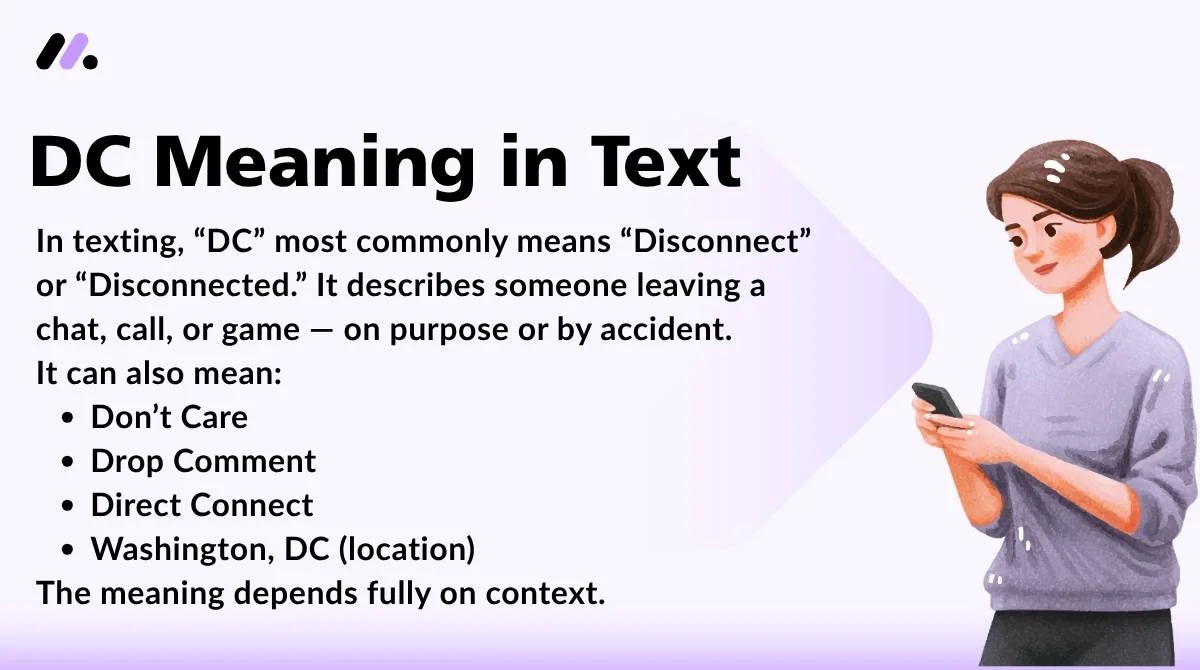
In texting, “DC” most commonly means “Disconnect” or “Disconnected.” It describes someone leaving a chat, call, or game — on purpose or by accident.
It can also mean:
- Don’t Care
- Drop Comment
- Direct Connect
- Washington, DC (location)
The meaning depends fully on context.
The Most Common Meanings of “DC”
1. DC = Disconnect / Disconnected
This is the most common meaning online.
People use it when someone leaves a call, game, or chat suddenly.
When it applies:
- Video calls
- Online games
- Live streams
- Group chats
Examples:
- “Bro you DC?”
- “I think she DC’d.”
- “My WiFi DC again.”
In gaming, this meaning is very common.
2. DC = Don’t Care
Sometimes “DC” is short for “don’t care.” It can sound casual or cold depending on tone.
When it applies:
- Arguments
- Drama
- Short replies
- Dismissive answers
Examples:
- “Do whatever, DC.”
- “I DC anymore.”
- “DC tbh.”
This version can feel rude if used harshly.
3. DC = Drop Comment
On Instagram, TikTok, and YouTube, “DC” sometimes means “Drop Comment.”
Creators use it to boost engagement.
When it applies:
- Captions
- Reels
- Giveaways
- Q&A posts
Examples:
- “DC your favorite color.”
- “DC if you agree.”
Here, it’s a call to action.
4. DC = Washington, DC
Sometimes it simply refers to the U.S. capital, Washington, DC.
Examples:
- “I’m flying to DC tomorrow.”
- “He lives in DC.”
This meaning is usually clear from context.
How “DC” Is Used in Real Conversations
Friends & Casual Texting
Among friends, “DC” usually means disconnect.
Example:
- “Why you DC last night?”
- “Sorry my phone DC’d.”
It’s short and normal in daily chat.
It can also mean “don’t care” between close friends joking around.
Example:
- “You still mad?”
- “Nah DC anymore.”
Tone matters.
Instagram & Snapchat
On social media, context changes the meaning.
If someone comments “DC,” they might mean:
- “Drop comment” (asking others to reply)
- “Don’t care” (reacting to drama)
Creators often write:
- “DC your thoughts below.”
Influencers use short slang to increase engagement.
Dating Apps
On dating apps, “DC” often means “don’t care.”
Example:
- “Pizza or sushi?”
- “DC, you choose.”
This can feel relaxed and easygoing.
But if used during conflict:
- “Why did you ghost?”
- “DC.”
That feels cold.
Gaming & Online Communities
In gaming, “DC” almost always means disconnect.
Example:
- “Tank DC.”
- “He rage DC’d.”
Players use it when someone leaves mid-game.
It can also be used as a complaint:
- “Fix your net, stop DC.”
Very common in competitive games.
Work or Professional Chat
In professional chat, “DC” is less common but still appears.
In tech teams, it may mean:
- Disconnect
- Data Center
- Domain Controller
Example:
- “User DC’d from server.”
- “Check DC settings.”
It rarely means “don’t care” in professional spaces — that would sound rude.
Is “DC” Rude, Flirty, or Offensive?
It depends on meaning and tone.
When It’s Neutral
- Talking about internet issues
- Gaming disconnect
- Location reference
These uses are harmless.
When It Feels Rude
If “DC” means “don’t care,” it can sound dismissive.
Example:
- “This matters to me.”
- “DC.”
That feels cold.
Short answers often feel harsher than intended.
When It Sounds Casual or Flirty
On dating apps:
- “DC, surprise me 😉”
Here, it feels relaxed and playful.
Tone depends on relationship closeness.
Psychological Context
Short replies like “DC” remove emotion. No emojis. No tone markers. That makes it easy to misunderstand.
People often assume negative tone when messages are very short.
If you’re unsure, ask for clarity.
How to Respond When Someone Says “DC”
Casual Replies
If they mean disconnect:
- “Yeah my WiFi crashed.”
- “Oops I lagged.”
- “Back now.”
If they mean don’t care:
- “You sure?”
- “Alright cool.”
Funny Replies
- “DC? Like the superheroes?”
- “Disconnected from reality?”
- “WiFi fighting again?”
Humor works well with friends.
Neutral Replies
- “Got it.”
- “Okay.”
- “No problem.”
Safe and calm.
Professional Replies
If technical:
- “I’ll reconnect now.”
- “Issue resolved.”
- “Server is stable.”
Keep it clear and polite.
Common Misunderstandings About “DC”
1. Thinking It Always Means Don’t Care
In gaming, it rarely means that.
Most of the time, it means disconnect.
2. Confusing It With “IDK”
“IDK” means “I don’t know.”
“DC” means “don’t care” or “disconnect.”
They are not the same.
3. Assuming It’s Rude Every Time
It’s not always negative.
Context changes everything.
4. Mixing It With “DC” Brand References
Some think of DC Comics like DC Comics when they see “DC.”
But in texting, that meaning is rare unless the topic is superheroes.
5. Reading Tone Too Fast
Short messages often look colder than intended.
Always check conversation flow.
Similar Slang Terms You Should Know
Here are related slang terms that show up in the same spaces:
- IDK – I don’t know
- IDC – I don’t care
- BRB – Be right back
- AFK – Away from keyboard
- TTYL – Talk to you later
- IMO – In my opinion
- TBH – To be honest
- SMH – Shaking my head
- ICYMI – In case you missed it
- GG – Good game
- RN – Right now
These often appear in the same chats as “DC.”
When You Should Avoid Using “DC”
Professional Settings
Avoid using “DC” to mean “don’t care” at work. It sounds careless.
Instead, say:
- “I have no preference.”
- “Either option works.”
Cross-Cultural Chats
Not everyone understands English slang.
Short forms can confuse people.
Spell it out if needed.
Sensitive Situations
If someone is upset, avoid saying “DC.”
It may sound like you don’t respect their feelings.
Use full sentences instead.
FAQs
What does DC mean in text messages?
Most commonly, it means disconnect or disconnected, especially in gaming or calls.
Does DC mean don’t care?
Yes. In some conversations, DC stands for “don’t care.” Tone matters.
Is DC rude in texting?
It can be rude if it means “don’t care” during serious conversations.
What does DC mean in gaming?
In gaming, DC means someone disconnected from the match.
What does DC mean on Instagram?
It may mean “drop comment” in captions or engagement posts.
Is DC the same as IDC?
No. IDC clearly means “I don’t care.” DC can mean disconnect or don’t care.
What should I reply if someone texts DC?
Ask for context or reply based on conversation. If unsure, say “What do you mean?”
Conclusion
“DC” is short, simple, and context-based.
Most of the time, it means disconnect — especially in gaming or online calls.
Sometimes, it means don’t care, which can sound relaxed or rude depending on tone.
On social media, it may mean drop comment to boost engagement.
The key to understanding DC meaning in text is context. Look at the platform, the relationship, and the message before it.
Short slang saves time, but it also removes tone. When unsure, ask.
Now when you see “DC,” you won’t feel confused.
You’ll know exactly what it means.

Calvin Merrick is an English language educator and content writer dedicated to making similes and meanings simple, clear, and easy to understand for students worldwide.