Excitement is one of the most powerful feelings we can express—but it’s also one of the hardest to describe in a fresh, vivid way.
Saying “I was excited” feels flat. But saying “I was bouncing like a ball on a trampoline”? That paints a picture. That makes people feel it.
Similes help bring writing to life. They turn simple emotions into colorful, memorable images. Whether you’re writing a story, essay, or even a social post, the right simile can make your words pop.
In this guide, you’ll discover 28+ powerful excitement similes—some classic, many fresh and creative. You’ll also learn how to use them, create your own, and avoid common mistakes.
By the end, you’ll have a toolbox full of expressions that make excitement jump off the page.
What Is a Simile? (Quick Clear Definition)
A simile compares two different things using “like” or “as” to make meaning clearer or more vivid.
Example:
She was as excited as a child on their birthday.
Quick List – Most Popular Similes for “Excitement”
- As excited as a kid on Christmas morning
- Like a dog wagging its tail
- As giddy as a schoolchild
- Like fireworks bursting in the sky
- As thrilled as a fan at a concert
- Like a bouncing ball
- As eager as a puppy
- Like a spark in dry grass
- As lively as a festival crowd
- Like a rocket ready to launch
Complete List of Similes for “Excitement” (Grouped by Meaning)
Funny & Lighthearted
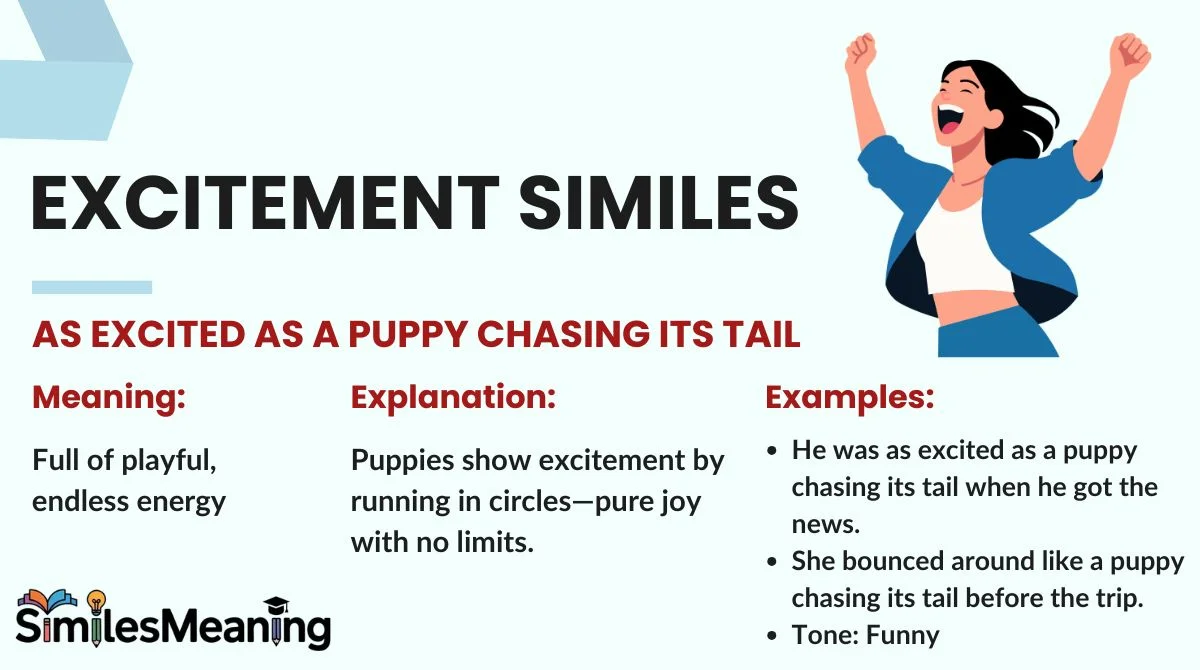
As excited as a puppy chasing its tail
Meaning: Full of playful, endless energy
Explanation: Puppies show excitement by running in circles—pure joy with no limits.
Examples:
- He was as excited as a puppy chasing its tail when he got the news.
- She bounced around like a puppy chasing its tail before the trip.
Tone: Funny
Like popcorn popping in a pan
Meaning: Quick bursts of excitement
Explanation: Popcorn jumps rapidly, just like sudden excitement.
Examples:
- Ideas popped in her mind like popcorn in a pan.
- His excitement bubbled like popcorn popping nonstop.
Tone: Casual
As jumpy as a frog in the rain
Meaning: Restless with excitement
Explanation: Frogs leap around when active—mirroring nervous excitement.
Examples:
- He was as jumpy as a frog in the rain before the match.
- She felt like a frog in the rain waiting backstage.
Tone: Funny
Like a soda can shaken too much
Meaning: Ready to burst with excitement
Explanation: Pressure builds until it explodes—just like excitement.
Examples:
- He was like a soda can shaken too much before opening his gift.
- Her excitement fizzed like a shaken soda.
Tone: Casual
Emotional & Deep
As excited as a dream coming true
Meaning: Deep, heartfelt excitement
Explanation: When dreams come true, emotions run strong and meaningful.
Examples:
- She felt as excited as a dream coming true when she got accepted.
- He stood there, as excited as his biggest dream unfolding.
Tone: Serious
Like a heart racing before a big moment
Meaning: Emotional anticipation
Explanation: Excitement often shows physically through a fast heartbeat.
Examples:
- His chest felt like a heart racing before a big moment.
- She waited, heart racing with excitement.
Tone: Serious
As alive as a sunrise after darkness
Meaning: Renewed excitement
Explanation: Sunrise brings hope and energy after night.
Examples:
- He felt as alive as a sunrise after hearing the news.
- Her excitement glowed like morning light.
Tone: Poetic
Like a song building to its chorus
Meaning: Growing excitement
Explanation: Music builds energy until it peaks.
Examples:
- The moment felt like a song building to its chorus.
- Her excitement rose like music getting louder.
Tone: Poetic
Dramatic & Intense
Like fireworks exploding in the sky
Meaning: Bright, powerful excitement
Explanation: Fireworks represent loud, colorful bursts of energy.
Examples:
- His excitement exploded like fireworks.
- The crowd felt like fireworks in the night sky.
Tone: Dramatic
As wild as a storm at sea
Meaning: Uncontrolled excitement
Explanation: Storms are intense and unpredictable.
Examples:
- Her excitement was as wild as a storm at sea.
- He felt like waves crashing inside him.
Tone: Serious
Like a rocket blasting off
Meaning: Sudden, powerful excitement
Explanation: Rockets launch with explosive energy.
Examples:
- His joy shot up like a rocket blasting off.
- She leaped like a rocket ready to launch.
Tone: Dramatic
As electric as lightning in the night
Meaning: Sharp, intense excitement
Explanation: Lightning is fast, bright, and powerful.
Examples:
- The room felt as electric as lightning.
- His excitement struck like lightning.
Tone: Dramatic
Slow & Building Excitement
Like water slowly boiling
Meaning: Gradual excitement
Explanation: Heat builds slowly before reaching a peak.
Examples:
- Her excitement was like water slowly boiling.
- The tension built like a simmering pot.
Tone: Serious
As steady as a drumbeat rising
Meaning: Consistent excitement
Explanation: Drums build rhythm and anticipation.
Examples:
- The crowd grew excited like a rising drumbeat.
- His feelings built steadily like music.
Tone: Poetic
Creative & Unique
Like a kite pulling hard in the wind
Meaning: Excitement that lifts you
Explanation: A strong wind pulls the kite upward with energy.
Examples:
- She felt like a kite tugging in the wind.
- His excitement lifted him like a flying kite.
Tone: Creative
As bright as neon lights in the dark
Meaning: Noticeable excitement
Explanation: Neon lights stand out and grab attention.
Examples:
- Her joy was as bright as neon lights.
- His excitement lit up the room.
Tone: Casual
Like bees buzzing around honey
Meaning: Busy, energetic excitement
Explanation: Bees swarm with activity and purpose.
Examples:
- The kids buzzed like bees around the stage.
- His thoughts buzzed with excitement.
Tone: Funny
As restless as wind before a storm
Meaning: Uneasy excitement
Explanation: Wind signals something big is coming.
Examples:
- She felt as restless as wind before a storm.
- His excitement stirred like shifting air.
Tone: Serious
Poetic & Literary
Like stars dancing in the sky
Meaning: Magical excitement
Explanation: Stars twinkling feel alive and joyful.
Examples:
- Her excitement shimmered like dancing stars.
- The moment sparkled like the night sky.
Tone: Poetic
As light as feathers in the breeze
Meaning: Gentle excitement
Explanation: Feathers float softly, like calm joy.
Examples:
- She felt as light as feathers in the breeze.
- His excitement lifted him gently.
Tone: Poetic
Like waves kissing the shore
Meaning: Soft, repeated excitement
Explanation: Waves return again and again with rhythm.
Examples:
- Her excitement came like waves on the shore.
- He felt small bursts of joy again and again.
Tone: Poetic
Fresh and Unique Similes You Won’t Hear Every Day
- Like a lantern suddenly lit in a dark cave
Imagery: Sudden brightness in darkness = instant excitement - As eager as a bookmark nearing the final page
Imagery: Anticipation of a story ending - Like a compass spinning toward adventure
Imagery: Pull toward something exciting and unknown - As thrilled as rain hitting dry earth
Imagery: Long-awaited relief and joy - Like a key finally finding its lock
Imagery: Perfect moment of fulfillment
How to Use These Similes in Writing
In Essays:
Use similes to make examples more vivid.
Instead of: “The students were excited,”
Write: “The students were like popcorn popping in a pan.”
In Stories:
Similes help readers feel emotions.
Instead of telling excitement, show it through action and comparison.
How to Create Your Own Similes (Mini Writing Guide)
Step-by-step method:
- Pick the feeling (excitement)
- Think of something with similar energy
- Connect using “like” or “as”
- Keep it simple and visual
5 Practical Tips:
- Use everyday objects
- Think about movement
- Use senses (sound, light, motion)
- Avoid clichés
- Keep it short
Transformation Examples:
- Excited → Like a drum beating faster
- Very excited → Like fireworks bursting
- Nervous excitement → Like wind before a storm
Common Mistakes When Using Similes
Overuse:
Too many similes make writing messy. Use them wisely.
Clichés:
Avoid overused ones unless needed for clarity.
Tone mismatch:
Funny similes don’t fit serious writing. Choose carefully.
Practice Exercise
Fill in the blanks:
- As excited as a ______ on Christmas morning
- Like a ______ ready to launch
- As lively as a ______ crowd
- Like popcorn ______ in a pan
- As bright as ______ lights
- Like a heart ______ before a race
- As wild as a ______ at sea
- Like bees ______ around honey
- As restless as ______ before a storm
- Like stars ______ in the sky
- As light as ______ in the breeze
- Like waves ______ the shore
Answers:
- child
- rocket
- festival
- popping
- neon
- racing
- storm
- buzzing
- wind
- dancing
- feathers
- kissing
FAQs (Optimized for People Also Ask)
What is a simile for excitement?
A simile for excitement compares the feeling to something energetic, like “as excited as a kid on Christmas.”
Why use similes in writing?
They make writing more vivid, engaging, and easier to imagine.
Are similes good for essays?
Yes, when used carefully, they make examples clearer and more interesting.
Can similes be funny?
Absolutely. Funny similes add personality and charm.
How do I avoid cliché similes?
Create your own by using fresh, everyday comparisons.
What’s the difference between simile and metaphor?
Similes use “like” or “as,” while metaphors make direct comparisons.
Final Thoughts
Excitement deserves more than plain words. With the right similes, you can turn simple feelings into powerful images that readers remember.
Whether you use a classic or create your own, the key is clarity, creativity, and emotion.
Start using these similes today—and watch your writing come alive with energy.

Calvin Merrick is an English language educator and content writer dedicated to making similes and meanings simple, clear, and easy to understand for students worldwide.