Hate is a strong feeling. It burns. It stings. It sticks.
When you write about hate, simple words often feel too small. That’s where similes help. A good simile paints a picture. It helps readers see the feeling instead of just reading about it.
Whether you’re writing a story, poem, speech, or school essay, the right simile can make your words powerful and clear. It adds color. It adds emotion. It makes your writing memorable.
In this guide, you’ll discover 21+ high-quality hate similes. Some are funny. Some are deep. Some are intense.
At least a third are fresh and creative—you won’t hear them every day. You’ll also learn how to use them and how to create your own.
Let’s dive in.
What Is a Simile? (Quick Clear Definition)
A simile is a comparison between two different things using the words “like” or “as.”
It helps readers understand a feeling or idea by linking it to something familiar.
Example:
He was as brave as a lion.
Quick List – Most Popular Similes for “Hate”
- As bitter as poison
- Like fire in dry grass
- As cold as ice
- Like a storm ready to break
- As sharp as a knife
- Like a snake in the grass
- As heavy as a stone
- Like oil on water
- As dark as midnight
- Like thunder in a quiet sky
Complete List of Similes for “Hate” (Grouped by Meaning)
Funny & Lighthearted
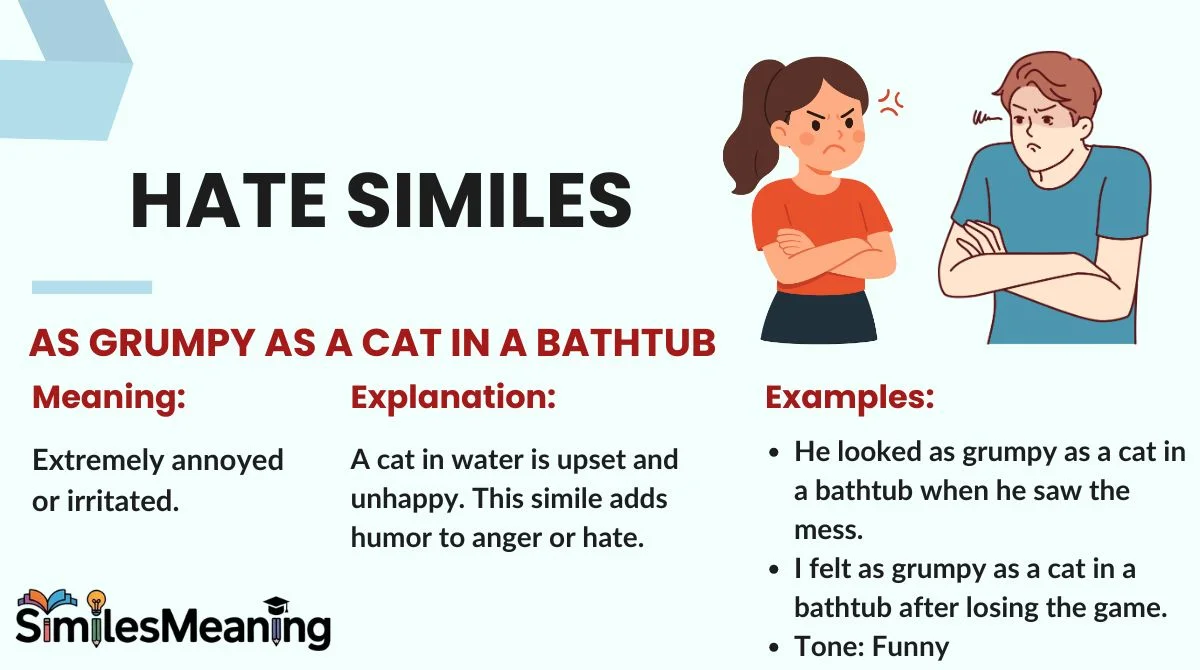
As grumpy as a cat in a bathtub
Meaning: Extremely annoyed or irritated.
Explanation: A cat in water is upset and unhappy. This simile adds humor to anger or hate.
Examples:
- He looked as grumpy as a cat in a bathtub when he saw the mess.
- I felt as grumpy as a cat in a bathtub after losing the game.
Tone: Funny
Like a kid forced to eat broccoli
Meaning: Strong dislike.
Explanation: Many kids hate vegetables. This simile makes hate feel playful.
Examples:
- She reacted like a kid forced to eat broccoli when she heard the news.
- He avoided math homework like a kid forced to eat broccoli.
Tone: Casual
As sour as spoiled milk
Meaning: Full of resentment or dislike.
Explanation: Spoiled milk smells and tastes bad. Sourness matches bitterness.
Examples:
- His mood turned as sour as spoiled milk.
- The argument left her as sour as spoiled milk.
Tone: Casual
Emotional & Deep
As cold as winter wind
Meaning: Emotionless or cruel hate.
Explanation: Winter wind feels harsh and icy. It reflects cold-hearted feelings.
Examples:
- Her voice was as cold as winter wind.
- His stare felt as cold as winter wind.
Tone: Serious
Like a bruise that won’t heal
Meaning: Lingering resentment.
Explanation: A bruise fades slowly. So does deep hate.
Examples:
- His anger stayed like a bruise that won’t heal.
- The betrayal felt like a bruise that won’t heal.
Tone: Poetic
As heavy as a sack of stones
Meaning: Emotionally draining hatred.
Explanation: Stones are heavy. Hate can weigh down the heart.
Examples:
- The silence between them was as heavy as a sack of stones.
- She carried her hate as heavy as a sack of stones.
Tone: Serious
Like rust eating iron
Meaning: Slowly destroying from inside.
Explanation: Rust eats metal over time. Hate does the same to people.
Examples:
- His jealousy spread like rust eating iron.
- Hate grew in her like rust eating iron.
Tone: Poetic
Dramatic & Intense
Like fire in dry grass
Meaning: Spreading quickly and fiercely.
Explanation: Dry grass catches fire fast. Intense hate spreads the same way.
Examples:
- His rage spread like fire in dry grass.
- Rumors burned like fire in dry grass.
Tone: Intense
As sharp as a blade
Meaning: Hurtful and cutting.
Explanation: A blade cuts deeply. Harsh hate does too.
Examples:
- Her words were as sharp as a blade.
- His tone felt as sharp as a blade.
Tone: Serious
Like thunder in a silent room
Meaning: Sudden and shocking hate.
Explanation: Thunder breaks silence loudly. Strong hate can shock others.
Examples:
- His outburst hit like thunder in a silent room.
- The insult fell like thunder in a silent room.
Tone: Dramatic
As dark as a moonless night
Meaning: Deep and overwhelming hate.
Explanation: A moonless night feels endless and dark. So does powerful resentment.
Examples:
- His thoughts were as dark as a moonless night.
- The mood turned as dark as a moonless night.
Tone: Poetic
Slow & Monotonous
Like a slow drip of poison
Meaning: Gradual but harmful hate.
Explanation: Poison dripping slowly still harms. Quiet hate builds over time.
Examples:
- His jealousy worked like a slow drip of poison.
- The tension grew like a slow drip of poison.
Tone: Serious
As dull as gray rain
Meaning: Lifeless resentment.
Explanation: Gray rain feels sad and flat. So does tired hate.
Examples:
- Her anger felt as dull as gray rain.
- The room felt as dull as gray rain after the fight.
Tone: Casual
Creative & Unique
Like sand in a shoe
Meaning: Small but constant annoyance.
Explanation: Sand irritates with every step. So does ongoing dislike.
Examples:
- His comments were like sand in a shoe.
- The problem lingered like sand in a shoe.
Tone: Casual
As stubborn as a locked door
Meaning: Refusing to forgive.
Explanation: A locked door will not open. Some hate won’t either.
Examples:
- Her heart was as stubborn as a locked door.
- His anger stayed as stubborn as a locked door.
Tone: Serious
Like a shadow at noon
Meaning: Hate that clings closely.
Explanation: At noon, shadows stay tight to you. Some hate follows everywhere.
Examples:
- The memory followed him like a shadow at noon.
- Her resentment clung like a shadow at noon.
Tone: Poetic
As tight as a knotted rope
Meaning: Tense and unrelaxed hate.
Explanation: A knot pulls tight. So does inner anger.
Examples:
- His jaw was as tight as a knotted rope.
- The air felt as tight as a knotted rope.
Tone: Serious
Poetic & Literary
Like ink spilled on white paper
Meaning: Hate that ruins something pure.
Explanation: Ink stains clean paper. Hate stains peace.
Examples:
- His words spread like ink spilled on white paper.
- The rumor fell like ink on white paper.
Tone: Poetic
As bitter as burnt coffee
Meaning: Sharp, lingering dislike.
Explanation: Burnt coffee tastes harsh and stays in the mouth.
Examples:
- His reply was as bitter as burnt coffee.
- She felt as bitter as burnt coffee after the loss.
Tone: Casual
Like a cracked mirror
Meaning: Hate that distorts how you see things.
Explanation: A cracked mirror shows broken images. Hate twists perspective.
Examples:
- His anger made him see the world like a cracked mirror.
- Jealousy works like a cracked mirror.
Tone: Poetic
Fresh and Unique Similes You Won’t Hear Every Day
Here are 5 original comparisons with vivid imagery:
- Like smoke trapped in a jar – Hate that has no escape and builds pressure.
- As restless as a caged storm – Strong anger waiting to explode.
- Like frost on a dying leaf – Cold hate settling on something already weak.
- As loud as a drum in a quiet forest – Hate that demands attention.
- Like a compass spinning in circles – Hate that causes confusion and loss of direction.
Each of these similes paints a clear image. That image helps readers feel the emotion more deeply.
How to Use These Similes in Writing
In Essays
- Use similes to describe emotions in character analysis.
- Add them when explaining conflict.
- Keep them short and natural.
- Don’t overload one paragraph with too many.
Example:
The rivalry grew like rust eating iron, slowly destroying their friendship.
In Stories
- Use similes during emotional scenes.
- Add them to dialogue for impact.
- Match tone with genre.
Example:
Her voice was as cold as winter wind when she said goodbye.
How to Create Your Own Similes (Mini Writing Guide)
Step-by-Step Method
- Pick the emotion (hate, anger, resentment).
- Think of objects that feel similar (fire, ice, rust).
- Connect them using “like” or “as.”
- Make sure the image is clear.
- Test it in a sentence.
5 Practical Tips
- Use simple images readers know.
- Avoid overused clichés.
- Match the mood of your story.
- Keep comparisons short.
- Read it aloud to check flow.
3 Transformation Examples
Plain sentence:
He hated the noise.
With simile:
He hated the noise like sand scraping glass.
Plain sentence:
She felt angry.
With simile:
She felt angry like fire in dry grass.
Plain sentence:
They disliked each other.
With simile:
They avoided each other like oil on water.
Common Mistakes When Using Similes
Overuse:
Too many similes make writing messy.
Clichés:
Avoid tired comparisons like “cold as ice” unless used in a fresh way.
Tone mismatch:
Don’t use a funny simile in a tragic scene.
Practice Exercise
Fill in the blanks:
- His anger spread like ________.
- Her voice was as cold as ________.
- The insult hit like ________.
- His jealousy grew like ________.
- The silence felt as heavy as ________.
- She reacted like ________.
- The mood turned as dark as ________.
- His reply was as bitter as ________.
- The tension tightened like ________.
- Her resentment clung like ________.
- The argument burned like ________.
- His dislike lingered like ________.
Answers
- fire in dry grass
- winter wind
- thunder in a silent room
- rust eating iron
- a sack of stones
- a kid forced to eat broccoli
- a moonless night
- burnt coffee
- a knotted rope
- a shadow at noon
- fire in dry grass
- a bruise that won’t heal
FAQs
What is a strong simile for hate?
“Like fire in dry grass” shows fast and intense hatred.
Can similes describe emotions?
Yes. Similes make emotions clearer and more powerful.
Are similes good for essays?
Yes. They add color and improve description when used wisely.
What’s the difference between simile and metaphor?
A simile uses “like” or “as.” A metaphor does not.
Should I avoid clichés?
Yes. Fresh comparisons make writing stronger.
How many similes should I use in one paragraph?
One or two is usually enough.
Final Thoughts
Hate is a powerful emotion. Writing about it requires strong images and clear language. The right simile can turn a simple sentence into something unforgettable.
Use these 21+ hate similes wisely. Mix humor with depth. Choose tone carefully. And most importantly—create your own.
When your comparisons are fresh and vivid, your writing will stand out every time.

Calvin Merrick is an English language educator and content writer dedicated to making similes and meanings simple, clear, and easy to understand for students worldwide.