Mental health can feel hard to explain. Some days it feels bright and hopeful. Other days it feels heavy and dark. But finding the right words can make a big difference.
That’s where similes help.
Similes compare one thing to another using “like” or “as.” They turn big feelings into clear pictures. When you say, “My mind felt like a crowded room,” people instantly understand the stress.
In this guide, you’ll find 21+ powerful mental health similes. Some are common. Many are fresh and creative. Each one comes with meaning, examples, and tone notes so you can use them in essays, stories, journals, or speeches.
By the end, you’ll know how to use similes with confidence—and even create your own.
What Is a Simile? (Quick Clear Definition)
A simile is a comparison using the words “like” or “as.”
It helps describe something by linking it to a clear image.
Example:
“Her thoughts were like a storm.”
This means her thoughts were loud, messy, and hard to control.
Quick List – Most Popular Similes for “Mental Health”
- Like a storm inside my head
- Like walking through thick fog
- Like carrying a heavy backpack
- Like a roller coaster of emotions
- Like a cracked mirror
- Like a tangled ball of yarn
- Like a candle in the dark
- Like a locked door
- Like a broken record
- Like sunshine after rain
Complete List of Similes for “Mental Health” (Grouped by Meaning)
Funny & Lighthearted
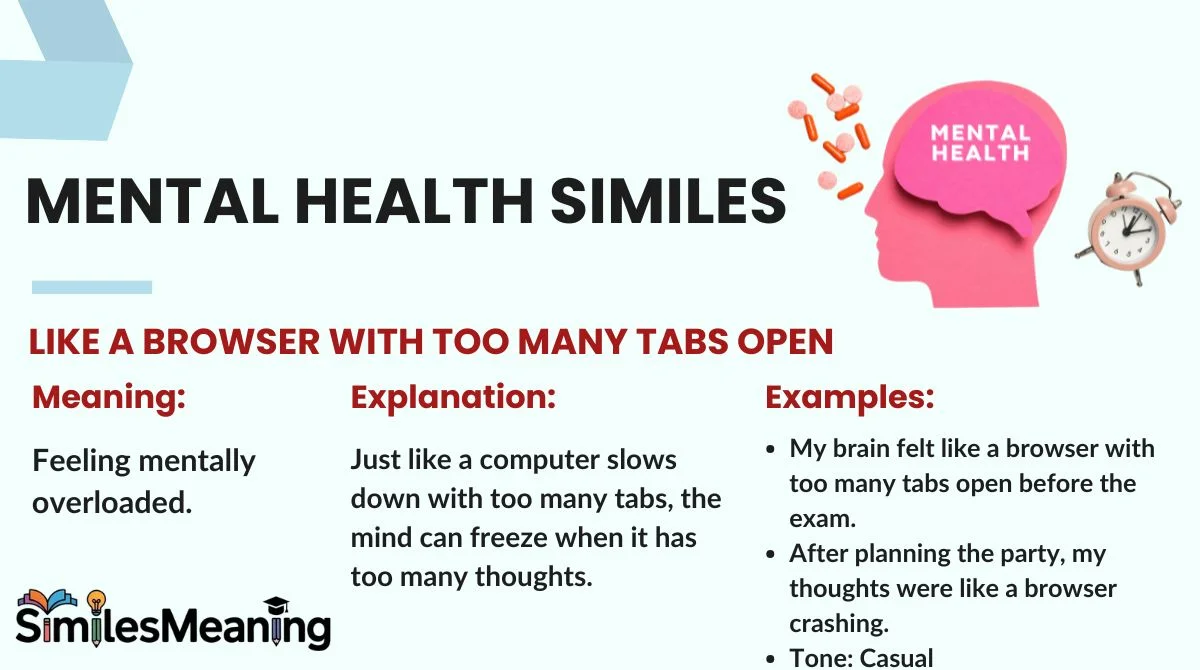
Like a browser with too many tabs open
Meaning: Feeling mentally overloaded.
Explanation: Just like a computer slows down with too many tabs, the mind can freeze when it has too many thoughts.
Examples:
- My brain felt like a browser with too many tabs open before the exam.
- After planning the party, my thoughts were like a browser crashing.
Tone: Casual
Like a cat chasing its own tail
Meaning: Going in circles mentally.
Explanation: The mind keeps repeating the same thoughts without progress.
Examples:
- My worries spun like a cat chasing its own tail.
- I kept replaying the mistake, like a cat going round and round.
Tone: Funny
Like popcorn popping in a pan
Meaning: Fast, jumpy thoughts.
Explanation: Thoughts appear quickly and loudly, one after another.
Examples:
- Ideas popped like popcorn in my head.
- My anxiety felt like kernels bursting all at once.
Tone: Light
Emotional & Deep
Like carrying a heavy backpack all day
Meaning: Emotional burden.
Explanation: Mental stress feels like physical weight that never leaves.
Examples:
- Grief sat on my shoulders like a heavy backpack.
- I felt like I was carrying bricks inside me.
Tone: Serious
Like a cracked mirror
Meaning: Damaged self-image.
Explanation: A cracked mirror shows a broken reflection, just like low self-esteem distorts self-view.
Examples:
- My confidence felt like a cracked mirror.
- I saw myself in pieces, like broken glass.
Tone: Poetic
Like walking through thick fog
Meaning: Confusion or depression.
Explanation: Fog blocks vision, just like sadness can cloud thinking.
Examples:
- Each day felt like walking through fog.
- My thoughts moved slowly, like steps in mist.
Tone: Serious
Like a house with no lights on
Meaning: Emotional emptiness.
Explanation: A dark house feels lifeless, like numbness inside.
Examples:
- My heart felt like a house with no lights on.
- Joy seemed to switch off, room by room.
Tone: Poetic
Dramatic & Intense
Like a storm trapped in a jar
Meaning: Bottled-up emotions.
Explanation: A storm wants to explode, but it’s held inside.
Examples:
- My anger felt like a storm trapped in glass.
- I smiled outside, but inside it was thunder.
Tone: Dramatic
Like standing on thin ice
Meaning: Emotional instability.
Explanation: Thin ice can break at any moment, just like fragile mental states.
Examples:
- I felt like I was walking on thin ice all week.
- One small comment could crack everything.
Tone: Serious
Like a volcano ready to erupt
Meaning: Intense hidden anger or stress.
Explanation: Pressure builds silently until it explodes.
Examples:
- He was like a volcano before the meeting.
- Stress bubbled under the surface.
Tone: Dramatic
Like drowning in invisible water
Meaning: Silent struggle.
Explanation: Others can’t see the pain, but it feels overwhelming.
Examples:
- I felt like I was drowning, even though I smiled.
- The sadness pulled me down quietly.
Tone: Serious
Slow & Monotonous
Like a clock ticking in an empty room
Meaning: Lonely thoughts.
Explanation: The ticking sound shows time passing slowly and quietly.
Examples:
- My evenings felt like a clock in silence.
- Each minute echoed in my head.
Tone: Poetic
Like watching paint dry
Meaning: Emotional numbness.
Explanation: Nothing feels exciting or alive.
Examples:
- My days felt like watching paint dry.
- Nothing moved inside me.
Tone: Casual
Like a train stuck at a red signal
Meaning: Feeling mentally stuck.
Explanation: The train wants to move but cannot.
Examples:
- My motivation felt like a train at a red light.
- I wanted to move forward, but I couldn’t.
Tone: Serious
Creative & Unique
Like a snow globe that never settles
Meaning: Constant mental chaos.
Explanation: The snow keeps swirling instead of falling calmly.
Examples:
- My mind was like a shaken snow globe.
- Thoughts kept floating everywhere.
Tone: Creative
Like ink spreading in water
Meaning: Anxiety slowly growing.
Explanation: One small worry spreads and colors everything.
Examples:
- Fear spread like ink in clear water.
- A tiny thought turned the whole day dark.
Tone: Poetic
Like a radio stuck between stations
Meaning: Mental confusion.
Explanation: You hear noise but no clear message.
Examples:
- My thoughts felt like static.
- I couldn’t tune into peace.
Tone: Creative
Like a garden full of weeds
Meaning: Negative thoughts taking over.
Explanation: Without care, weeds grow faster than flowers.
Examples:
- My mind felt like an untended garden.
- Doubts grew where hope once bloomed.
Tone: Serious
Poetic & Literary
Like a candle flickering in the wind
Meaning: Fragile hope.
Explanation: The flame is small but still alive.
Examples:
- My hope was like a candle in the wind.
- It shook, but it did not die.
Tone: Poetic
Like sunshine breaking through clouds
Meaning: Recovery or healing.
Explanation: Light returns after darkness.
Examples:
- Therapy felt like sunshine after rain.
- Slowly, light found its way back.
Tone: Hopeful
Like roots growing under frozen ground
Meaning: Hidden strength.
Explanation: Even when things look lifeless, growth continues below.
Examples:
- My healing was like roots under ice.
- Strength grew where no one could see.
Tone: Poetic
Fresh and Unique Similes You Won’t Hear Every Day
- Like a compass spinning without north – Feeling lost and unsure.
- Like a battery stuck at 1% – Emotionally drained but still trying.
- Like a library after closing time – Quiet, but full of unspoken thoughts.
- Like a text message left on “typing…” – Waiting for clarity that never comes.
- Like a bridge with missing planks – Struggling to move safely from one thought to another.
These images are powerful because they connect modern life (phones, batteries, bridges) with inner emotions.
How to Use These Similes in Writing
In Essays
- Use similes to explain mental health topics clearly.
- Add one strong simile in the introduction to grab attention.
- Avoid overusing them—one or two per paragraph is enough.
In Stories
- Show a character’s emotions instead of telling them.
Instead of saying “She was sad,” write:
“She moved like someone walking through thick fog.”
How to Create Your Own Similes (Mini Writing Guide)
Step-by-Step Method
- Name the feeling (sad, anxious, hopeful).
- Think of an object or scene that looks similar.
- Connect them using “like” or “as.”
- Check if the image is clear.
- Read it aloud.
5 Practical Tips
- Use simple images.
- Pick things people know.
- Avoid clichés.
- Match tone with topic.
- Keep it short and sharp.
3 Transformation Examples
Plain sentence: I felt anxious.
Simile: I felt like a balloon about to burst.
Plain sentence: She felt calm.
Simile: She was as calm as still water.
Plain sentence: He felt lost.
Simile: He was like a compass spinning in circles.
Common Mistakes When Using Similes
Overuse
Too many similes make writing messy.
Clichés
Avoid tired lines like “as busy as a bee.”
Tone Mismatch
Don’t use funny similes in serious mental health essays.
Practice Exercise
Fill in the blanks:
- My thoughts were like a ______ in a storm.
- Depression felt like walking through ______.
- My hope was like a candle in the ______.
- Anxiety spread like ______ in water.
- I felt like a train at a ______ signal.
- My mind was like a snow ______.
- Anger was like a ______ ready to erupt.
- My heart felt like a house with no ______ on.
- I felt like a battery at ______ percent.
- My thoughts were like popcorn in a ______.
- I felt like standing on thin ______.
- My healing was like roots under ______ ground.
Answers
- boat
- fog
- wind
- ink
- red
- globe
- volcano
- lights
- 1
- pan
- ice
- frozen
FAQs
What are mental health similes?
Mental health similes are comparisons that help describe feelings like anxiety, sadness, or hope using clear images.
Why are similes helpful in mental health writing?
They make abstract emotions easier to understand.
Can similes improve essays?
Yes. They add emotion and clarity when used carefully.
Are similes good for children?
Yes. Simple similes help young readers understand feelings better.
How many similes should I use in one paragraph?
Usually one or two is enough.
What makes a simile powerful?
Clear imagery, strong emotion, and originality.
Final Thoughts
Mental health is complex. But language can make it clearer.
Similes turn invisible feelings into visible pictures. They help us speak about anxiety, sadness, healing, and hope in ways people truly understand.
Use these 21+ mental health similes in essays, journals, speeches, or stories. Better yet—create your own.
Because sometimes, the right comparison can say what plain words cannot.

Calvin Merrick is an English language educator and content writer dedicated to making similes and meanings simple, clear, and easy to understand for students worldwide.