Autumn is one of the most beautiful and emotional seasons of the year. The air turns crisp, trees burst into gold and red, and the world feels quieter and softer.
Writers often try to capture this feeling, but simple descriptions sometimes fall flat. That’s where similes come in.
Similes make writing vivid. They compare one thing to another using words like “as” or “like.” With the right simile, a single sentence can paint a powerful picture in a reader’s mind.
Autumn is a perfect season for similes because it is full of colors, sounds, and emotions—falling leaves, cool winds, cozy evenings, and fading sunlight.
In this guide, you’ll discover 26+ creative similes for autumn that can bring your writing to life. You’ll also learn how to use them, how to create your own, and how to avoid common mistakes.
By the end, you’ll have a toolbox of expressive comparisons perfect for essays, stories, and creative writing.
What Is a Simile? (Quick Clear Definition)
A simile is a figure of speech that compares two different things using “like” or “as.”
It helps readers imagine something more clearly.
Example:
The leaves fell like golden rain.
Quick List – Most Popular Similes for “Autumn”
- Autumn leaves fall like golden snow
- The air feels as crisp as a fresh apple
- Trees glow like burning embers
- Leaves scatter like confetti in the wind
- The forest looks like a painted canvas
- The breeze whispers like a quiet secret
- Leaves drift like feathers from the sky
- The sunset burns like melted copper
- Autumn mornings feel like a cool breath
- The ground is covered like a colorful carpet
Complete List of Similes for “Autumn” (Grouped by Meaning)
Funny & Lighthearted Similes
Leaves Falling Like Confetti at a Parade
Meaning: Leaves fall in large, joyful bursts.
Explanation: When the wind shakes trees, leaves scatter everywhere, much like confetti thrown during celebrations.
Examples
- The wind blew and the leaves fell like confetti at a parade.
- The children laughed as red leaves danced like confetti in the air.
Tone: Funny / Casual
The Wind Is Like a Playful Puppy
Meaning: The autumn wind moves quickly and mischievously.
Explanation: Fall breezes often swirl leaves around in unpredictable ways, similar to a playful puppy running everywhere.
Examples
- The autumn wind chased the leaves like a playful puppy.
- The breeze tugged at my scarf like a puppy wanting attention.
Tone: Casual
Leaves Crunch Like Potato Chips
Meaning: Dry leaves make a sharp, crunchy sound.
Explanation: Walking through fall leaves produces a satisfying crunch, similar to biting into chips.
Examples
- The leaves under my boots crunched like potato chips.
- Every step sounded like someone opening a bag of chips.
Tone: Funny
The Air Feels Like Nature Turned on the Air Conditioner
Meaning: The weather suddenly becomes cooler.
Explanation: Autumn often brings refreshing coolness after hot summer days.
Examples
- When autumn arrived, the air felt like nature turned on the air conditioner.
- The cool breeze hit my face like fresh AC on a hot day.
Tone: Casual
Emotional & Deep Similes
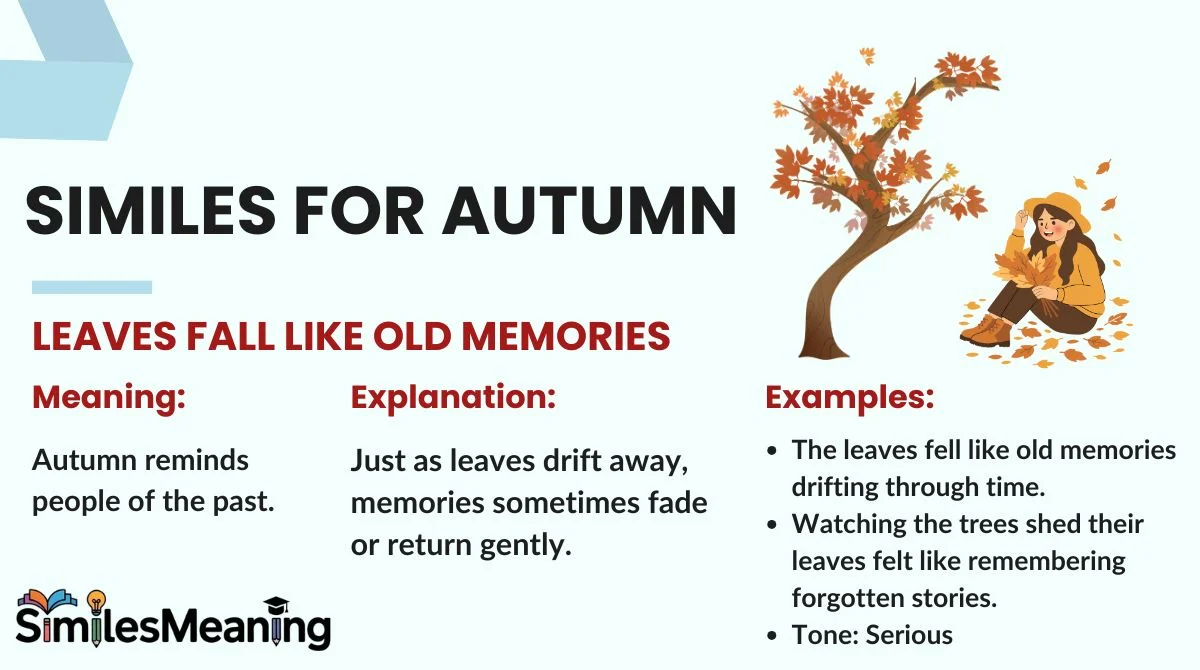
Leaves Fall Like Old Memories
Meaning: Autumn reminds people of the past.
Explanation: Just as leaves drift away, memories sometimes fade or return gently.
Examples
- The leaves fell like old memories drifting through time.
- Watching the trees shed their leaves felt like remembering forgotten stories.
Tone: Serious
The Evening Sky Glows Like a Dying Fire
Meaning: The sunset slowly fades.
Explanation: Autumn sunsets often look warm and fiery before fading into darkness.
Examples
- The sky glowed like a dying fire over the hills.
- The sunset flickered like the last flame in a fireplace.
Tone: Poetic
Autumn Feels Like a Quiet Goodbye
Meaning: The season marks the end of summer.
Explanation: Fall often carries a soft sense of ending and change.
Examples
- The golden trees felt like a quiet goodbye to summer.
- The falling leaves whispered like a farewell song.
Tone: Poetic
The Wind Sighs Like a Tired Traveler
Meaning: The wind sounds slow and weary.
Explanation: Autumn winds often sound softer and slower than summer breezes.
Examples
- The wind sighed like a tired traveler through the trees.
- The branches swayed like travelers resting after a long journey.
Tone: Serious
Dramatic & Intense Similes
Trees Burn Like Silent Flames
Meaning: Autumn trees glow with bright colors.
Explanation: Red and orange leaves can make forests look like they are on fire.
Examples
- The hills burned like silent flames in autumn.
- The maple trees blazed like fire against the sky.
Tone: Dramatic
The Forest Looks Like a Painter Spilled Colors
Meaning: The landscape becomes extremely colorful.
Explanation: Fall foliage creates vibrant mixes of red, orange, and yellow.
Examples
- The valley looked like a painter spilled colors across the hills.
- The trees glowed like a giant art project.
Tone: Creative
Leaves Swirl Like Tiny Tornadoes
Meaning: Wind spins leaves rapidly.
Explanation: Strong gusts can lift leaves and spin them in circles.
Examples
- The wind made the leaves spin like tiny tornadoes.
- Brown leaves twirled like mini whirlwinds.
Tone: Dramatic
The Sunset Spreads Like Liquid Gold
Meaning: Warm golden light fills the sky.
Explanation: Autumn sunlight often looks soft and golden.
Examples
- The sunset poured like liquid gold across the horizon.
- Golden light flowed like honey over the hills.
Tone: Poetic
Slow & Monotonous Similes
Leaves Drift Like Lazy Snowflakes
Meaning: Leaves fall slowly and gently.
Explanation: Light winds cause leaves to float down softly.
Examples
- The leaves drifted like lazy snowflakes.
- A single leaf floated like slow snow.
Tone: Calm
The Day Fades Like a Slow Candle
Meaning: Autumn daylight disappears gradually.
Explanation: Shorter days feel like a candle slowly burning down.
Examples
- The daylight faded like a slow candle.
- The evening dimmed like a candle losing its flame.
Tone: Serious
The Forest Grows Quiet Like a Sleeping Town
Meaning: Nature becomes calm and silent.
Explanation: Many animals become less active during fall.
Examples
- The forest grew quiet like a sleeping town.
- The woods felt like a village after midnight.
Tone: Calm
Creative & Unique Similes
Leaves Fall Like Pages from an Old Book
Meaning: Leaves fall steadily over time.
Explanation: The falling leaves resemble pages slowly turning.
Examples
- The leaves fell like pages from an old book.
- Autumn turned the trees like a story losing its pages.
Tone: Literary
The Air Smells Like Cinnamon and Smoke
Meaning: Autumn scents are warm and cozy.
Explanation: Fall often brings smells of fireplaces and spices.
Examples
- The air smelled like cinnamon and smoke.
- The breeze carried scents like a bakery near a campfire.
Tone: Cozy
Trees Stand Like Golden Statues
Meaning: Trees appear bright and still.
Explanation: Sunlight on yellow leaves can make trees glow.
Examples
- The birch trees stood like golden statues.
- The forest looked like a museum of golden sculptures.
Tone: Poetic
Leaves Dance Like Tiny Butterflies
Meaning: Leaves move lightly in the wind.
Explanation: Floating leaves resemble butterflies fluttering.
Examples
- The leaves danced like tiny butterflies in the wind.
- Yellow leaves fluttered like butterflies escaping a garden.
Tone: Lighthearted
Poetic & Literary Similes
Autumn Spreads Like Warm Honey
Meaning: The season slowly covers the landscape.
Explanation: Honey moves slowly and warmly, like autumn colors spreading.
Examples
- Autumn spread like warm honey across the hills.
- The golden season flowed like honey through the forest.
Tone: Poetic
The Sky Blushes Like a Shy Bride
Meaning: The sky turns soft pink or orange.
Explanation: Autumn sunsets often have gentle blush tones.
Examples
- The sky blushed like a shy bride at sunset.
- Pink clouds glowed like a bride’s cheeks.
Tone: Poetic
The Wind Whispers Like a Secret
Meaning: The breeze sounds soft and quiet.
Explanation: Light autumn winds move gently through trees.
Examples
- The wind whispered like a secret in the branches.
- The leaves rustled like quiet whispers.
Tone: Poetic
Fresh and Unique Similes You Won’t Hear Every Day
Here are five original similes that add fresh imagery to autumn writing.
Autumn arrives like a painter changing palettes
The season replaces summer’s greens with warm reds and golds.
Leaves fall like time slipping through fingers
This image shows the passing of time and the changing year.
The wind runs through trees like fingers through hair
It creates a soft, natural movement.
The forest glows like a lantern at dusk
Golden leaves make woods shine softly.
Autumn spreads like a slow sunset across the earth
Colors gradually expand across the landscape.
How to Use These Similes in Writing
In Essays
Similes can make descriptive essays stronger.
Example:
The park looked like a colorful carpet as autumn leaves covered the ground.
This helps readers visualize the scene instantly.
In Stories
Similes add emotion and atmosphere.
Example:
The wind whispered like a secret through the empty street.
This builds mood and imagery.
How to Create Your Own Similes (Mini Writing Guide)
Step-by-Step Method
- Identify what you want to describe.
- Think about its key quality (color, motion, sound).
- Compare it to something familiar.
- Connect them using like or as.
- Make sure the comparison feels natural.
5 Practical Tips
- Focus on visual images
- Use simple comparisons
- Avoid clichés when possible
- Match the tone of your writing
- Read the sentence aloud to test flow
3 Transformation Examples
Basic sentence:
Leaves fell from the tree.
With simile:
Leaves fell like golden snow.
Basic sentence:
The wind blew through the forest.
With simile:
The wind moved like a whisper through the trees.
Basic sentence:
The sunset was bright.
With simile:
The sunset burned like liquid gold.
Common Mistakes When Using Similes
Overusing Them
Too many similes can overwhelm readers. Use them sparingly for the strongest impact.
Using Clichés
Common similes like “cold as ice” may feel dull. Try creative comparisons.
Tone Mismatch
A funny simile might ruin a serious moment. Always match the tone to the situation.
Practice Exercise
Fill in the blanks with a suitable simile.
- The leaves fell __________.
- The wind sounded __________.
- The sunset glowed __________.
- The forest looked __________.
- The air felt __________.
- Leaves swirled __________.
- The ground looked __________.
- The breeze moved __________.
- The trees stood __________.
- The sky turned red __________.
- The wind rushed __________.
- The leaves floated __________.
Answers
- like golden snow
- like a whisper
- like liquid gold
- like a painted canvas
- as crisp as an apple
- like tiny tornadoes
- like a colorful carpet
- like a secret
- like golden statues
- like a burning ember
- like a racing river
- like lazy snowflakes
FAQs
What are similes for autumn?
Similes for autumn are comparisons that describe the season using “like” or “as.” They help create vivid images of falling leaves, cool winds, and colorful trees.
Why are similes useful in writing?
Similes make writing more descriptive, visual, and engaging, helping readers imagine scenes clearly.
What is a simple autumn simile?
A simple example is:
Leaves fall like golden snow.
Can similes be used in essays?
Yes. Similes make essays more vivid, especially in descriptive and narrative writing.
What is the difference between a simile and a metaphor?
A simile uses “like” or “as.”
A metaphor compares things directly without those words.
How can students learn similes easily?
Students can learn by reading examples, practicing comparisons, and describing everyday scenes with “like” or “as.”
Final Thoughts
Autumn is a season full of beauty, color, and quiet emotion. With the right simile, even a simple sentence can become vivid and memorable.
The 26+ similes in this guide give writers many ways to describe falling leaves, cool winds, glowing sunsets, and peaceful forests.
Whether you’re writing an essay, story, or poem, these comparisons can help your words paint stronger pictures.
The best part is that similes are easy to create. Once you start noticing the colors, sounds, and feelings of autumn, you’ll discover endless ways to compare them to the world around you.
So the next time you see leaves drifting through the air, try turning that moment into a simile. You might create a line that readers remember long after autumn ends.

Calvin Merrick is an English language educator and content writer dedicated to making similes and meanings simple, clear, and easy to understand for students worldwide.