Similes make writing sparkle. They help children describe feelings, people, and objects in ways that paint pictures in the mind.
Instead of saying “the dog was fast,” a simile like “the dog was as fast as a cheetah” creates excitement and imagination.
Similes improve storytelling, school essays, and everyday expression. This guide offers 26+ creative similes for children, grouped by theme and meaning, plus tips to create your own.
Whether you are a student, teacher, or parent, you will discover simple and powerful ways to make language more vivid and enjoyable.
What You Will Learn
- Clear examples of similes children can understand
- Categories from funny to emotional and poetic
- Ways to use similes in writing
- Methods for creating original comparisons
- Common mistakes and how to avoid them
Let’s dive into the world of similes and creativity.
What Is a Simile? (Quick Clear Definition)
A simile compares two things using the words “like” or “as.” It helps readers understand ideas by linking them to something familiar.
Example:
- She was as busy as a bee.
This means she worked very hard, just like bees do.
Similes are useful because they make writing colorful and easy to imagine.
Quick List – Popular Similes for Children
- As busy as a bee
- As brave as a lion
- As fast as a cheetah
- As quiet as a mouse
- As happy as a clam
- Like a shining star
- As strong as an ox
- As gentle as a lamb
- Like a fish in water
- As cool as ice
These examples are simple and great for beginners.
Complete List of Similes for Children (Grouped by Meaning)
Funny & Lighthearted Similes
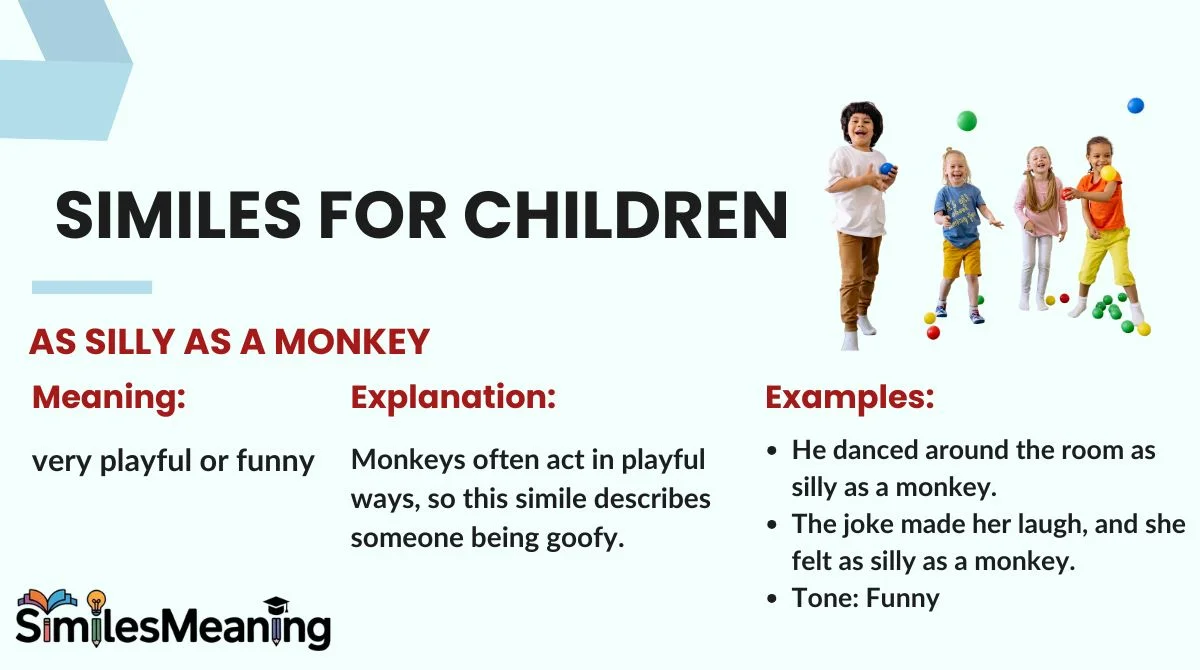
As silly as a monkey
Meaning: very playful or funny
Explanation: Monkeys often act in playful ways, so this simile describes someone being goofy.
Examples:
- He danced around the room as silly as a monkey.
- The joke made her laugh, and she felt as silly as a monkey.
Tone: Funny
As clumsy as a puppy
Meaning: not very careful or coordinated
Explanation: Puppies sometimes bump into things because they are learning.
Examples:
- He tripped over his shoelaces, as clumsy as a puppy.
- The child carried the cup as clumsy as a puppy but didn’t spill it.
Tone: Funny
Like a balloon in the wind
Meaning: moving in unpredictable ways
Explanation: Balloons float and drift, just like someone who moves around without direction.
Examples:
- She danced like a balloon in the wind.
- His hair bounced like a balloon in the wind.
Tone: Lighthearted
As chatty as a parrot
Meaning: talking a lot
Explanation: Parrots are known for repeating words and making noise.
Examples:
- She was as chatty as a parrot at lunchtime.
- The boy told stories, as chatty as a parrot.
Tone: Funny
Emotional & Deep Similes
As happy as sunshine
Meaning: extremely joyful
Explanation: Sunshine feels warm and bright, just like happiness.
Examples:
- She smiled, as happy as sunshine.
- The good news made him feel as happy as sunshine.
Tone: Positive
As lonely as a lost puppy
Meaning: feeling alone or sad
Explanation: A lost puppy seems helpless and separated from others.
Examples:
- He sat quietly, as lonely as a lost puppy.
- She missed her friends and felt as lonely as a lost puppy.
Tone: Emotional
Like a heart full of balloons
Meaning: feeling light and joyful
Explanation: Balloons rising upward represent happiness and excitement.
Examples:
- Her heart felt like a heart full of balloons.
- Winning the game made him feel like a heart full of balloons.
Tone: Poetic
As brave as a lion
Meaning: very courageous
Explanation: Lions are symbols of strength and bravery.
Examples:
- She faced the challenge as brave as a lion.
- The firefighter worked as brave as a lion.
Tone: Inspirational
Dramatic & Intense Similes
As fast as a shooting star
Meaning: extremely quick
Explanation: Shooting stars streak across the sky in seconds.
Examples:
- He ran as fast as a shooting star.
- The bicycle zoomed by, as fast as a shooting star.
Tone: Dramatic
Like thunder in the sky
Meaning: loud and powerful
Explanation: Thunder makes a strong, surprising sound.
Examples:
- Her voice was like thunder in the sky.
- The applause sounded like thunder in the sky.
Tone: Intense
As strong as an ox
Meaning: very powerful
Explanation: Oxen are large animals known for strength.
Examples:
- He lifted the box as strong as an ox.
- The athlete worked out and became as strong as an ox.
Tone: Serious
Like a storm of ideas
Meaning: many thoughts at once
Explanation: Storms are busy and energetic, just like creative thinking.
Examples:
- Her mind was like a storm of ideas.
- The group brainstormed like a storm of ideas.
Tone: Creative
Slow & Calm Similes
As quiet as a mouse
Meaning: very silent
Explanation: Mice move softly and make little noise.
Examples:
- He walked as quiet as a mouse.
- The classroom was as quiet as a mouse during the test.
Tone: Calm
Like a peaceful river
Meaning: calm and steady
Explanation: Rivers flow gently, representing tranquility.
Examples:
- Her voice was like a peaceful river.
- The afternoon felt like a peaceful river.
Tone: Poetic
As slow as a turtle
Meaning: moving very slowly
Explanation: Turtles are known for their gradual pace.
Examples:
- He walked as slow as a turtle.
- The line moved as slow as a turtle.
Tone: Lighthearted
Like a soft blanket
Meaning: comforting and gentle
Explanation: Blankets feel warm and safe.
Examples:
- Her words were like a soft blanket.
- The kind message felt like a soft blanket.
Tone: Emotional
Creative & Unique Similes
As curious as a detective
Meaning: eager to discover answers
Explanation: Detectives investigate mysteries.
Examples:
- She asked questions as curious as a detective.
- The child explored the room, as curious as a detective.
Tone: Creative
Like a rainbow after rain
Meaning: something beautiful after difficulty
Explanation: Rainbows appear after storms and symbolize hope.
Examples:
- The good news felt like a rainbow after rain.
- His smile was like a rainbow after rain.
Tone: Poetic
As bright as a firefly
Meaning: shining or noticeable
Explanation: Fireflies glow in the dark.
Examples:
- Her idea was as bright as a firefly.
- The lantern shone as bright as a firefly.
Tone: Positive
Like a puzzle waiting to be solved
Meaning: something intriguing
Explanation: Puzzles require thinking and patience.
Examples:
- The problem was like a puzzle waiting to be solved.
- She looked at the question like a puzzle waiting to be solved.
Tone: Intellectual
Fresh and Unique Similes You Won’t Hear Every Day
As energetic as bouncing bubbles
Meaning: full of energy and joy
Explanation: Bubbles float and bounce, representing liveliness.
Examples:
- The children were as energetic as bouncing bubbles.
- His excitement was as energetic as bouncing bubbles.
Tone: Fun
Like a notebook full of secrets
Meaning: mysterious or private
Explanation: Notebooks can hold hidden thoughts.
Examples:
- Her expression was like a notebook full of secrets.
- The old box seemed like a notebook full of secrets.
Tone: Mysterious
As steady as a clock ticking
Meaning: consistent and reliable
Explanation: Clocks tick in a regular rhythm.
Examples:
- He worked as steady as a clock ticking.
- The team progressed as steady as a clock ticking.
Tone: Serious
Like sunshine breaking through clouds
Meaning: hope after difficulty
Explanation: Sunlight after clouds represents positivity.
Examples:
- Her kindness was like sunshine breaking through clouds.
- The good news felt like sunshine breaking through clouds.
Tone: Inspirational
As imaginative as a dreamer
Meaning: creative and full of ideas
Explanation: Dreamers imagine possibilities.
Examples:
- She was as imaginative as a dreamer.
- The story was written as imaginative as a dreamer.
Tone: Creative
How to Use These Similes in Writing
Similes improve essays, stories, and descriptions. Here are ideas:
- School essays: “The playground was as busy as a beehive.”
- Stories: “The hero stood as brave as a lion.”
- Descriptions: “The night was like a blanket of stars.”
Use similes sparingly to keep writing clear and powerful.
How to Create Your Own Similes (Mini Writing Guide)
Step 1: Choose Two Things to Compare
Pick something familiar and something you want to describe.
Example: Compare a runner to a cheetah.
Step 2: Use “Like” or “As”
- He ran like a cheetah.
- He was as fast as a cheetah.
Step 3: Think About Shared Qualities
Cheetahs are fast, so the runner must be fast.
Step 4: Keep It Simple
Children and readers understand clear comparisons.
Step 5: Practice Often
The more you write, the better you become.
Practical Tips
- Avoid clichés
- Use original ideas
- Match tone to context
- Test your similes in sentences
- Read examples for inspiration
Common Mistakes When Using Similes
- Overuse: Too many similes can feel repetitive.
- Clichés: Avoid old phrases like “as busy as a bee” unless necessary.
- Mismatch: Ensure comparisons make sense.
- Complexity: Keep language simple for children.
Practice Exercise
Fill in the blanks with your own similes:
- She was as ______ as ______.
- The dog ran like ______.
- His smile was as ______ as ______.
- The room felt like ______.
- He worked as ______ as ______.
- The idea was like ______.
- She sang as ______ as ______.
- The storm sounded like ______.
- He moved as ______ as ______.
- Her heart felt like ______.
- The answer was as ______ as ______.
- The day was like ______.
Answers (Examples)
Your answers may differ—creativity matters!
FAQs
What is a simple simile for children?
A simile compares two things using “like” or “as.” Example: She is as fast as a cheetah.
Why are similes important?
They make writing vivid and help readers imagine ideas.
Can children create their own similes?
Yes! Practice comparisons and use imagination.
What is a common mistake with similes?
Overusing them or making comparisons that do not make sense.
Are similes only for writing?
No. They improve speaking and everyday description.
How many similes should I use?
Use a few strong similes instead of many weak ones.
Final Thoughts
Similes are powerful tools for expression. They help children describe ideas in creative ways and make writing enjoyable.
Whether you use classic examples or invent your own, similes bring language to life. Practice often, stay imaginative, and explore new comparisons.

Calvin Merrick is an English language educator and content writer dedicated to making similes and meanings simple, clear, and easy to understand for students worldwide.