Cold is something we all feel. It bites our skin in winter. It slips into quiet rooms. It shows up in people’s voices and hearts. But saying “It was very cold” feels dull. Flat. Forgettable.
That’s where similes help.
Similes make writing come alive. They help readers see, feel, and even shiver along with your words. A strong simile can turn simple sentences into something vivid and emotional.
In this guide, you’ll discover 21+ high-quality similes for cold—funny, dramatic, poetic, and fresh. You’ll also learn how to use them in essays and stories, how to create your own, and what mistakes to avoid.
Let’s add some frost to your writing.
What Is a Simile? (Quick Clear Definition)
A simile compares two different things using “like” or “as.”
It helps describe something in a clearer or more creative way.
Example:
The wind was as cold as ice.
Quick List – Most Popular Similes for “Cold”
- As cold as ice
- As cold as a freezer
- As cold as snow
- As cold as a winter morning
- As cold as stone
- As cold as the Arctic
- As cold as steel
- As cold as a ghost
- As cold as frost
- As cold as December
Complete List of Similes for “Cold” (Grouped by Meaning)
Funny & Lighthearted
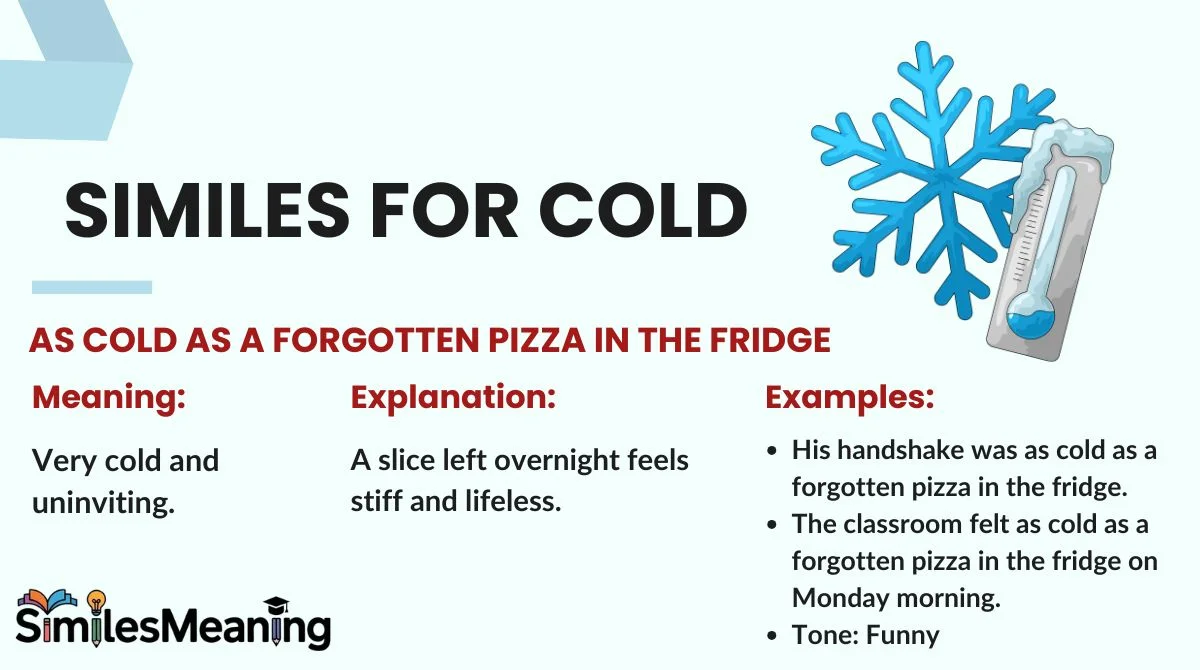
As cold as a forgotten pizza in the fridge
Meaning: Very cold and uninviting.
Explanation: A slice left overnight feels stiff and lifeless.
Examples:
- His handshake was as cold as a forgotten pizza in the fridge.
- The classroom felt as cold as a forgotten pizza in the fridge on Monday morning.
Tone: Funny
As cold as a penguin’s toes
Meaning: Playfully freezing.
Explanation: Penguins live on ice, so their toes must feel icy.
Examples:
- My fingers were as cold as a penguin’s toes.
- The bathroom tiles were as cold as a penguin’s toes.
Tone: Casual
As cold as leftover soup
Meaning: Suddenly unpleasant and chilly.
Explanation: Soup is meant to be warm, so cold soup feels wrong.
Examples:
- Her reply was as cold as leftover soup.
- The welcome we got was as cold as leftover soup.
Tone: Funny
Emotional & Deep
As cold as a lonely night
Meaning: Emotionally distant and empty.
Explanation: Loneliness can feel icy and silent.
Examples:
- His voice was as cold as a lonely night.
- The house felt as cold as a lonely night after she left.
Tone: Serious
As cold as a broken promise
Meaning: Hurtful and heartless.
Explanation: Broken trust leaves a chilling feeling inside.
Examples:
- Her words were as cold as a broken promise.
- His silence was as cold as a broken promise.
Tone: Emotional
As cold as an empty church
Meaning: Quiet and emotionally heavy.
Explanation: Large empty spaces can feel still and chilling.
Examples:
- The hall stood as cold as an empty church.
- After the argument, the room felt as cold as an empty church.
Tone: Poetic
Dramatic & Intense
As cold as the Arctic wind
Meaning: Extremely freezing.
Explanation: Arctic winds are known for harsh cold.
Examples:
- The air was as cold as the Arctic wind.
- His stare felt as cold as the Arctic wind.
Tone: Dramatic
As cold as a slab of marble
Meaning: Hard and icy to the touch.
Explanation: Marble feels smooth and freezing.
Examples:
- Her hands were as cold as a slab of marble.
- The floor was as cold as a slab of marble.
Tone: Serious
As cold as a vampire’s touch
Meaning: Frighteningly cold.
Explanation: Vampires are often imagined as icy and lifeless.
Examples:
- His fingers were as cold as a vampire’s touch.
- The wind brushed my face, as cold as a vampire’s touch.
Tone: Dramatic
As cold as deep space
Meaning: Shockingly and endlessly cold.
Explanation: Space is known for extreme temperatures.
Examples:
- The night felt as cold as deep space.
- Her silence was as cold as deep space.
Tone: Intense
Slow & Monotonous Cold
As cold as a stone bench in winter
Meaning: Steady and uncomfortable cold.
Explanation: Outdoor benches hold cold for hours.
Examples:
- The seat was as cold as a stone bench in winter.
- The steps felt as cold as a stone bench in winter.
Tone: Casual
As cold as early morning dew
Meaning: Light but sharp cold.
Explanation: Dew chills grass at sunrise.
Examples:
- The grass was as cold as early morning dew.
- Her fingers felt as cold as early morning dew.
Tone: Poetic
As cold as a silent basement
Meaning: Damp and unsettling cold.
Explanation: Basements often feel cool and still.
Examples:
- The air was as cold as a silent basement.
- His tone turned as cold as a silent basement.
Tone: Serious
Creative & Unique (Less Common)
As cold as a paused clock in winter
Meaning: Frozen and lifeless.
Explanation: A stopped clock suggests time frozen.
Examples:
- The town felt as cold as a paused clock in winter.
- His smile was as cold as a paused clock in winter.
Tone: Creative
As cold as silver under moonlight
Meaning: Bright yet icy.
Explanation: Silver shines but looks cold at night.
Examples:
- The lake shimmered, as cold as silver under moonlight.
- Her eyes were as cold as silver under moonlight.
Tone: Poetic
As cold as a shadow at sunrise
Meaning: Quiet and fading cold.
Explanation: Early shadows feel cool before warmth comes.
Examples:
- The wind was as cold as a shadow at sunrise.
- His goodbye felt as cold as a shadow at sunrise.
Tone: Literary
As cold as a locked diary
Meaning: Secretive and emotionally distant.
Explanation: A locked diary hides feelings inside.
Examples:
- Her face was as cold as a locked diary.
- The letter felt as cold as a locked diary.
Tone: Emotional
As cold as iron chains
Meaning: Harsh and biting cold.
Explanation: Metal chains feel painfully icy.
Examples:
- The railing was as cold as iron chains.
- His grip felt as cold as iron chains.
Tone: Dramatic
Poetic & Literary
As cold as winter’s last breath
Meaning: Deep seasonal chill.
Explanation: Suggests the final icy wind of winter.
Examples:
- The wind blew, as cold as winter’s last breath.
- Her whisper was as cold as winter’s last breath.
Tone: Poetic
As cold as pale starlight
Meaning: Beautiful yet distant cold.
Explanation: Stars shine but give no warmth.
Examples:
- The sky looked as cold as pale starlight.
- His gaze was as cold as pale starlight.
Tone: Literary
As cold as a forgotten battlefield
Meaning: Heavy and haunting cold.
Explanation: Suggests silence after chaos.
Examples:
- The field lay as cold as a forgotten battlefield.
- His silence was as cold as a forgotten battlefield.
Tone: Serious
Fresh and Unique Similes You Won’t Hear Every Day
Here are five original similes with strong imagery:
- As cold as unspoken truth – Truth left unsaid creates distance.
- As cold as glass before dawn – Windows chill deeply overnight.
- As cold as a moonlit grave – Suggests eerie night frost.
- As cold as ink in an unwritten letter – Words that never came feel distant.
- As cold as a starless sky – Darkness without warmth or hope.
Each one connects physical cold to emotion or image. That makes it powerful.
How to Use These Similes in Writing
In Essays
- Describe weather in descriptive essays.
- Show emotional distance in character analysis.
- Add detail to narrative writing tasks.
Example:
The meeting room was as cold as stone, matching the manager’s tone.
In Stories
- Show mood without saying “It was cold.”
- Reveal character feelings.
- Make scenes vivid and sensory.
Example:
Her stare was as cold as silver under moonlight, and I knew she meant every word.
How to Create Your Own Similes (Mini Writing Guide)
Step-by-Step Method
- Think about the type of cold (weather, emotion, touch).
- Picture objects that feel cold.
- Choose something unexpected.
- Connect using “like” or “as.”
- Test it in a sentence.
5 Practical Tips
- Use senses (touch, sight, sound).
- Avoid overused clichés.
- Match the tone of your story.
- Keep it simple.
- Make sure readers understand the image.
3 Transformation Examples
Plain: The wind was cold.
Better: The wind was as cold as iron chains.
Plain: She sounded distant.
Better: Her voice was as cold as a broken promise.
Plain: The night felt freezing.
Better: The night felt as cold as deep space.
Common Mistakes When Using Similes
Overuse
Too many similes make writing messy. Use them where they matter most.
Clichés
“As cold as ice” is common. Try fresher images when possible.
Tone Mismatch
Don’t use a funny simile in a sad funeral scene. Match emotion carefully.
Practice Exercise
Fill in the blanks:
- The wind was as cold as ________.
- Her stare felt as cold as ________.
- The bench was as cold as ________.
- His silence was as cold as ________.
- The lake shimmered, as cold as ________.
- My hands were as cold as ________.
- The basement air felt as cold as ________.
- The night sky looked as cold as ________.
- His reply was as cold as ________.
- The marble floor was as cold as ________.
- The goodbye felt as cold as ________.
- The hallway stood as cold as ________.
Answers (Sample)
- the Arctic wind
- a broken promise
- a stone bench in winter
- deep space
- silver under moonlight
- a penguin’s toes
- a silent basement
- pale starlight
- leftover soup
- iron chains
- winter’s last breath
- an empty church
FAQs
What is the best simile for cold weather?
“As cold as the Arctic wind” is strong because it suggests extreme freezing conditions.
What is a poetic simile for cold?
“As cold as pale starlight” sounds beautiful and distant.
What simile shows emotional coldness?
“As cold as a broken promise” clearly shows emotional pain.
Can similes describe people?
Yes. You can describe voices, stares, hands, or personalities.
Are similes good for essays?
Yes. They make writing vivid and engaging when used carefully.
What is the difference between a simile and a metaphor?
A simile uses “like” or “as.” A metaphor says something is something else.
Final Thoughts
Cold is more than weather. It can describe silence, distance, fear, and loss. The right simile helps readers feel that chill.
Use popular similes when you need clarity. Use creative ones when you want power. And try building your own when you want something unforgettable.
Now your writing won’t just say it’s cold.
Your readers will feel it.

Calvin Merrick is an English language educator and content writer dedicated to making similes and meanings simple, clear, and easy to understand for students worldwide.