Depression is hard to explain. It’s not just sadness—it’s heavier, quieter, and often invisible. That’s where similes help. They turn feelings into images we can see, feel, and understand.
A simple comparison can say what long paragraphs cannot.
This guide gives you powerful similes for depression that are easy to use, clear, and emotionally strong.
Whether you’re writing a story, a poem, a journal entry, or just trying to describe how you feel, these similes will help you speak with clarity.
You’ll find creative ideas, simple meanings, and real examples you can use right away. By the end, you’ll not only know 29+ similes—you’ll know how to create your own.
What Is a Simile? (Quick Clear Definition)
A simile is a comparison between two things using “like” or “as.”
It helps explain a feeling or idea in a simple way.
Example:
“Her sadness felt like a heavy rain cloud.”
Quick List – Most Popular Similes for “Depression”
- Like a dark cloud that won’t go away
- Like being stuck in a deep hole
- Like walking through thick fog
- Like carrying a heavy backpack all day
- Like a room with no windows
- Like sinking in slow motion
- Like a candle losing its flame
- Like a broken clock that won’t move
- Like drowning without water
- Like being lost in a maze
Complete List of Similes for “Depression” (Grouped by Meaning)
Emotional & Deep
Like a storm that never passes
Meaning: Ongoing emotional pain
Explanation: The feeling stays and does not fade.
Examples:
- His thoughts felt like a storm that never passes.
- She lived each day like a storm that never passes.
Tone: Serious
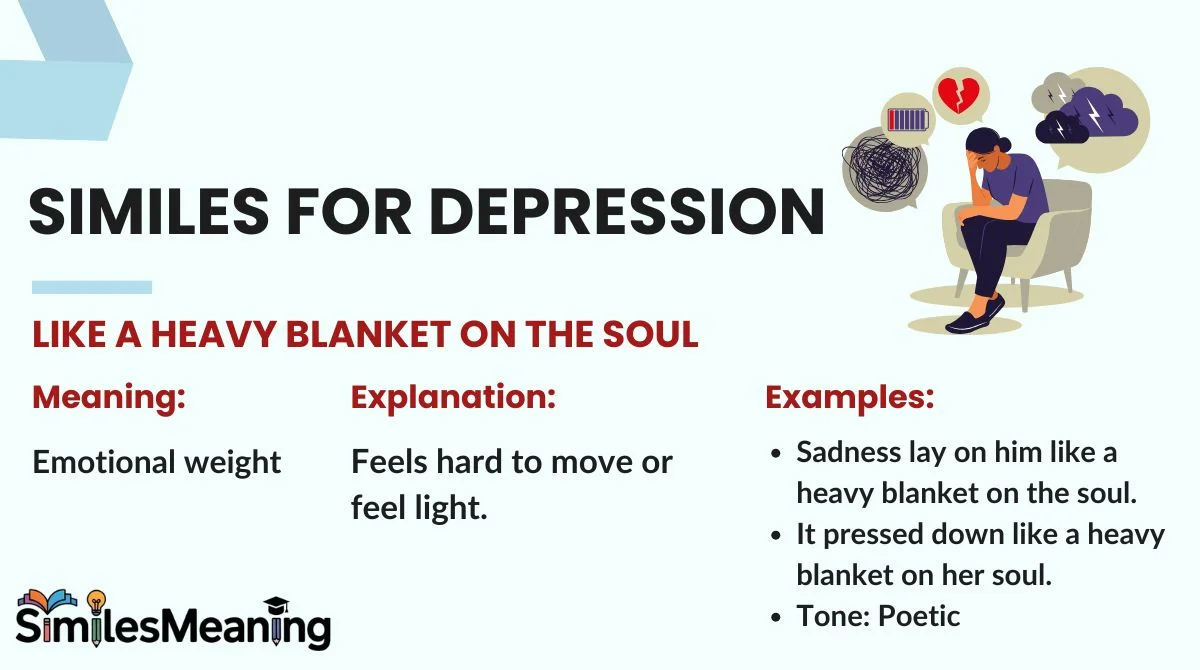
Like a heavy blanket on the soul
Meaning: Emotional weight
Explanation: Feels hard to move or feel light.
Examples:
- Sadness lay on him like a heavy blanket on the soul.
- It pressed down like a heavy blanket on her soul.
Tone: Poetic
Like a silent scream inside
Meaning: Hidden pain
Explanation: You feel pain but can’t express it.
Examples:
- His depression felt like a silent scream inside.
- She walked around with a silent scream inside her.
Tone: Serious
Like a shadow that follows everywhere
Meaning: Constant presence
Explanation: Depression never leaves.
Examples:
- It clung to him like a shadow that follows everywhere.
- Her sadness stayed like a shadow that follows everywhere.
Tone: Poetic
Like an empty room with echoes
Meaning: Loneliness
Explanation: Feels hollow and lonely.
Examples:
- His mind felt like an empty room with echoes.
- She sat there like an empty room with echoes.
Tone: Poetic
Dramatic & Intense
Like drowning in slow motion
Meaning: Overwhelming feeling
Explanation: You feel trapped and helpless.
Examples:
- Each day felt like drowning in slow motion.
- He struggled like he was drowning in slow motion.
Tone: Serious
Like being buried alive
Meaning: Extreme helplessness
Explanation: No way out of the feeling.
Examples:
- Depression felt like being buried alive.
- She panicked like she was being buried alive.
Tone: Dramatic
Like a black hole pulling everything in
Meaning: Loss of joy
Explanation: It takes away all energy and happiness.
Examples:
- His mind felt like a black hole pulling everything in.
- Her sadness worked like a black hole pulling everything in.
Tone: Serious
Like chains around your mind
Meaning: Mental restriction
Explanation: Hard to think clearly or freely.
Examples:
- His thoughts felt like chains around his mind.
- She struggled like chains were around her mind.
Tone: Serious
Like a fire that burns without light
Meaning: Pain without hope
Explanation: You feel hurt but see no meaning.
Examples:
- It felt like a fire that burns without light.
- His sadness burned like a fire without light.
Tone: Poetic
Slow & Monotonous
Like walking through thick mud
Meaning: Slow and tiring
Explanation: Everything feels difficult.
Examples:
- Life felt like walking through thick mud.
- She moved like she was walking through thick mud.
Tone: Casual
Like a clock ticking too slowly
Meaning: Time feels heavy
Explanation: Days feel long and endless.
Examples:
- Each hour felt like a clock ticking too slowly.
- He waited like a clock ticking too slowly.
Tone: Casual
Like a never-ending gray day
Meaning: Lack of joy
Explanation: Everything feels dull.
Examples:
- His life felt like a never-ending gray day.
- She lived in a never-ending gray day.
Tone: Poetic
Like dragging your feet through sand
Meaning: Exhaustion
Explanation: Even small tasks feel hard.
Examples:
- He moved like dragging his feet through sand.
- Her days felt like dragging her feet through sand.
Tone: Casual
Creative & Unique
Like a cracked mirror reflecting nothing
Meaning: Loss of identity
Explanation: You don’t recognize yourself.
Examples:
- His mind felt like a cracked mirror reflecting nothing.
- She saw herself like a cracked mirror reflecting nothing.
Tone: Poetic
Like a song stuck on one sad note
Meaning: Repetitive sadness
Explanation: Same feeling over and over.
Examples:
- His thoughts were like a song stuck on one sad note.
- Her mood stayed like a song stuck on one sad note.
Tone: Creative
Like a frozen river under ice
Meaning: Hidden emotions
Explanation: Feelings exist but don’t move.
Examples:
- His heart felt like a frozen river under ice.
- She stayed quiet like a frozen river under ice.
Tone: Poetic
Like a dim light flickering out
Meaning: Losing hope
Explanation: Hope slowly disappears.
Examples:
- His hope felt like a dim light flickering out.
- She faded like a dim light flickering out.
Tone: Poetic
Like a book with blank pages
Meaning: Lack of purpose
Explanation: Life feels empty.
Examples:
- His future felt like a book with blank pages.
- She lived like a book with blank pages.
Tone: Creative
Funny & Lighthearted
Like a phone with 1% battery all day
Meaning: Low energy
Explanation: You feel drained.
Examples:
- He felt like a phone with 1% battery all day.
- She worked like a phone with 1% battery.
Tone: Funny
Like a rainy day on repeat
Meaning: Same dull feeling
Explanation: Nothing changes.
Examples:
- Life felt like a rainy day on repeat.
- Her mood stayed like a rainy day on repeat.
Tone: Casual
Like socks that never dry
Meaning: Ongoing discomfort
Explanation: Always uncomfortable.
Examples:
- His mood felt like socks that never dry.
- She stayed uneasy like socks that never dry.
Tone: Funny
Poetic & Literary
Like autumn leaves falling endlessly
Meaning: Gradual loss
Explanation: Things slowly fade away.
Examples:
- His thoughts fell like autumn leaves endlessly.
- She felt like autumn leaves falling endlessly.
Tone: Poetic
Like a fading echo in the dark
Meaning: Losing presence
Explanation: Feeling invisible.
Examples:
- He felt like a fading echo in the dark.
- Her voice sounded like a fading echo in the dark.
Tone: Poetic
Like a wilted flower without sun
Meaning: Lack of care
Explanation: You need support but don’t get it.
Examples:
- She felt like a wilted flower without sun.
- He lived like a wilted flower without sun.
Tone: Poetic
Like night that never turns to day
Meaning: No hope
Explanation: Darkness feels endless.
Examples:
- His world felt like night that never turns to day.
- She stayed in night that never turns to day.
Tone: Poetic
Fresh and Unique Similes You Won’t Hear Every Day
- Like a paused video buffering forever
Imagery: Life feels stuck, waiting but never moving - Like a deflated balloon in a quiet room
Imagery: Lost energy and joy - Like ink spreading in water
Imagery: Sadness slowly taking over everything - Like a library with no books
Imagery: Empty mind, no ideas or emotions - Like footsteps erased in snow
Imagery: Feeling forgotten or invisible
How to Use These Similes in Writing
In essays:
Use similes to explain emotions clearly. Example:
“Depression feels like walking through thick mud, making even small tasks difficult.”
In stories:
Add depth to characters. Example:
“He sat quietly, like a fading echo in the dark, unseen and unheard.”
How to Create Your Own Similes (Mini Writing Guide)
Step-by-step method:
- Think of the feeling (sad, heavy, empty)
- Find an object or scene
- Connect them with “like” or “as”
5 practical tips:
- Keep it simple
- Use real-life images
- Avoid clichés
- Match the tone
- Test it in a sentence
Transformation examples:
- Sad → “like rain” → “like cold rain at night”
- Empty → “like a box” → “like an open box with nothing inside”
- Tired → “like a battery” → “like a battery that won’t recharge”
Common Mistakes When Using Similes
Overuse:
Too many similes make writing messy.
Clichés:
Avoid overused ones like “dark cloud” unless improved.
Tone mismatch:
Don’t use funny similes in serious writing (unless intentional).
Practice Exercise
Fill in the blanks:
- Depression felt like ______
- His mind was like ______
- She walked like ______
- It stayed like ______
- His heart felt like ______
- Life became like ______
- Each day felt like ______
- Her thoughts were like ______
- He lived like ______
- It pressed like ______
- She felt like ______
- His energy was like ______
Answers (Sample)
- a frozen river
- a black hole
- walking through mud
- a shadow
- a wilted flower
- a gray day
- drowning slowly
- a broken song
- an empty room
- a heavy blanket
- a fading echo
- a dying battery
FAQs (Optimized for People Also Ask)
What is a simile for depression?
A simile for depression compares the feeling to something else using “like” or “as,” such as “like walking through thick fog.”
Why use similes for depression?
They make emotions easier to understand and more vivid.
Are similes good for essays?
Yes, they help explain feelings clearly and improve writing quality.
Can similes be simple?
Yes, simple similes are often the most powerful.
How many similes should I use?
Use only a few to keep writing clear and strong.
Are creative similes better than common ones?
Yes, unique similes make your writing stand out.
Final Thoughts
Depression is complex, but words can bring clarity. Similes turn silent feelings into something visible and real. Whether you choose something simple or poetic, the right simile can connect deeply with readers.
Use these examples, adapt them, and create your own. The more you practice, the better your writing—and your expression—will become.

Calvin Merrick is an English language educator and content writer dedicated to making similes and meanings simple, clear, and easy to understand for students worldwide.