Fear is one of the strongest emotions we feel. It can freeze us, shake us, or make our hearts race. But describing fear in plain words can feel flat. That’s where similes come in.
Similes help you paint pictures with words. They make your writing vivid, clear, and memorable. Instead of saying “I was scared,” you can show it in a way readers feel it.
This topic is exciting because fear shows up everywhere—in stories, essays, speeches, and daily life. When you master similes for fear, your writing becomes more alive and emotional.
In this guide, you’ll find 29+ powerful similes, easy explanations, examples, and tips. By the end, you’ll know how to use and create your own similes like a pro.
What Is a Simile? (Quick Clear Definition)
A simile compares two different things using “like” or “as” to describe something clearly.
Example:
She was as quiet as a mouse.
Quick List – Most Popular Similes for “Fear”
- As scared as a mouse in a trap
- Like a deer in headlights
- As pale as a ghost
- Like a leaf in the wind
- As frozen as ice
- Like a rabbit before a fox
- As shaky as jelly
- Like a child lost in the dark
- As still as a statue
- Like thunder in the chest
Complete List of Similes for “Fear” (Grouped by Meaning)
Funny & Lighthearted
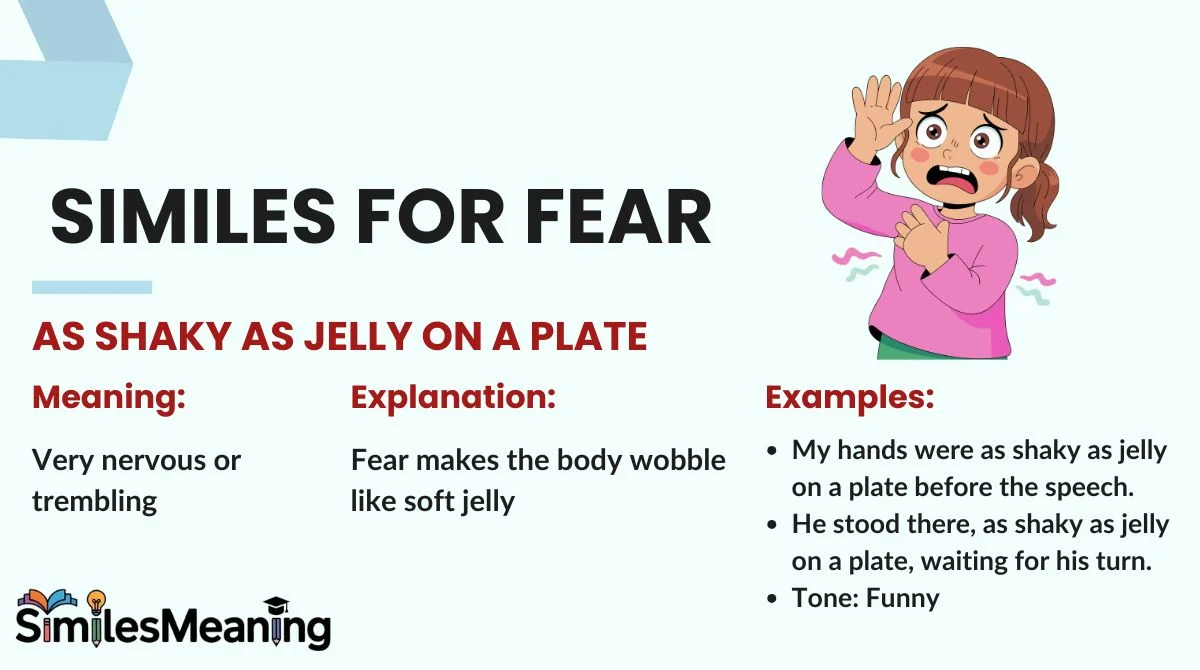
As shaky as jelly on a plate
Meaning: Very nervous or trembling
Explanation: Fear makes the body wobble like soft jelly
Examples:
- My hands were as shaky as jelly on a plate before the speech.
- He stood there, as shaky as jelly on a plate, waiting for his turn.
Tone: Funny
Like a cat in a room full of rocking chairs
Meaning: Extremely alert and nervous
Explanation: The image is playful but shows constant fear of danger
Examples:
- She looked like a cat in a room full of rocking chairs during the test.
- I felt like a cat in a room full of rocking chairs at my first job.
Tone: Funny
As jumpy as popcorn in a pan
Meaning: Easily startled
Explanation: Fear causes quick, sudden reactions like popping corn
Examples:
- He was as jumpy as popcorn in a pan after watching that movie.
- I became as jumpy as popcorn in a pan in the dark hallway.
Tone: Casual
Like a chicken near a firecracker
Meaning: Ready to panic any second
Explanation: A silly image showing nervous energy
Examples:
- She acted like a chicken near a firecracker during the storm.
- I felt like a chicken near a firecracker before the exam results.
Tone: Funny
Emotional & Deep
As cold as fear in the bones
Meaning: Deep, chilling fear
Explanation: Fear can feel like cold spreading through the body
Examples:
- The sound made him as cold as fear in the bones.
- I felt as cold as fear in the bones walking alone at night.
Tone: Serious
Like a shadow that won’t leave
Meaning: Constant fear
Explanation: Fear follows like a shadow, always present
Examples:
- The worry stayed like a shadow that wouldn’t leave.
- Fear followed her like a shadow that wouldn’t leave.
Tone: Poetic
As heavy as a storm cloud
Meaning: Overwhelming fear
Explanation: Fear presses down like a dark cloud
Examples:
- The silence felt as heavy as a storm cloud.
- His fear hung as heavy as a storm cloud.
Tone: Serious
Like a heart trapped in a cage
Meaning: Feeling stuck with fear
Explanation: Fear restricts movement and thought
Examples:
- My chest felt like a heart trapped in a cage.
- She breathed like a heart trapped in a cage.
Tone: Emotional
As quiet as fear before a scream
Meaning: Tense silence
Explanation: Fear builds quietly before bursting
Examples:
- The room was as quiet as fear before a scream.
- It felt as quiet as fear before a scream.
Tone: Poetic
Dramatic & Intense
Like a deer in headlights
Meaning: Frozen in fear
Explanation: Sudden fear stops all movement
Examples:
- He stood like a deer in headlights when called.
- I felt like a deer in headlights during the interview.
Tone: Serious
As frozen as ice
Meaning: Unable to move
Explanation: Fear can paralyze
Examples:
- She was as frozen as ice when she heard the noise.
- I stood as frozen as ice at the door.
Tone: Serious
Like thunder in the chest
Meaning: Strong heartbeat from fear
Explanation: Fear makes the heart pound loudly
Examples:
- My heart felt like thunder in my chest.
- He stood there with thunder in his chest.
Tone: Dramatic
As pale as a ghost
Meaning: Showing fear on the face
Explanation: Fear drains color from the skin
Examples:
- She turned as pale as a ghost.
- He looked as pale as a ghost after the news.
Tone: Casual
Like a rabbit before a fox
Meaning: Facing danger helplessly
Explanation: Shows fear when escape seems impossible
Examples:
- He stood like a rabbit before a fox.
- I felt like a rabbit before a fox in that moment.
Tone: Serious
Slow & Building Fear
Like a drip of water in silence
Meaning: Slowly growing fear
Explanation: Small moments build tension
Examples:
- Fear grew like a drip of water in silence.
- The tension felt like a drip of water in silence.
Tone: Poetic
As creeping as fog at night
Meaning: Gradual fear
Explanation: Fear spreads slowly and quietly
Examples:
- The fear was as creeping as fog at night.
- It came as creeping as fog at night.
Tone: Poetic
Like footsteps behind you
Meaning: Suspenseful fear
Explanation: Suggests something unknown approaching
Examples:
- The feeling was like footsteps behind you.
- Fear followed like footsteps behind you.
Tone: Dramatic
Creative & Unique
Like a glass about to crack
Meaning: Tense fear
Explanation: Fear builds pressure inside
Examples:
- I felt like a glass about to crack.
- Her nerves were like glass about to crack.
Tone: Creative
As tight as a knot in the stomach
Meaning: Nervous fear
Explanation: Physical reaction to fear
Examples:
- My stomach was as tight as a knot.
- He felt as tight as a knot before speaking.
Tone: Casual
Like a flickering light in the dark
Meaning: Uncertain fear
Explanation: Fear mixed with doubt
Examples:
- Hope felt like a flickering light in the dark.
- Fear came like a flickering light in the dark.
Tone: Poetic
As thin as a whisper
Meaning: Fragile calm before fear
Explanation: Fear can break calm easily
Examples:
- The silence was as thin as a whisper.
- Calm felt as thin as a whisper.
Tone: Poetic
Like sand slipping through fingers
Meaning: Losing control from fear
Explanation: Fear makes control disappear
Examples:
- Control felt like sand slipping through fingers.
- My thoughts slipped like sand through fingers.
Tone: Creative
Poetic & Literary
Like a storm behind the eyes
Meaning: Hidden fear
Explanation: Fear builds internally
Examples:
- He carried a storm behind his eyes.
- Fear stayed like a storm behind her eyes.
Tone: Poetic
As silent as a held breath
Meaning: Quiet tension
Explanation: Fear stops even breathing
Examples:
- The room was as silent as a held breath.
- We waited as silent as a held breath.
Tone: Poetic
Like darkness swallowing light
Meaning: Fear overpowering hope
Explanation: Fear takes over emotions
Examples:
- Fear came like darkness swallowing light.
- Hope faded like darkness swallowing light.
Tone: Poetic
As fragile as a glass heart
Meaning: Emotional fear
Explanation: Fear makes emotions delicate
Examples:
- She felt as fragile as a glass heart.
- His courage was as fragile as a glass heart.
Tone: Emotional
Fresh and Unique Similes You Won’t Hear Every Day
- Like a phone battery at 1% in a storm
Fear feels urgent and unstable, like losing control anytime. - As tight as a drum before it breaks
Shows pressure building to a breaking point. - Like a browser with too many tabs open
Fear overwhelms the mind with too many thoughts. - As sharp as cold metal on skin
Fear feels sudden and chilling. - Like a paused video before the jump scare
Suspenseful fear, waiting for something to happen.
How to Use These Similes in Writing
In Essays:
Use similes to explain emotions clearly.
Example: “The fear spread like fog, making it hard to think.”
In Stories:
Similes help readers feel the scene.
Example: “Her heart beat like thunder in her chest as the door creaked open.”
How to Create Your Own Similes (Mini Writing Guide)
Step-by-Step Method
- Pick the emotion (fear)
- Think of a physical feeling (shaking, cold)
- Find something similar (jelly, ice)
- Connect using “like” or “as”
5 Practical Tips
- Use simple images
- Think of nature or daily life
- Avoid overused phrases
- Match tone with context
- Keep it short and clear
Transformation Examples
- “I was scared” → “I was as frozen as ice”
- “She felt nervous” → “She was as shaky as jelly”
- “He panicked” → “He ran like a rabbit before a fox”
Common Mistakes When Using Similes
Overuse:
Too many similes can confuse readers.
Clichés:
Avoid using only common ones like “pale as a ghost.”
Tone Mismatch:
Don’t use funny similes in serious scenes.
Practice Exercise
Fill in the blanks:
- As scared as a ______
- Like a ______ in headlights
- As shaky as ______
- Like a ______ before a fox
- As cold as ______
- Like ______ behind you
- As pale as ______
- Like a ______ about to crack
- As silent as ______
- Like darkness ______ light
- As tight as ______
- Like a ______ in the dark
Answers
- mouse
- deer
- jelly
- rabbit
- ice
- footsteps
- ghost
- glass
- a held breath
- swallowing
- a knot
- flickering light
FAQs (Optimized for People Also Ask)
What is a good simile for fear?
A good simile is “like a deer in headlights” because it clearly shows frozen fear.
Why use similes for fear in writing?
They make emotions vivid and easy to understand.
Can similes improve storytelling?
Yes, they help readers feel the scene instead of just reading it.
Are similes better than metaphors?
Both are useful. Similes are simpler and clearer for beginners.
How many similes should I use?
Use them carefully—1–2 per paragraph is enough.
Can I create my own similes?
Yes, original similes make your writing unique and creative.
Final Thoughts
Fear is a powerful emotion, and similes help bring it to life. With the right comparison, a simple sentence can become vivid and unforgettable.
Use the similes in this guide to improve your essays, stories, and daily writing. Try creating your own too. The more you practice, the more natural it becomes.
Great writing doesn’t just tell—it shows. And similes are one of the easiest ways to do that.

Calvin Merrick is an English language educator and content writer dedicated to making similes and meanings simple, clear, and easy to understand for students worldwide.