Laughter is one of the most joyful sounds in the world. It fills a room with energy, lifts moods, and connects people in seconds.
But when writing, simply saying “he laughed” or “she laughed loudly” can feel dull and flat.
This is where similes come in.
Similes add color and imagination to writing by comparing laughter to something vivid and familiar. Instead of plain descriptions, you can paint pictures in the reader’s mind.
A character might laugh like a bubbling brook, like popcorn popping, or like a hyena at a comedy show.
In this guide, you’ll discover 25+ powerful similes for laughing that make writing more expressive, creative, and fun. You’ll also learn how to use them correctly, create your own similes, and avoid common mistakes.
By the end, you’ll have a toolbox full of laughter similes you can use in stories, essays, and everyday writing.
What Is a Simile? (Quick Clear Definition)
A simile is a comparison between two different things using the words “like” or “as.”
It helps readers imagine something more clearly.
Example:
She laughed like a bubbling fountain.
This compares laughter to the sound of water bubbling.
Quick List – Most Popular Similes for Laughing
- Laughing like a hyena
- Laughing like a bubbling brook
- Laughing like popcorn popping
- Laughing like a child at a circus
- Laughing like bells ringing
- Laughing like a tickled monkey
- Laughing like thunder rolling
- Laughing like soda fizzing
- Laughing like birds chirping
- Laughing like a cartoon villain
Complete List of Similes for Laughing (Grouped by Meaning)
Funny & Lighthearted Similes
Laughing Like a Hyena
Meaning: Loud, wild, uncontrollable laughter.
This simile compares laughter to the famous cackling sound hyenas make.
Examples
- He laughed like a hyena when he heard the joke.
- The kids were laughing like hyenas during the comedy show.
Tone: Funny
Laughing Like Popcorn Popping
Meaning: Quick bursts of laughter.
Just like popcorn pops again and again, this simile describes repeated giggles.
Examples
- Her laughter popped like popcorn in a pan.
- The room filled with laughter like popcorn popping.
Tone: Casual
Laughing Like a Tickled Monkey
Meaning: Silly, playful laughter.
This simile paints a humorous image of a monkey giggling.
Examples
- He laughed like a tickled monkey when he slipped on the banana peel.
- The children laughed like tickled monkeys during the game.
Tone: Funny
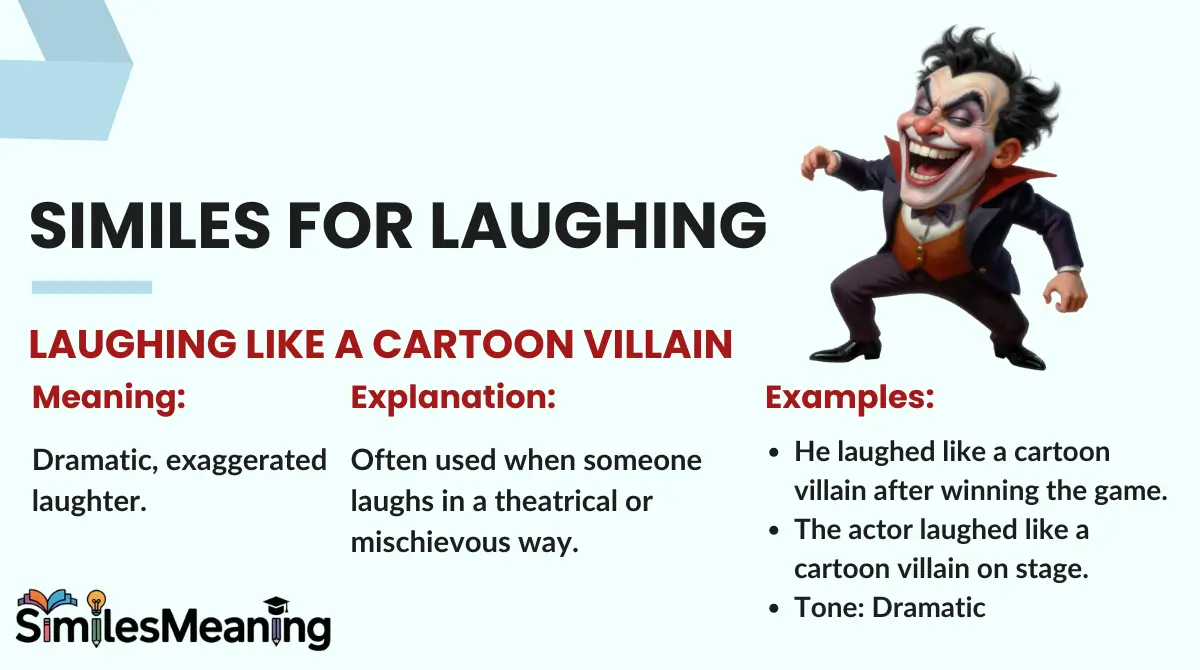
Laughing Like a Cartoon Villain
Meaning: Dramatic, exaggerated laughter.
Often used when someone laughs in a theatrical or mischievous way.
Examples
- He laughed like a cartoon villain after winning the game.
- The actor laughed like a cartoon villain on stage.
Tone: Dramatic
Laughing Like Soda Fizzing
Meaning: Light, bubbly laughter.
This simile compares laughter to the soft fizz of soda.
Examples
- Her laugh bubbled like soda fizzing in a glass.
- The girl’s laughter fizzed like fresh soda.
Tone: Playful
Joyful & Cheerful Similes
Laughing Like Bells Ringing
Meaning: Clear, happy laughter.
Bells create a bright and cheerful sound, just like joyful laughter.
Examples
- Her laughter rang like silver bells.
- The child laughed like bells ringing on a holiday morning.
Tone: Cheerful
Laughing Like a Child at a Circus
Meaning: Pure and excited laughter.
This simile shows innocent joy and excitement.
Examples
- He laughed like a child at a circus when the magician appeared.
- She laughed like a child seeing fireworks.
Tone: Joyful
Laughing Like Birds Chirping
Meaning: Light, happy laughter.
Birds chirping represent happiness and energy.
Examples
- The girls laughed like birds chirping in the morning.
- Their laughter sounded like cheerful birds in spring.
Tone: Casual
Laughing Like Sunshine Breaking Through Clouds
Meaning: Warm and uplifting laughter.
This simile shows laughter that brightens the mood.
Examples
- Her laughter burst like sunshine through clouds.
- His laugh spread like sunlight after rain.
Tone: Poetic
Dramatic & Intense Similes
Laughing Like Thunder Rolling
Meaning: Deep, booming laughter.
This simile compares laughter to the powerful rumble of thunder.
Examples
- He laughed like thunder rolling across the sky.
- The giant man laughed like distant thunder.
Tone: Dramatic
Laughing Like a Storm Breaking
Meaning: Sudden, powerful laughter.
This simile suggests laughter that explodes suddenly.
Examples
- Their laughter burst like a storm breaking.
- He laughed like thunder after lightning.
Tone: Intense
Laughing Like a Cracking Fire
Meaning: Strong, energetic laughter.
Like logs snapping in a fireplace.
Examples
- The old man laughed like a crackling fire.
- Her laughter snapped like firewood in flames.
Tone: Dramatic
Laughing Like a Roaring Engine
Meaning: Loud, unstoppable laughter.
This simile emphasizes power and volume.
Examples
- He laughed like a roaring engine.
- The crowd laughed like engines revving together.
Tone: Strong
Gentle & Soft Similes
Laughing Like a Bubbling Brook
Meaning: Soft, pleasant laughter.
A brook makes a gentle, flowing sound.
Examples
- Her laugh flowed like a bubbling brook.
- The girl laughed like water dancing over stones.
Tone: Poetic
Laughing Like Wind Chimes
Meaning: Light, delicate laughter.
Wind chimes make soft musical sounds.
Examples
- She laughed like wind chimes in the breeze.
- The baby’s laughter sounded like tiny chimes.
Tone: Gentle
Laughing Like Feathers Floating
Meaning: Quiet and soft laughter.
Feathers move lightly in the air.
Examples
- He laughed like feathers drifting in the wind.
- Her laughter floated like feathers in the air.
Tone: Soft
Creative & Unique Similes
Laughing Like Bubbles Rising
Meaning: Happy laughter that keeps coming.
Bubbles rise again and again in water.
Examples
- Her laughter rose like bubbles in sparkling water.
- The children laughed like bubbles floating upward.
Tone: Creative
Laughing Like Fireworks Popping
Meaning: Exciting bursts of laughter.
This simile shows lively energy.
Examples
- Their laughter exploded like fireworks popping.
- The crowd laughed like fireworks on New Year’s Eve.
Tone: Excited
Laughing Like Marbles Rolling on a Table
Meaning: Rapid, scattered laughter.
Marbles rolling create a quick, clattering sound.
Examples
- The boys laughed like marbles rolling on wood.
- Her giggles scattered like marbles across a table.
Tone: Unique
Laughing Like Rain Tapping on a Window
Meaning: Gentle, repeating laughter.
Raindrops tap rhythmically on glass.
Examples
- She laughed like rain tapping on the window.
- Their giggles sounded like raindrops on glass.
Tone: Calm
Poetic & Literary Similes
Laughing Like Spring Water
Meaning: Fresh, lively laughter.
Spring water represents purity and life.
Examples
- Her laughter flowed like fresh spring water.
- The girl laughed like water from a mountain spring.
Tone: Poetic
Laughing Like Music in the Air
Meaning: Pleasant and harmonious laughter.
Music makes environments feel joyful.
Examples
- His laughter floated like music in the air.
- The children laughed like a cheerful melody.
Tone: Literary
Laughing Like Stars Twinkling
Meaning: Bright, sparkling laughter.
Stars shine softly in the night sky.
Examples
- She laughed like stars twinkling above.
- Their laughter sparkled like stars at midnight.
Tone: Poetic
Fresh and Unique Similes You Won’t Hear Every Day
Here are five original similes designed to spark creativity.
Laughing like a kettle about to whistle
This image suggests laughter building up and bursting out suddenly.
Laughing like puzzle pieces clicking together
This shows laughter that feels satisfying and natural.
Laughing like a bicycle bell on a sunny street
This describes cheerful, bright laughter.
Laughing like leaves shaking in a playful wind
A soft but lively type of laughter.
Laughing like a campfire waking up at night
Warm laughter that spreads around a group.
How to Use These Similes in Writing
In Stories
Similes help bring characters to life.
Instead of writing:
He laughed loudly.
You could write:
He laughed like thunder rolling across the hills.
This makes the scene more vivid.
In Essays
Similes can make essays more engaging.
Example:
The classroom erupted with laughter like popcorn popping.
This helps readers picture the moment.
How to Create Your Own Similes (Mini Writing Guide)
Creating similes is easier than it looks.
Step-by-Step Method
- Think about the feeling or sound of the laughter.
- Imagine something that sounds or behaves the same way.
- Connect them using like or as.
5 Practical Tips
- Use everyday images readers understand.
- Avoid overused comparisons.
- Match the tone of your writing.
- Keep the comparison simple.
- Read it aloud to test the rhythm.
Transformation Examples
Plain sentence:
She laughed loudly.
Improved versions:
- She laughed like thunder crashing.
- She laughed like fireworks bursting.
- She laughed like a kettle whistling.
Common Mistakes When Using Similes
Overusing Similes
Too many similes can make writing messy.
Use them sparingly for impact.
Using Clichés
Examples like “laughing like a hyena” are common.
Mix them with creative ones.
Tone Mismatch
Serious scenes should not include silly comparisons.
Example:
❌ The hero laughed like a tickled monkey at the funeral.
Practice Exercise
Fill in the blanks with the best simile.
- She laughed like ______ ringing.
- The kids laughed like ______ popping.
- His laughter rolled like ______.
- The baby laughed like ______ chiming.
- The crowd laughed like ______ exploding.
- Her laugh flowed like ______.
- The boys laughed like ______ rolling.
- She giggled like ______ fizzing.
- His laugh burst like ______ breaking.
- The class laughed like ______ chirping.
- The old man laughed like ______ fire.
- Her laughter sparkled like ______.
Answers
- bells
- popcorn
- thunder
- wind chimes
- fireworks
- a bubbling brook
- marbles
- soda
- a storm
- birds
- a crackling
- stars
FAQs
What is a simile for laughing loudly?
A good simile is “laughing like thunder rolling.” It describes deep, booming laughter.
What is a funny simile for laughing?
“Laughing like a tickled monkey” is a playful and humorous simile.
What is a gentle simile for laughter?
“Laughing like wind chimes in the breeze” describes soft and delicate laughter.
Why do writers use similes?
Similes make writing more vivid by helping readers imagine sounds, emotions, and actions clearly.
Can similes improve storytelling?
Yes. Similes make scenes more colorful and help readers feel the emotion of the moment.
How many similes should be used in writing?
Use them sparingly. One strong simile can be more powerful than several weak ones.
Final Thoughts
Laughter is powerful. It shows joy, humor, surprise, and connection.
Using similes helps writers capture those emotions in a vivid and memorable way. Instead of simple descriptions, you can create lively images that readers instantly understand.
With the 25+ similes for laughing in this guide, you now have a wide range of comparisons—from playful and funny to poetic and dramatic.
Try mixing these similes into stories, essays, and creative writing. Even better, use the techniques in this guide to invent your own.
The more imaginative your comparisons become, the more alive your writing will feel.

Calvin Merrick is an English language educator and content writer dedicated to making similes and meanings simple, clear, and easy to understand for students worldwide.