Music is powerful. A single melody can lift your mood, bring tears to your eyes, or make your feet move without thinking. But when we try to describe music in writing, words can feel too small.
That’s where similes help.
Similes compare one thing to another using words like “like” or “as.” They paint a picture in the reader’s mind.
Instead of simply saying music sounds beautiful, you can say it flows like a gentle river or bursts like fireworks in the night sky.
In this guide, you’ll discover 26+ creative similes for music that make descriptions vivid and memorable. You’ll also learn how to use them in essays, stories, and everyday writing.
By the end, you’ll have a toolkit of similes that help your writing sound as alive and expressive as the music you’re describing.
What Is a Simile? (Quick Clear Definition)
A simile is a figure of speech that compares two different things using “like” or “as.”
It helps readers imagine something more clearly.
Example:
Her voice was like a soft violin in the quiet room.
Quick List – Most Popular Similes for “Music”
- Sweet like a nightingale’s song
- Smooth like flowing water
- Loud like thunder in the sky
- Soft like a whisper in the wind
- Bright like bells on a winter morning
- Wild like a storm at sea
- Joyful like children laughing
- Gentle like rain on leaves
- Clear like crystal chimes
- Deep like the ocean at night
Complete List of Similes for “Music” (Grouped by Meaning)
Funny & Lighthearted Similes for Music
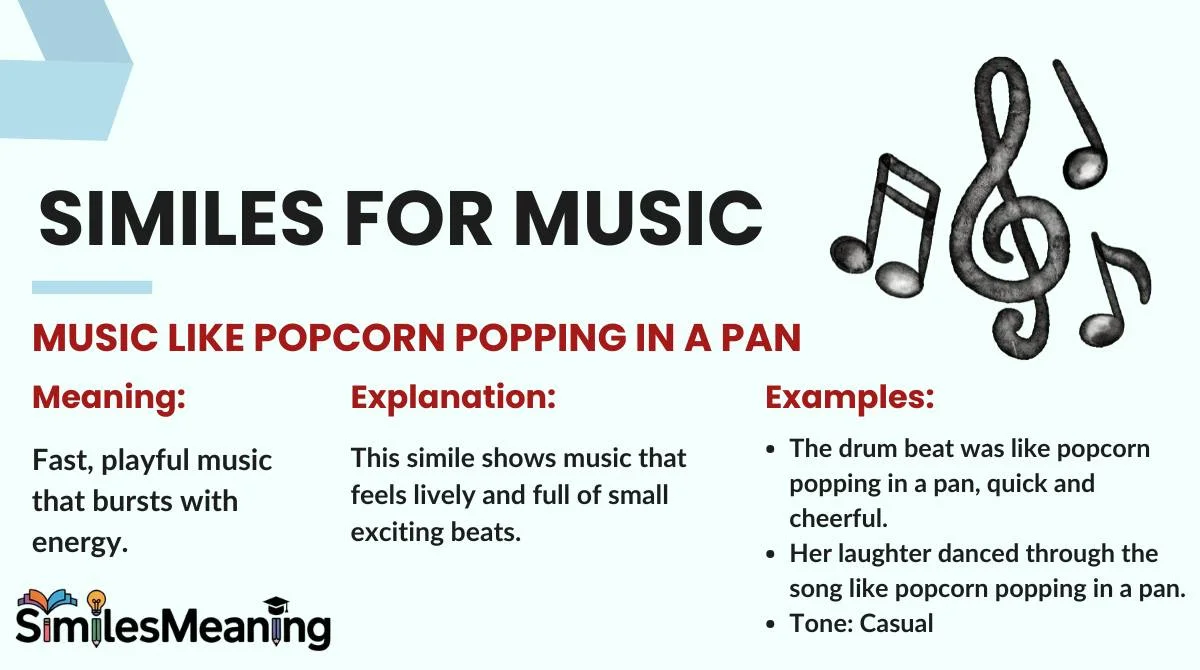
Music like popcorn popping in a pan
Meaning: Fast, playful music that bursts with energy.
This simile shows music that feels lively and full of small exciting beats.
Example sentences:
The drum beat was like popcorn popping in a pan, quick and cheerful.
Her laughter danced through the song like popcorn popping in a pan.
Tone: Casual
Music like bubbles rising in soda
Meaning: Light, sparkling music.
The sound feels playful and fizzy, just like bubbles moving upward.
Example sentences:
The piano notes floated like bubbles rising in soda.
The cheerful tune bounced like bubbles rising in soda.
Tone: Casual
Music like a puppy wagging its tail
Meaning: Happy, excited music.
This simile gives the feeling of pure joy and energy.
Example sentences:
The upbeat guitar riff bounced like a puppy wagging its tail.
The children clapped as the song danced like a puppy wagging its tail.
Tone: Funny
Music like marbles rolling across the floor
Meaning: Quick, scattered notes.
It suggests playful, uneven sounds moving in many directions.
Example sentences:
The piano keys clicked like marbles rolling across the floor.
The melody skipped like marbles rolling across the floor.
Tone: Casual
Emotional & Deep Similes for Music
Music like a warm hug on a cold day
Meaning: Comforting and soothing music.
It makes listeners feel safe and calm.
Example sentences:
Her voice wrapped around the room like a warm hug on a cold day.
The slow song felt like a warm hug on a cold day.
Tone: Emotional
Music like tears falling quietly
Meaning: Sad and emotional music.
This simile expresses soft sadness.
Example sentences:
The violin cried like tears falling quietly.
The melody drifted like tears falling quietly in the dark.
Tone: Serious
Music like memories drifting through the mind
Meaning: Music that brings nostalgia.
It reminds listeners of the past.
Example sentences:
The old tune floated like memories drifting through the mind.
The piano echoed like memories drifting through the mind.
Tone: Poetic
Music like a heartbeat in the dark
Meaning: Deep, emotional rhythm.
It feels personal and powerful.
Example sentences:
The bass pulsed like a heartbeat in the dark.
The rhythm thumped like a heartbeat in the dark.
Tone: Serious
Dramatic & Intense Similes for Music
Music like thunder rolling across the sky
Meaning: Loud, powerful music.
It shows strength and dramatic sound.
Example sentences:
The drums roared like thunder rolling across the sky.
The orchestra rose like thunder rolling across the sky.
Tone: Dramatic
Music like waves crashing on rocks
Meaning: Strong, rhythmic music.
It suggests repeated power and intensity.
Example sentences:
The heavy beat struck like waves crashing on rocks.
The guitar blasted like waves crashing on rocks.
Tone: Serious
Music like fire racing through dry grass
Meaning: Fast, explosive music.
This simile suggests speed and intensity.
Example sentences:
The violin ran like fire racing through dry grass.
The band played like fire racing through dry grass.
Tone: Dramatic
Music like fireworks bursting in the sky
Meaning: Bright and exciting music.
It shows sudden bursts of sound and color.
Example sentences:
The chorus exploded like fireworks bursting in the sky.
The trumpet rang like fireworks bursting in the sky.
Tone: Energetic
Slow & Gentle Similes for Music
Music like rain falling on leaves
Meaning: Soft, calming music.
It feels peaceful and natural.
Example sentences:
The harp sounded like rain falling on leaves.
The gentle tune drifted like rain falling on leaves.
Tone: Calm
Music like a quiet river flowing
Meaning: Smooth, continuous music.
It suggests steady movement.
Example sentences:
The melody flowed like a quiet river.
Her voice moved like a quiet river flowing.
Tone: Peaceful
Music like wind through tall grass
Meaning: Soft, whispering music.
It gives a peaceful countryside feeling.
Example sentences:
The flute whispered like wind through tall grass.
The tune moved like wind through tall grass.
Tone: Poetic
Music like clouds drifting across the sky
Meaning: Slow and relaxing music.
It shows gentle movement and calm.
Example sentences:
The notes floated like clouds drifting across the sky.
The calm melody drifted like clouds drifting across the sky.
Tone: Relaxed
Creative & Unique Similes for Music
Music like stars blinking in the night
Meaning: Light notes appearing one by one.
It suggests delicate beauty.
Example sentences:
The piano notes sparkled like stars blinking in the night.
The soft tune appeared like stars blinking in the night.
Tone: Poetic
Music like lanterns glowing in fog
Meaning: Soft sounds shining through silence.
It suggests warmth and mystery.
Example sentences:
The violin glowed like lanterns glowing in fog.
The melody shone like lanterns glowing in fog.
Tone: Literary
Music like feathers floating on air
Meaning: Extremely light music.
It shows softness and grace.
Example sentences:
The harp floated like feathers on air.
The gentle notes drifted like feathers floating on air.
Tone: Calm
Music like a silver thread weaving through silence
Meaning: Smooth and elegant music.
This simile highlights graceful movement.
Example sentences:
The flute moved like a silver thread weaving through silence.
The melody flowed like a silver thread weaving through silence.
Tone: Poetic
Poetic & Literary Similes for Music
Music like moonlight spilling across water
Meaning: Beautiful, dreamy music.
It suggests quiet magic.
Example sentences:
The piano spread like moonlight spilling across water.
The song shimmered like moonlight spilling across water.
Tone: Poetic
Music like a bird gliding across the sky
Meaning: Smooth and effortless music.
It expresses freedom.
Example sentences:
Her voice soared like a bird gliding across the sky.
The melody rose like a bird gliding across the sky.
Tone: Poetic
Music like a story whispered by the wind
Meaning: Gentle and mysterious music.
It suggests imagination and depth.
Example sentences:
The flute sounded like a story whispered by the wind.
The quiet tune drifted like a story whispered by the wind.
Tone: Literary
Music like morning sunlight through a window
Meaning: Bright, hopeful music.
It brings a feeling of freshness.
Example sentences:
The cheerful tune shone like morning sunlight through a window.
The chorus spread like morning sunlight through a window.
Tone: Positive
Fresh and Unique Similes You Won’t Hear Every Day
Here are five original similes that add creative flair to your writing.
Music like snowflakes landing on still water
Soft notes touching silence gently.
Music like fireflies dancing over a summer field
Tiny glowing sounds appearing and fading.
Music like paint spreading across a blank canvas
Layers of sound building slowly.
Music like footsteps echoing in a quiet hall
Clear notes bouncing through silence.
Music like a secret drifting through the air
Soft sounds carrying mystery.
Each simile creates strong imagery that helps readers feel the music.
How to Use These Similes in Writing
Similes make writing more vivid and expressive.
In Essays
Use similes when describing songs, instruments, or performances.
Example:
The violin sounded like rain falling on leaves, soft and calming.
This helps readers imagine the sound.
In Stories
Similes help build atmosphere and emotion.
Example:
The piano echoed through the empty hall like memories drifting through the mind.
Now the scene feels deeper and more emotional.
How to Create Your Own Similes (Mini Writing Guide)
You can create strong similes in three simple steps.
Step 1: Identify the feeling
Ask yourself:
Is the music happy, sad, loud, soft, or mysterious?
Step 2: Think of something similar
Find an object or experience with the same feeling.
Example:
Soft → rain
Loud → thunder
Step 3: Connect them with “like” or “as”
Example:
The music was like rain on a quiet lake.
5 Practical Tips
- Focus on sound, feeling, or movement
- Use nature comparisons for vivid imagery
- Keep similes simple and clear
- Avoid very common clichés
- Match the simile with the tone of the scene
3 Transformation Examples
Plain sentence:
The music was beautiful.
Improved:
The music shimmered like moonlight on water.
Plain sentence:
The drums were loud.
Improved:
The drums crashed like thunder across the sky.
Plain sentence:
The melody was soft.
Improved:
The melody floated like feathers on the wind.
Common Mistakes When Using Similes
Overusing Similes
Too many comparisons can overwhelm readers.
Use them sparingly for stronger impact.
Using Clichés
Examples like “sweet as honey” are overused.
Try more creative comparisons.
Tone Mismatch
Funny similes may ruin a serious scene.
Example mistake:
Comparing sad music to popcorn popping.
Always match the mood of the writing.
Practice Exercise
Fill in the blanks with suitable similes.
- The violin cried like ______
- The drum beat rolled like ______
- The piano notes sparkled like ______
- The flute whispered like ______
- The melody flowed like ______
- The chorus burst like ______
- The harp sounded like ______
- The rhythm thumped like ______
- The tune drifted like ______
- The music glowed like ______
- The song spread like ______
- The notes floated like ______
Answers
- tears falling quietly
- thunder in the sky
- stars in the night
- wind through tall grass
- a quiet river
- fireworks in the sky
- rain on leaves
- a heartbeat in the dark
- clouds across the sky
- lanterns in fog
- morning sunlight
- feathers in the air
FAQs
What are similes for music?
Similes for music are comparisons that describe music using “like” or “as.” They help readers imagine how music sounds or feels.
Why are similes useful in writing?
Similes make writing more vivid and emotional. They help readers picture sounds, feelings, and scenes more clearly.
Can similes describe different types of music?
Yes. Similes can describe loud music, soft music, happy music, sad music, or dramatic music.
Are similes good for storytelling?
Yes. Similes help create strong imagery, which makes stories more engaging.
How many similes should I use in writing?
Use them occasionally. Too many can make writing feel crowded.
What is the difference between a simile and a metaphor?
A simile uses “like” or “as.”
A metaphor compares things directly without those words.
Example:
Simile → The music was like rain.
Metaphor → The music was rain.
Final Thoughts
Music is one of the most emotional experiences humans share. Yet describing it in words can feel challenging.
That’s why similes are so helpful.
They turn simple descriptions into vivid images—music can become thunder in the sky, moonlight on water, or feathers drifting in the wind.
With the 26+ similes in this guide, you now have a creative toolkit to make your writing more expressive, engaging, and memorable.
Next time you hear a beautiful melody, try describing it with a simile. You may discover that words can sing just as beautifully as music.

Calvin Merrick is an English language educator and content writer dedicated to making similes and meanings simple, clear, and easy to understand for students worldwide.