Trees are more than wood and leaves. They are quiet giants, breathing life into the world, standing like old guardians, watching seasons come and go.
Writers use similes to paint pictures with words—comparing one thing to another using “like” or “as.” A good simile makes ideas clearer, emotions stronger, and stories more alive.
If you want your writing to sparkle, learning similes for trees is a fantastic place to start. Imagine saying: The tree stood like an old soldier, or Its branches stretched like tired arms.
These comparisons help readers see and feel what you mean.
In this guide, you will discover 26+ creative similes for trees, grouped by meaning, with explanations and examples.
You will also learn how to create your own similes and use them in essays, stories, and everyday writing. Let’s grow your vocabulary—one branch at a time.
What Is a Simile? (Quick Clear Definition)
A simile is a comparison between two different things using like or as.
Example:
- The tree stood like a giant umbrella.
This helps readers imagine the shape and feeling of the tree.
Similes are powerful because they:
- Make writing vivid
- Explain ideas simply
- Add emotion and creativity
Quick List – Most Popular Similes for Trees
- The tree stood like a giant.
- The branches stretched like arms.
- It was as tall as a skyscraper.
- The leaves danced like tiny flags.
- The trunk was as strong as steel.
- It stood like an old guardian.
- The tree swayed like a sleepy dancer.
- Its roots clutched the earth like fingers.
- The bark was rough like aged skin.
- It towered like a silent monument.
Complete List of Similes for Trees (Grouped by Meaning)
Funny & Lighthearted
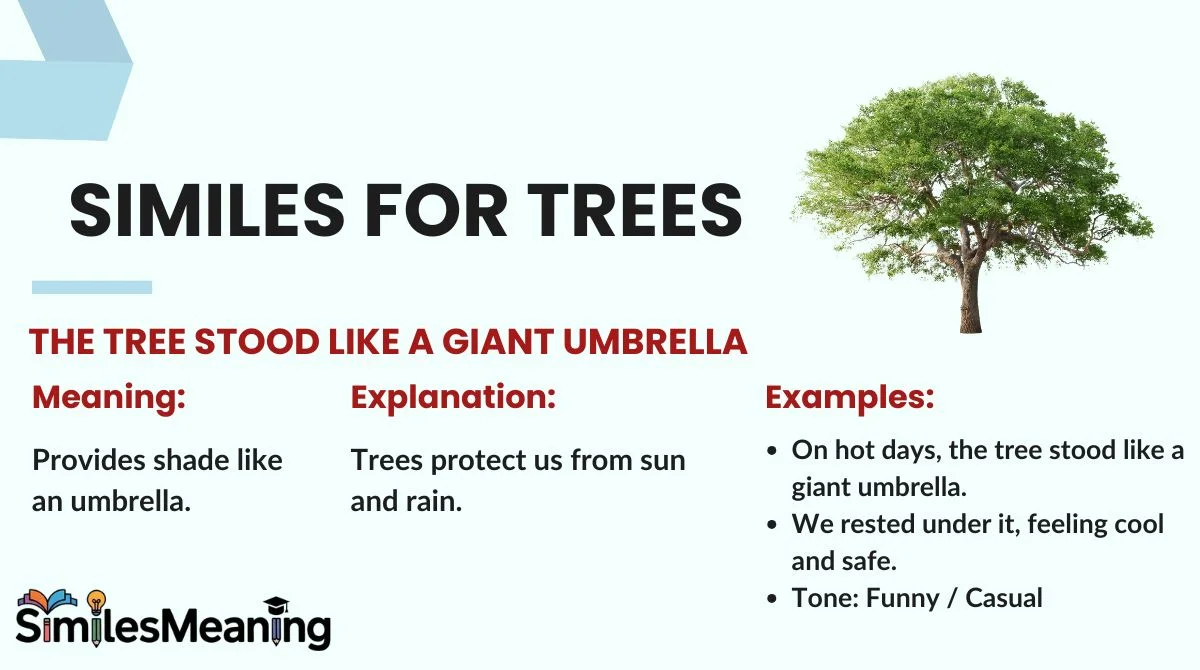
The tree stood like a giant umbrella
Meaning: Provides shade like an umbrella.
Explanation: Trees protect us from sun and rain.
Examples:
- On hot days, the tree stood like a giant umbrella.
- We rested under it, feeling cool and safe.
Tone: Funny / Casual
The branches waved like excited hands
Meaning: Moving in the wind.
Explanation: Branches look like hands saying hello.
Examples:
- The branches waved like excited hands in the breeze.
- It seemed to greet us as we walked by.
Tone: Lighthearted
The tree stood like a sleepy giant
Meaning: Quiet and unmoving.
Explanation: Giants in stories are big and calm.
Examples:
- The tree stood like a sleepy giant all afternoon.
- Nothing disturbed its peaceful rest.
Tone: Playful
Emotional & Deep
The tree stood like an old friend
Meaning: Familiar and comforting.
Explanation: Trees can feel like companions.
Examples:
- The tree stood like an old friend, always waiting.
- I visited it often, feeling safe near its shade.
Tone: Emotional
Its branches reached like hopeful hands
Meaning: Searching or longing.
Explanation: Hands reaching symbolize hope.
Examples:
- The branches reached like hopeful hands toward the sky.
- It looked as if the tree wished to touch the clouds.
Tone: Poetic
The tree stood like a memory
Meaning: Something from the past.
Explanation: Memories stay with us, like trees standing for years.
Examples:
- The tree stood like a memory of childhood.
- I remembered playing beneath it long ago.
Tone: Deep
Dramatic & Intense
The tree stood like a silent soldier
Meaning: Strong and enduring.
Explanation: Soldiers are brave and steady.
Examples:
- The tree stood like a silent soldier through storms.
- It never bent, even in heavy winds.
Tone: Dramatic
The trunk was as strong as steel
Meaning: Very tough and unbreakable.
Explanation: Steel is strong and durable.
Examples:
- The trunk was as strong as steel, resisting time.
- No storm could break its mighty foundation.
Tone: Intense
It towered like a monument
Meaning: Large and impressive.
Explanation: Monuments are built to last.
Examples:
- It towered like a monument over the field.
- People admired its greatness from afar.
Tone: Formal
Slow & Monotonous
The tree stood like a patient watcher
Meaning: Waiting quietly.
Explanation: Trees seem to watch the world.
Examples:
- The tree stood like a patient watcher all day.
- Nothing hurried it; time moved slowly.
Tone: Calm
The leaves moved like slow dancers
Meaning: Gentle, rhythmic movement.
Explanation: Dancers move gracefully.
Examples:
- The leaves moved like slow dancers in the breeze.
- Their motions were soft and relaxing.
Tone: Poetic
It stood like an old clock
Meaning: Steady and unchanging.
Explanation: Clocks mark time.
Examples:
- It stood like an old clock, ticking seasons away.
- Years passed, but the tree remained.
Tone: Reflective
Creative & Unique
The tree stood like a living cathedral
Meaning: Sacred and majestic.
Explanation: Cathedrals are grand and inspiring.
Examples:
- The tree stood like a living cathedral, full of quiet awe.
- Sunlight filtered through its branches like stained glass.
Tone: Poetic
Its roots clutched the earth like secrets
Meaning: Deep and hidden.
Explanation: Secrets stay buried.
Examples:
- Its roots clutched the earth like secrets no one could see.
- They held the tree in place for centuries.
Tone: Mysterious
The branches stretched like roads
Meaning: Pathways in nature.
Explanation: Roads lead to destinations.
Examples:
- The branches stretched like roads toward the sky.
- Birds traveled along them like tiny explorers.
Tone: Creative
Fresh and Less Common Similes
The tree stood like a silent library
Meaning: Quiet and full of knowledge.
Explanation: Libraries are places of wisdom.
Examples:
- The tree stood like a silent library of nature.
- Its rings told stories of past years.
Tone: Unique
It swayed like a dreaming sailor
Meaning: Gentle movement.
Explanation: Sailors on ships sway with waves.
Examples:
- It swayed like a dreaming sailor on the sea of wind.
- The motion was calming and peaceful.
Tone: Poetic
The bark was like aged leather
Meaning: Tough and textured.
Explanation: Leather becomes worn with time.
Examples:
- The bark was like aged leather, rough but strong.
- It showed the marks of many seasons.
Tone: Descriptive
Fresh and Unique Similes You Won’t Hear Every Day
Here are five original similes that bring new imagery to tree descriptions:
- The tree stood like a storyteller
Explanation: Trees witness history, like storytellers.
Example: It seemed to whisper tales of old days. - Its branches reached like unspoken dreams
Explanation: Dreams are hopeful and distant.
Example: The branches stretched toward possibilities. - The tree stood like a quiet lighthouse
Explanation: Lighthouses guide and protect.
Example: It guided travelers with its presence. - The leaves fluttered like tiny messages
Explanation: Messages carry meaning.
Example: The wind seemed to deliver secrets. - The trunk stood like a pillar of time
Explanation: Pillars support structures.
Example: It reminded us that time keeps moving.
How to Use These Similes in Writing
Similes work best when they:
- Match the mood of your story
- Add clarity and emotion
- Avoid overuse
Where you can use them:
- Essays
- Stories
- Descriptions
- Poems
- Everyday writing
Example in an essay:
- The tree stood like a silent guardian, providing shade and shelter.
Example in a story:
- She rested under the tree, which stood like an old friend.
How to Create Your Own Similes (Mini Writing Guide)
Step 1: Choose What You Want to Describe
Is it tall, strong, quiet, or old?
Step 2: Think of Something Similar
Compare it to something readers understand.
Step 3: Use “Like” or “As”
- The tree is tall → The tree is as tall as a building.
- The branches move → The branches move like dancers.
Step 4: Keep It Simple
Good similes are clear, not confusing.
Step 5: Practice
Examples:
- The tree is strong → The tree is as strong as a mountain.
- The leaves move → The leaves move like tiny flags.
Common Mistakes When Using Similes
Overuse
Too many similes can feel crowded.
- Bad: The tree stood like a giant, like a soldier, like a friend.
- Good: The tree stood like a silent guardian.
Clichés
Avoid overused comparisons.
- Cliché: As strong as an ox.
- Better: As strong as old steel.
Tone Mismatch
Match similes to your writing style.
- Serious writing → Poetic or formal similes.
- Casual writing → Simple comparisons.
Practice Exercise
Fill in the blanks:
- The tree stood like ______.
- Its branches moved like ______.
- The trunk was as strong as ______.
- It felt like ______.
- The leaves danced like ______.
- The tree watched like ______.
- Its roots clutched the earth like ______.
- It stood as tall as ______.
- The bark was like ______.
- The wind moved it like ______.
- The tree seemed like ______.
- It provided shade like ______.
Answers (example ideas):
- a guardian
- dancers
- steel
- an old friend
- tiny flags
- a watcher
- fingers
- a building
- aged leather
- a gentle wave
- a memory
- an umbrella
FAQs
What is a simile?
A comparison using like or as.
Why are similes important?
They make writing vivid and understandable.
Can I use similes in essays?
Yes, but keep them relevant and not excessive.
What is a good tree simile?
The tree stood like a silent guardian.
How many similes should I use?
A few strong ones are better than many weak ones.
Are similes the same as metaphors?
No. Similes use like or as; metaphors do not.
Final Thoughts
Trees inspire writers because they represent strength, growth, and time. Similes help us describe them in creative ways.
Whether you write essays, stories, or poems, these comparisons can make your words more powerful.
Use the similes in this guide, practice creating your own, and watch your writing grow—just like a tree reaching toward the sky.

Calvin Merrick is an English language educator and content writer dedicated to making similes and meanings simple, clear, and easy to understand for students worldwide.