Snow has a special way of making the world feel calm, magical, and bright. Writers often try to capture that feeling with vivid descriptions. One of the easiest and most powerful tools for doing that is a simile.
Similes help readers picture a scene clearly by comparing one thing to another using words like “like” or “as.” Instead of simply saying “the snow was soft,” a writer might say, “the snow was as soft as cotton.” Instantly, the reader can imagine the texture.
Because snow appears in stories, poems, essays, and holiday writing, having a strong collection of snow similes can make your writing stand out.
Whether you’re writing a winter story, a poem, or a school essay, the right comparison can bring your scene to life.
In this guide, you’ll discover 23+ powerful snow similes, learn how to use them effectively, and even learn how to create your own.
What Is a Simile? (Quick Clear Definition)
A simile is a comparison between two different things using the words like or as.
Writers use similes to help readers imagine something more clearly.
Example:
The snow was as white as milk.
Quick List – Most Popular Similes for “Snow”
- As white as snow
- As soft as cotton
- Falling like feathers
- Quiet as fresh snow
- Cold as snow in winter
- Sparkling like diamonds
- Light as powdered sugar
- Soft as a cloud
- Bright as moonlit snow
- Thick as a winter blanket
Complete List of Similes for “Snow” (Grouped by Meaning)
Funny & Lighthearted Snow Similes
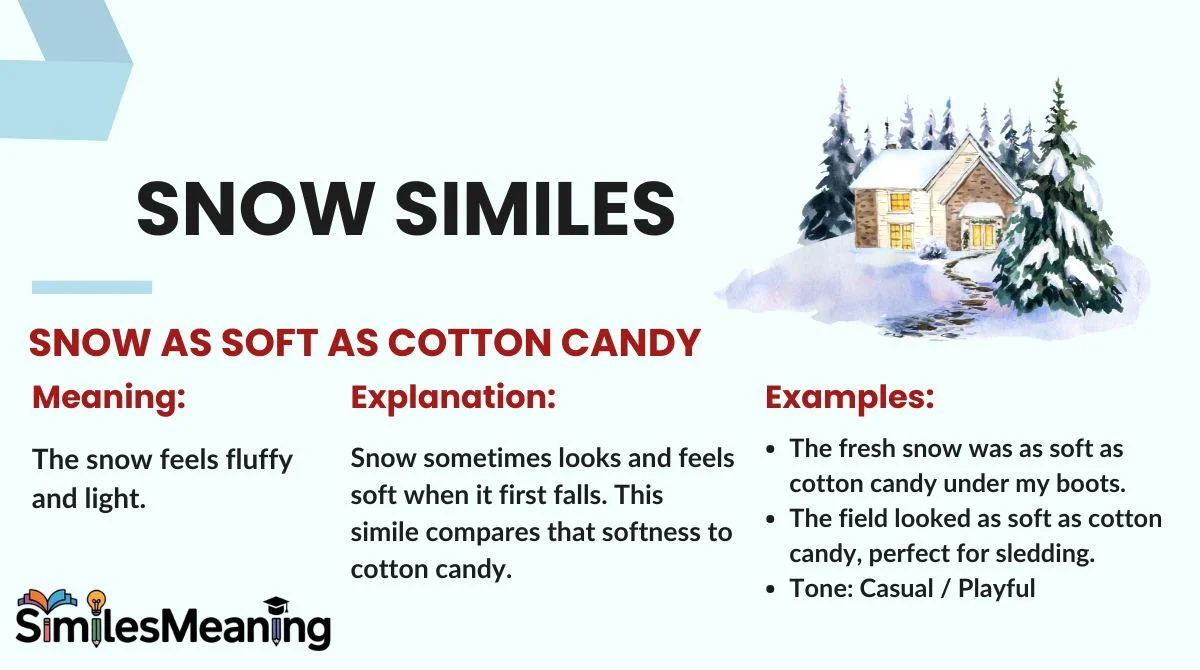
Snow as Soft as Cotton Candy
Meaning: The snow feels fluffy and light.
Snow sometimes looks and feels soft when it first falls. This simile compares that softness to cotton candy.
Example sentences:
- The fresh snow was as soft as cotton candy under my boots.
- The field looked as soft as cotton candy, perfect for sledding.
Tone: Casual / Playful
Snow Falling Like Feathers from a Pillow
Meaning: Snowflakes fall gently and slowly.
When snow drifts slowly from the sky, it can look like feathers floating down.
Example sentences:
- The flakes drifted like feathers from a pillow in the quiet air.
- Snow floated like feathers from a pillow, covering the street.
Tone: Poetic / Light
Snow Piled Up Like Whipped Cream
Meaning: Snow looks fluffy and piled high.
Fresh snow often forms soft mounds that resemble whipped cream.
Example sentences:
- The snow on the cars looked like whipped cream.
- Drifts piled up like whipped cream along the road.
Tone: Funny / Casual
Snow as Messy as Powdered Sugar on Cookies
Meaning: Snow spreads everywhere in small flakes.
This simile shows how snow scatters across surfaces.
Example sentences:
- The yard was as messy as powdered sugar on cookies after the storm.
- Snow dusted the porch like powdered sugar on cookies.
Tone: Playful
Emotional & Deep Snow Similes
Quiet as Fresh Snow at Dawn
Meaning: Extremely peaceful and silent.
Fresh snow often absorbs sound, creating deep quiet.
Example sentences:
- The forest was as quiet as fresh snow at dawn.
- Everything felt as quiet as fresh snow at dawn.
Tone: Serious / Calm
Snow Like a Gentle Blanket
Meaning: Snow covering the ground softly.
Snow often spreads evenly like a blanket covering the earth.
Example sentences:
- The snow lay like a gentle blanket over the town.
- Fields were covered like a gentle blanket of white.
Tone: Poetic
Snow as Pure as New Paper
Meaning: Completely clean and untouched.
Untouched snow can feel perfectly clean.
Example sentences:
- The field was as pure as new paper before anyone walked on it.
- The hill looked as pure as new paper after the storm.
Tone: Serious
Snow Like Quiet Thoughts
Meaning: Snow falling slowly and calmly.
This simile connects snow with peaceful thinking.
Example sentences:
- The flakes drifted like quiet thoughts across the sky.
- Snow settled like quiet thoughts on the trees.
Tone: Poetic
Dramatic & Intense Snow Similes
Snow Like a White Storm of Stars
Meaning: Snow falling quickly and brightly.
This simile shows dramatic snowfall.
Example sentences:
- The blizzard rushed like a white storm of stars.
- Snow filled the sky like a storm of stars.
Tone: Dramatic
Snow Like Shattered Glass in the Wind
Meaning: Fast, sharp snowfall during a storm.
This simile emphasizes harsh winter storms.
Example sentences:
- The wind threw snow like shattered glass.
- Snow hit the windows like shattered glass in the wind.
Tone: Intense
Snow Falling Like Paper Torn from the Sky
Meaning: Snowflakes falling heavily.
Example sentences:
- Snow fell like paper torn from the sky.
- The storm dropped flakes like paper scraps.
Tone: Dramatic
Snow Like a Frozen Wave
Meaning: Large snowdrifts that look powerful.
Example sentences:
- The drift rose like a frozen wave beside the road.
- Snowbanks curved like frozen waves.
Tone: Strong
Creative & Unique Snow Similes
Snow Like Glitter Spilled Across the World
Meaning: Snow sparkling in sunlight.
Example sentences:
- The snow sparkled like glitter spilled across the world.
- Morning light made the snow shine like glitter.
Tone: Creative
Snow Like Tiny White Butterflies
Meaning: Snowflakes moving gently in the air.
Example sentences:
- Snow fluttered like tiny white butterflies.
- Flakes drifted like butterflies over the park.
Tone: Poetic
Snow Like Silent Confetti
Meaning: Snow falling lightly during celebration-like weather.
Example sentences:
- Snow fell like silent confetti during the parade.
- Flakes floated like confetti across the street.
Tone: Fun
Snow Like Frosted Sugar on a Cake
Meaning: Snow lightly covering surfaces.
Example sentences:
- The rooftops looked like frosted sugar on a cake.
- Snow dusted the hill like sugar frosting.
Tone: Casual
Poetic & Literary Snow Similes
Snow as White as Moonlight
Meaning: Bright and glowing snow.
Example sentences:
- The snow was as white as moonlight in the dark forest.
- The path glowed as white as moonlight.
Tone: Poetic
Snow Like Silver Dust
Meaning: Snow shining softly.
Example sentences:
- Snow drifted like silver dust in the wind.
- The air glittered like silver dust.
Tone: Literary
Snow Like a Whisper from the Sky
Meaning: Very gentle snowfall.
Example sentences:
- Snow fell like a whisper from the sky.
- The flakes landed like whispers.
Tone: Poetic
Snow as Light as Ash
Meaning: Very light snowflakes.
Example sentences:
- The flakes were as light as ash in the breeze.
- Snow floated as light as ash.
Tone: Calm
Snow Like Crushed Pearls
Meaning: Snow sparkling brightly.
Example sentences:
- The ground shimmered like crushed pearls.
- Snow glittered like pearls under the sun.
Tone: Elegant
Fresh and Unique Similes You Won’t Hear Every Day
Here are five original creative snow similes that feel fresh and imaginative.
Snow like pages from a silent book
The snowfall looks like white pages floating quietly through the air.
Snow like stars that forgot the sky
This image suggests stars falling gently to the ground.
Snow like powdered moonlight
A poetic image showing glowing white snow.
Snow like scattered chalk dust
Great for describing thin snow blowing across roads.
Snow like a painter’s spilled white paint
This simile works well when snow covers everything suddenly.
These unique comparisons help writers create vivid winter scenes that feel new and memorable.
How to Use These Similes in Writing
In Essays
Similes can improve descriptive essays about seasons, weather, or nature.
Example:
The field looked as soft as cotton candy after the snowfall.
They make writing clearer and easier to imagine.
In Stories
Similes help set mood and atmosphere.
Example:
Snow fell like feathers from a pillow as the town fell asleep.
This helps readers picture the scene and feel the emotion.
How to Create Your Own Similes (Mini Writing Guide)
Creating your own similes is easier than most people think.
Step-by-Step Method
- Choose the subject (snow).
- Think about its qualities (white, soft, cold, quiet).
- Think of objects with the same qualities.
- Compare them using like or as.
- Read it aloud to see if it sounds natural.
5 Practical Tips
- Focus on one clear quality.
- Use everyday objects readers know.
- Avoid overused comparisons.
- Keep similes short and clear.
- Match the tone of your story.
Transformation Examples
Plain sentence:
Snow covered the road.
Improved sentence:
Snow covered the road like a soft blanket.
Plain sentence:
Snowflakes were falling.
Improved sentence:
Snowflakes were falling like feathers.
Plain sentence:
The ground was white.
Improved sentence:
The ground was as white as moonlight.
Common Mistakes When Using Similes
Overusing Similes
Too many comparisons can slow down writing.
Use them only when they improve the description.
Using Clichés Too Often
Examples like “as white as snow” are common.
Mix familiar similes with fresh ones.
Tone Mismatch
Funny similes may not fit serious stories.
Example:
A dramatic winter survival story should not include silly comparisons.
Practice Exercise
Fill in the blanks with the best simile.
- Snow fell like ______ from the sky.
- The ground was as white as ______.
- Snow drifted like ______ in the wind.
- The field looked like a soft ______.
- Snow sparkled like ______ in the sun.
- Flakes floated like ______ in the air.
- The road was covered like a ______ blanket.
- Snow glittered like ______ pearls.
- The storm blew snow like ______ glass.
- Snowflakes moved like ______ butterflies.
- The hill looked like ______ sugar on a cake.
- Snow fell like a quiet ______.
Answers
- feathers
- moonlight
- silver dust
- blanket
- diamonds / glitter
- feathers
- winter
- crushed
- shattered
- tiny white
- frosted
- whisper
FAQs
What is a simile for snow?
A simile for snow is a comparison using like or as to describe snow. Example: Snow fell like feathers.
What is the most common snow simile?
One of the most common is “as white as snow.”
Why do writers use snow similes?
They help readers visualize winter scenes and make descriptions more vivid.
Can similes be used in essays?
Yes. Similes make essays more descriptive and engaging.
How many similes should you use in writing?
Use them sparingly. Too many comparisons can distract readers.
What is a creative snow simile?
Example: Snow fell like stars that forgot the sky.
Final Thoughts
Snow is one of the most beautiful elements of winter, and similes help writers capture its magic.
Whether you’re describing a quiet snowfall, a powerful blizzard, or sparkling snow under the sun, the right comparison can make your writing vivid and memorable.
By learning these 23+ snow similes, practicing how to use them, and creating your own comparisons, you can turn simple winter descriptions into powerful imagery.
Great writing often begins with simple tools—and a well-crafted simile is one of the best.

Calvin Merrick is an English language educator and content writer dedicated to making similes and meanings simple, clear, and easy to understand for students worldwide.