Weather is something we all experience every day. A bright sunny morning can lift your mood. A stormy afternoon can make everything feel tense. But how do writers bring these feelings to life with words?
That’s where similes come in.
Similes compare one thing to another using words like “as” or “like.” They help readers see, hear, and feel the scene.
Instead of saying “it was very windy,” a writer might say “the wind howled like a hungry wolf.” Suddenly, the weather feels alive.
In this guide, you’ll discover 24+ powerful weather similes you can use in stories, essays, and creative writing. Some are classic, while others are fresh and imaginative you may not have heard before.
By the end, you will know how to:
- Use weather similes naturally
- Create your own original comparisons
- Make your writing clearer, richer, and more exciting
Let’s dive in.
What Is a Simile? (Quick Clear Definition)
A simile is a comparison between two different things using the words “like” or “as.”
It helps describe something by comparing it to something familiar.
Example:
The rain fell like tiny needles against the window.
Quick List – Most Popular Similes for “Weather”
- As bright as the morning sun
- As cold as ice in winter
- Rain like falling silver threads
- Wind howling like a wolf
- Clouds like cotton in the sky
- Thunder like a giant drum
- Fog thick like soup
- Heat like fire on the skin
- Snow falling like feathers
- Lightning like a cracked whip
Complete List of Similes for “Weather” (Grouped by Meaning)
Funny & Lighthearted Weather Similes
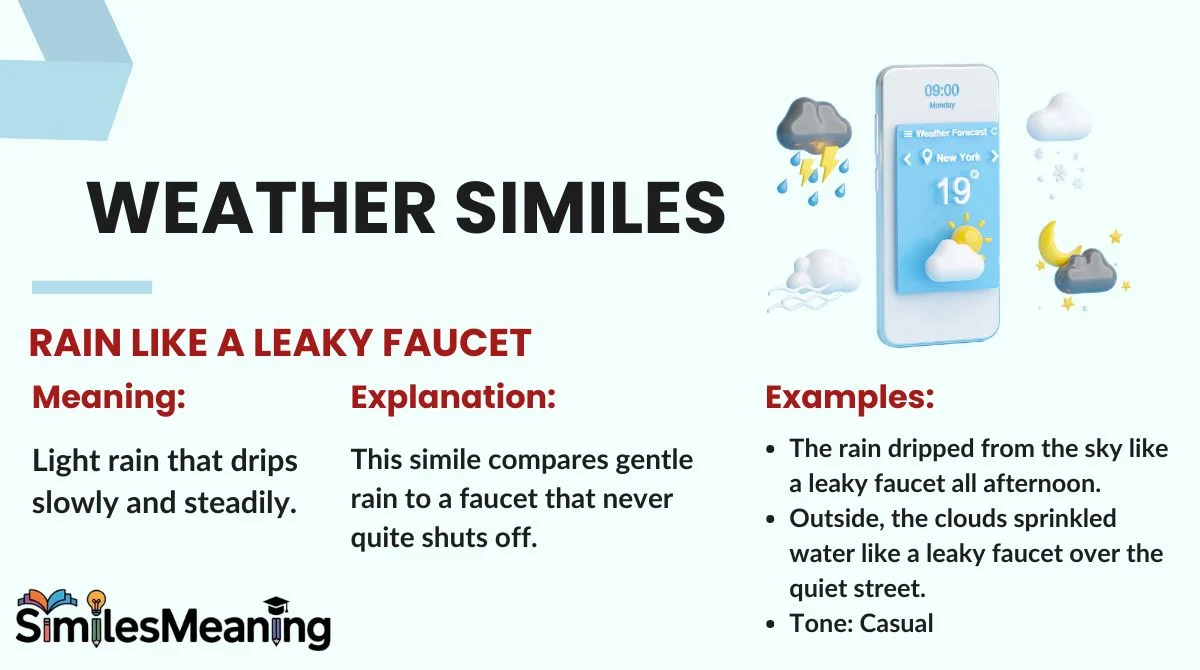
Rain Like a Leaky Faucet
Meaning: Light rain that drips slowly and steadily.
This simile compares gentle rain to a faucet that never quite shuts off.
Example sentences:
The rain dripped from the sky like a leaky faucet all afternoon.
Outside, the clouds sprinkled water like a leaky faucet over the quiet street.
Tone: Casual
Clouds Like Fluffy Marshmallows
Meaning: Soft, bright white clouds.
This simile paints clouds as soft and sweet shapes floating in the sky.
Example sentences:
The sky was full of clouds like fluffy marshmallows.
Children pointed at the clouds like marshmallows drifting in a blue bowl.
Tone: Funny
Wind Like a Playful Puppy
Meaning: A lively breeze that moves things around.
The wind is compared to a puppy that runs everywhere with excitement.
Example sentences:
The breeze jumped through the trees like a playful puppy.
Leaves danced in the wind like toys chased by a puppy.
Tone: Lighthearted
Sun Like a Smiling Face
Meaning: Bright sunshine that feels cheerful.
This simile gives the sun a friendly personality.
Example sentences:
The sun shone like a smiling face above the hills.
After days of rain, the sun appeared like a happy smile in the sky.
Tone: Casual
Emotional & Deep Weather Similes
Rain Like Quiet Tears
Meaning: Gentle rain that feels sad or emotional.
This comparison connects soft rainfall with human feelings.
Example sentences:
The rain slipped down the window like quiet tears.
Outside, the sky cried softly like tears falling in silence.
Tone: Serious
Fog Like a Lost Memory
Meaning: Thick fog that hides everything.
This simile suggests confusion and fading clarity.
Example sentences:
The fog covered the town like a lost memory.
Trees disappeared in the mist like memories fading away.
Tone: Poetic
Wind Like a Lonely Song
Meaning: A soft, sad wind.
The wind is compared to a song full of sadness.
Example sentences:
The wind moved through the valley like a lonely song.
At night, the breeze whispered like music from far away.
Tone: Poetic
Thunder Like a Warning Voice
Meaning: Loud thunder that feels serious and powerful.
Thunder is compared to a strong voice giving a warning.
Example sentences:
Thunder rolled across the sky like a warning voice.
The storm spoke loudly like a giant calling out.
Tone: Serious
Dramatic & Intense Weather Similes
Lightning Like a Cracked Whip
Meaning: Sharp, sudden lightning.
The quick flash resembles the snap of a whip.
Example sentences:
Lightning flashed like a cracked whip across the sky.
The storm lit up the clouds like a whip snapping in darkness.
Tone: Dramatic
Wind Like a Roaring Lion
Meaning: Extremely strong wind.
The wind is compared to the loud roar of a lion.
Example sentences:
The storm wind roared like a lion outside the house.
Trees bent in the wind like grass before a lion’s roar.
Tone: Dramatic
Rain Like Falling Nails
Meaning: Very heavy rain.
The rain feels sharp and forceful.
Example sentences:
Rain struck the roof like falling nails.
The storm poured down like thousands of nails hitting metal.
Tone: Intense
Thunder Like Giant Drums
Meaning: Deep, booming thunder.
Thunder sounds like massive drums in the sky.
Example sentences:
Thunder rolled like giant drums across the clouds.
The sky boomed like drums in a distant parade.
Tone: Dramatic
Slow & Monotonous Weather Similes
Drizzle Like a Slow Clock
Meaning: Rain that falls slowly and steadily.
The comparison highlights time passing slowly.
Example sentences:
Rain ticked down like a slow clock on the roof.
The drizzle continued like time moving one second at a time.
Tone: Casual
Fog Like Thick Soup
Meaning: Very dense fog.
This simile shows how hard it is to see through fog.
Example sentences:
The fog hung in the air like thick soup.
Cars moved slowly through the fog like spoons through soup.
Tone: Casual
Clouds Like Lazy Sheep
Meaning: Clouds moving slowly.
The image suggests a peaceful, slow sky.
Example sentences:
Clouds drifted like lazy sheep across the sky.
The wind pushed clouds like sheep walking through a field.
Tone: Light
Rain Like Soft Footsteps
Meaning: Very gentle rainfall.
The rain is quiet and delicate.
Example sentences:
Rain touched the ground like soft footsteps.
The drizzle arrived like someone walking quietly.
Tone: Poetic
Creative & Unique Weather Similes
Sun Like Melted Gold
Meaning: Warm, glowing sunlight.
The sunlight looks rich and bright.
Example sentences:
The sunset poured across the hills like melted gold.
Golden light spread through the sky like liquid treasure.
Tone: Poetic
Wind Like Invisible Rivers
Meaning: Air moving strongly but unseen.
The wind flows like water.
Example sentences:
The wind rushed through the valley like invisible rivers.
Leaves followed the wind like boats on hidden water.
Tone: Poetic
Snow Like Whispering Feathers
Meaning: Very soft snowfall.
The snow falls quietly and lightly.
Example sentences:
Snow drifted down like whispering feathers.
The night filled with snow like feathers falling from the sky.
Tone: Poetic
Heat Like an Open Oven
Meaning: Intense heat.
The air feels hot enough to cook.
Example sentences:
The afternoon heat felt like an open oven.
Walking outside was like standing beside a giant oven.
Tone: Casual
Poetic & Literary Weather Similes
Sunrise Like a Painted Sky
Meaning: A colorful sunrise.
The sky looks like artwork.
Example sentences:
The sunrise spread like paint across the sky.
Morning arrived like an artist coloring the horizon.
Tone: Poetic
Storm Like a Furious Ocean
Meaning: A wild storm.
The storm is as powerful as the sea.
Example sentences:
The storm raged like a furious ocean above us.
Clouds crashed together like waves in a stormy sea.
Tone: Dramatic
Night Sky Like Black Velvet
Meaning: A deep dark sky.
This simile shows richness and beauty.
Example sentences:
Stars sparkled on the sky like jewels on black velvet.
The night stretched above like smooth velvet cloth.
Tone: Poetic
Sunlight Like Liquid Honey
Meaning: Warm golden sunlight.
This simile shows thick glowing light.
Example sentences:
Sunlight poured through the trees like liquid honey.
Golden light spread across the field like sweet honey flowing.
Tone: Poetic
Fresh and Unique Similes You Won’t Hear Every Day
Here are five completely original weather similes.
1. The fog crept in like a shy ghost.
Imagery: Quiet, slow, and mysterious.
2. Rain scattered like handfuls of tiny beads.
Imagery: Small drops bouncing everywhere.
3. Lightning tore the sky like ripped paper.
Imagery: Sharp and sudden flashes.
4. The wind slipped through the streets like a secret.
Imagery: Quiet but noticeable movement.
5. Snow covered the town like a soft blanket of silence.
Imagery: Peaceful stillness after snowfall.
How to Use These Similes in Writing
In Essays
Similes help make descriptions clearer.
Example:
Instead of saying “the day was very hot,” write:
The heat felt like standing in front of an open oven.
In Stories
Similes build mood and emotion.
Example:
Thunder rolled like giant drums, warning everyone of the coming storm.
This helps readers feel the moment.
How to Create Your Own Similes (Mini Writing Guide)
Step-by-Step Method
- Choose the thing you want to describe
- Think about its strongest feature
- Find something else with that same feature
- Connect them using like or as
Example:
Wind → strong and loud
Comparison → roaring lion
Result:
The wind roared like a lion.
5 Practical Tips
- Focus on one strong quality
- Keep comparisons simple
- Use objects readers know well
- Avoid very long comparisons
- Try using nature, animals, or everyday items
Transformation Examples
Plain sentence:
The rain was heavy.
Improved sentence:
The rain fell like thousands of tiny nails.
Plain sentence:
The sky was colorful.
Improved sentence:
The sky glowed like spilled paint across a canvas.
Plain sentence:
The wind was strong.
Improved sentence:
The wind roared like a hungry lion.
Common Mistakes When Using Similes
Overusing Similes
Too many comparisons can slow down your writing.
Use them only when they add meaning.
Using Clichés
Some similes are used too often.
Example:
Cold as ice.
Try creative alternatives instead.
Tone Mismatch
A funny simile may ruin a serious scene.
Example:
A sad moment should not include a silly comparison.
Practice Exercise
Fill in the blanks with the correct simile idea.
- The wind roared like ______
- Snow fell like ______
- The fog covered the town like ______
- Rain tapped the roof like ______
- The sun shone like ______
- Thunder sounded like ______
- The heat felt like ______
- Clouds floated like ______
- Lightning flashed like ______
- Rain fell like ______
- The wind moved like ______
- The sky looked like ______
Answers
- a lion
- feathers
- thick soup
- soft footsteps
- a smiling face
- giant drums
- an open oven
- lazy sheep
- a cracked whip
- falling nails
- invisible rivers
- a painted canvas
FAQs
What are weather similes?
Weather similes are comparisons that describe weather using “like” or “as.” They make descriptions more vivid and easier to imagine.
Why are similes useful in writing?
Similes help readers visualize scenes, feel emotions, and understand descriptions quickly.
Are similes good for children’s writing?
Yes. Similes are excellent for children because they make language clear, playful, and memorable.
What is the difference between a simile and a metaphor?
A simile uses “like” or “as.”
A metaphor compares directly without those words.
Example:
Simile: The rain fell like needles.
Metaphor: The rain was needles.
How many similes should I use in a paragraph?
Usually one or two is enough. Too many can make writing confusing.
Can I create my own similes?
Yes. In fact, original similes make writing stronger and more interesting.
Final Thoughts
Weather is one of the easiest ways to create atmosphere in writing. A simple sky can become magical, dramatic, or emotional when described with the right simile.
Instead of plain descriptions, similes turn weather into something readers can picture and feel.
The 24+ weather similes in this guide give you powerful tools for storytelling, essays, poetry, and creative writing.
Use them wisely, mix in your own ideas, and your writing will instantly become more vivid and engaging.
Remember: the best similes are clear, simple, and imaginative.

Calvin Merrick is an English language educator and content writer dedicated to making similes and meanings simple, clear, and easy to understand for students worldwide.