You open your phone and see a message: “You didn’t come? That’s FOMO.”
Or someone posts party photos and captions it: “Major FOMO vibes tonight.”
Now you pause. Is that good? Is it shade? Is someone judging you?
That confusion is why so many people search for FOMO meaning in text. The word pops up in group chats, Instagram captions, Snapchat stories, dating apps, and even work Slack messages. But its tone changes based on context.
In 2026, texting slang moves fast. If you miss one trend, you feel… well, FOMO.
This guide breaks it down in simple English. You’ll learn what FOMO means in text, how people use it, when it feels positive or negative, and how to reply without sounding awkward. No fluff. Just clear answers.
Let’s decode it.
What Does “FOMO Meaning in Text” Mean?
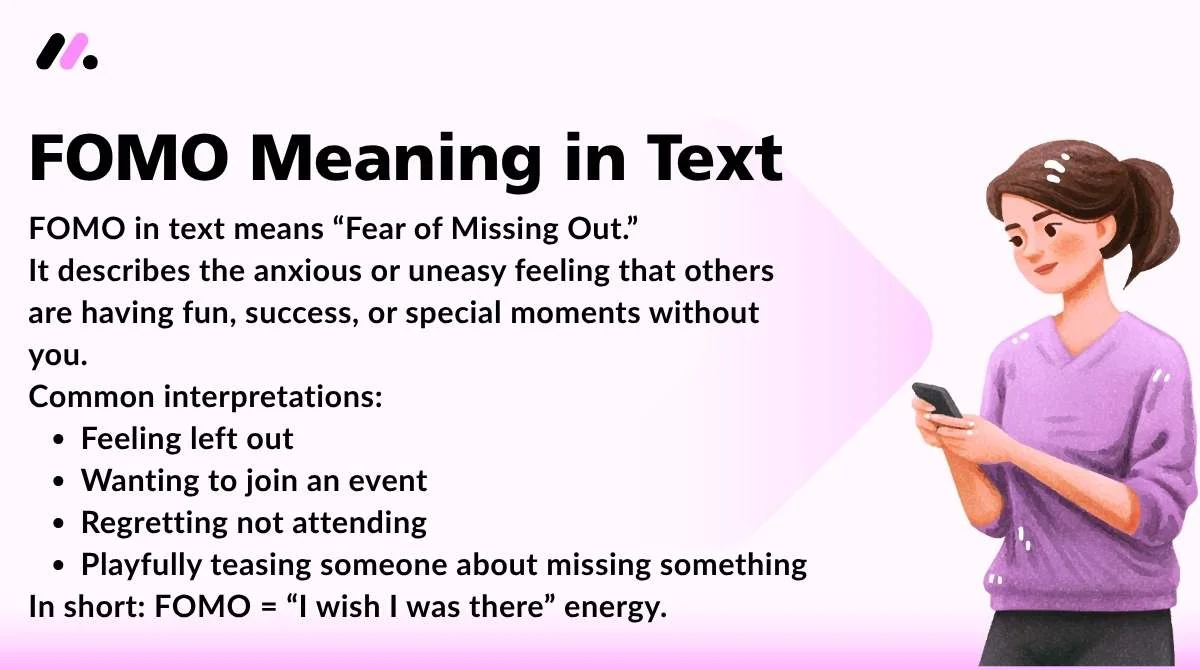
FOMO in text means “Fear of Missing Out.”
It describes the anxious or uneasy feeling that others are having fun, success, or special moments without you.
Common interpretations:
- Feeling left out
- Wanting to join an event
- Regretting not attending
- Playfully teasing someone about missing something
In short: FOMO = “I wish I was there” energy.
The Most Common Meanings of “FOMO Meaning in Text”
1. Feeling Left Out
This is the main meaning.
Someone sees photos, videos, or messages about an event they didn’t attend. They feel they missed something exciting.
Example:
- “You guys went to the concert without me? I’ve got serious FOMO.”
When it applies:
- Group trips
- Parties
- Hangouts
- Inside jokes
2. Regret for Skipping Something
Sometimes people say FOMO when they chose not to go — but now regret it.
Example:
- “I stayed home to sleep but now I have FOMO seeing your stories.”
When it applies:
- Weekend plans
- Last-minute invites
- Work events
- Limited-time offers
3. Playful Teasing
Friends often use FOMO as a joke.
Example:
- “Posting this just to give you FOMO.”
It’s not mean. It’s playful. It means:
“I know you’d love this.”
4. Marketing or Trend Hype
Brands also use FOMO.
Example:
- “Sale ends tonight! Don’t miss out!”
In text messages or ads, FOMO creates urgency.
When it applies:
- Limited sales
- Exclusive invites
- Early access launches
How “FOMO Meaning in Text” Is Used in Real Conversations
Friends & Casual Texting
This is where FOMO appears most.
Example:
- “We’re at the beach and it’s perfect.”
- “Stop. I already have FOMO.”
Tone here is emotional but friendly.
Sometimes:
- “You didn’t invite me? FOMO.”
That can feel light or slightly annoyed depending on tone.
Instagram & Snapchat
On social media, FOMO often shows up in captions or comments.
Examples:
- “This trip = pure FOMO.”
- “Giving everyone FOMO right now.”
- “Major FOMO energy.”
It usually means:
“This is so fun you’ll wish you were here.”
Stories and reels often create FOMO on purpose.
Dating Apps
In dating chats, FOMO can feel flirty.
Example:
- “You skipped our plan? Now you’ve got FOMO.”
Or:
- “If you don’t come, you’ll regret it.”
It can mean:
“You don’t want to miss time with me.”
That’s soft flirt energy.
Gaming & Online Communities
Gamers use FOMO for:
- Limited skins
- Special events
- Time-limited rewards
Example:
- “If you don’t log in today, big FOMO.”
Here it means:
“You’ll miss rare content.”
Work or Professional Chat
FOMO sometimes appears in Slack or team chats.
Example:
- “Missed the team lunch. Total FOMO.”
It’s casual but safe.
However, in formal emails, it’s not ideal.
Is “FOMO Meaning in Text” Rude, Flirty, or Offensive?
It depends on tone.
Positive Tone
Feels:
- Playful
- Excited
- Social
- Friendly
Example:
- “Wish you were here. FOMO for sure.”
This builds connection.
Neutral Tone
Feels:
- Honest
- Reflective
- Emotional
Example:
- “Seeing those pics gives me FOMO.”
No drama. Just truth.
Slightly Negative Tone
Can feel:
- Left out
- Hurt
- Excluded
Example:
- “You didn’t tell me? Wow. FOMO.”
If someone uses it with sarcasm, it may signal deeper feelings.
Psychology behind it:
Humans want belonging. FOMO taps into that fear of being excluded.
How to Respond When Someone Says “FOMO Meaning in Text”
Casual Replies
- “Come next time!”
- “We missed you!”
- “You have to join us next weekend.”
These keep it friendly.
Funny Replies
- “Too late. VIP only.”
- “Next invite costs snacks.”
- “Should’ve been faster.”
Use only with close friends.
Neutral Replies
- “Yeah, it was a good time.”
- “We’ll do it again soon.”
- “Hope you can join next time.”
Safe and balanced.
Professional Replies
- “We’ll share the highlights.”
- “We’ll schedule another session.”
- “You’ll be included next time.”
Keep tone respectful.
Common Misunderstandings About “FOMO Meaning in Text”
1. It Always Means Jealousy
Not true.
FOMO is often light-hearted. It doesn’t always mean someone is angry or jealous.
2. It Means You’re Angry
Sometimes people say FOMO playfully. It’s not a complaint.
Tone matters more than the word.
3. Confusing It With “FOBO”
FOBO means Fear of Better Options.
That’s different. FOBO is about not choosing because something better might appear.
FOMO = missing out.
FOBO = fear of commitment.
4. Thinking It’s Always Negative
FOMO can drive motivation.
Example:
- “Everyone’s learning this skill. I’ve got FOMO.”
That can push growth.
Similar Slang Terms You Should Know
Here are related terms often used with FOMO:
- YOLO – You Only Live Once.
- JOMO – Joy of Missing Out.
- FOBO – Fear of Better Options.
- OMO – Overwhelmed by Missing Out.
- Stan – To strongly support someone.
- Vibes – The emotional feeling of a place or moment.
- Lowkey – Slightly or secretly.
- Highkey – Very obvious or strong.
- Glow up – Big personal improvement.
- Main character energy – Acting like you are the focus of your own story.
These words often appear in the same social spaces.
When You Should Avoid Using “FOMO Meaning in Text”
1. Formal Business Emails
Don’t write:
- “You’ll get FOMO if you skip the meeting.”
It feels unprofessional.
Use:
- “You won’t want to miss this.”
2. Cross-Cultural Conversations
Not everyone knows internet slang.
Older coworkers or international clients may not understand FOMO.
Clarity beats trendiness.
3. Sensitive Situations
Avoid using FOMO when:
- Someone couldn’t attend due to illness
- Someone wasn’t invited intentionally
- The topic is serious (funerals, emergencies)
In these cases, FOMO may sound insensitive.
FAQs
What is the simple meaning of FOMO in text?
FOMO means Fear of Missing Out. It describes the feeling that others are enjoying something without you.
Is FOMO a bad word?
No. It’s not offensive. It usually expresses emotion or playful regret.
Can FOMO be flirty?
Yes. In dating chats, it can suggest “You don’t want to miss time with me.”
Why do brands use FOMO in marketing?
It creates urgency. People act faster when they fear missing a deal or event.
What is the opposite of FOMO?
JOMO — Joy of Missing Out. It means feeling happy about staying home or skipping events.
Do Gen Z still use FOMO in 2026?
Yes. It remains popular in texting, social media captions, and online gaming communities.
Is FOMO only about parties?
No. It can relate to career moves, trends, learning, travel, and online events.
Conclusion
Now you fully understand FOMO meaning in text.
It stands for Fear of Missing Out. It describes the feeling of being left out, wishing you were somewhere, or regretting skipping an event. Most of the time, it’s playful and social. Sometimes, it reflects real emotion.
Tone and context decide everything.
In 2026 texting culture, FOMO is still strong. It appears in DMs, Snapchat stories, gaming chats, dating apps, and even workplace messages.
If someone says they have FOMO, it usually means they care. They want connection. They want inclusion.
And now, you know exactly how to read it — and how to reply.

Calvin Merrick is an English language educator and content writer dedicated to making similes and meanings simple, clear, and easy to understand for students worldwide.