You’re scrolling through your messages, and suddenly someone drops “GFN.” You pause. Is it good? Is it bad? Is it even slang?
You’re not alone. A lot of people search “GFN meaning in text” because this short form shows up in chats, gaming, and social apps—but no one explains it clearly.
The truth is, GFN is one of those abbreviations that can mean different things depending on where you see it. That’s why it can feel confusing or even awkward if you don’t understand it right away.
This guide will break everything down in simple words. You’ll learn exactly what GFN means, when people use it, how to reply, and when to avoid it.
By the end, you won’t just understand it—you’ll know how to use it like a pro.
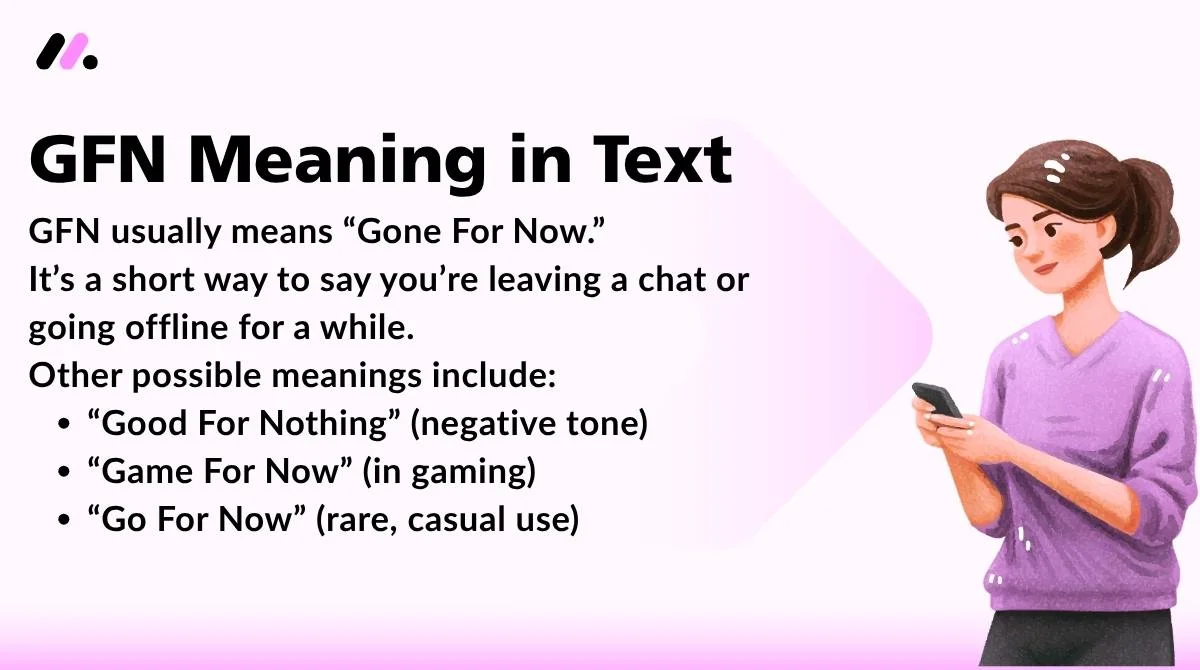
What Does “GFN” Mean in Text?
GFN usually means “Gone For Now.”
It’s a short way to say you’re leaving a chat or going offline for a while.
Other possible meanings include:
- “Good For Nothing” (negative tone)
- “Game For Now” (in gaming)
- “Go For Now” (rare, casual use)
The Most Common Meanings of “GFN”
1. Gone For Now (Most Common)
This is the main meaning people use today.
It simply means:
“I’m leaving, but I’ll be back later.”
It’s casual and friendly—not permanent.
Example:
- “I gotta go, GFN!”
- “Busy rn, GFN.”
When to use it:
- Ending a chat quickly
- Logging off games
- Leaving group chats temporarily
2. Good For Nothing (Negative Meaning)
This version has a completely different tone.
It means someone is useless or lazy.
Example:
- “He’s a GFN, never helps anyone.”
When to use it:
- Honestly, best to avoid it
- Can sound rude or insulting
3. Game For Now (Gaming Use)
In gaming circles, GFN can mean:
“I’ll play for now” or “Let’s play for a bit.”
Example:
- “You hopping on? GFN.”
When to use it:
- Multiplayer chats
- Discord or game lobbies
4. Go For Now (Rare Use)
This is less common but still exists.
It means:
“I’ll go now.”
Example:
- “Okay, GFN, talk later.”
How “GFN” Is Used in Real Conversations
Friends & Casual Texting
This is where GFN is most popular.
People use it as a quick exit line.
Examples:
- “Mom calling, GFN.”
- “Battery low, GFN.”
It feels relaxed and natural.
Instagram & Snapchat
On social media, GFN is often used in DMs.
Examples:
- “Heading out, GFN.”
- “BRB later, GFN.”
It’s short, so it fits fast conversations.
Dating Apps
GFN can show polite interest without ending things fully.
Examples:
- “Had fun chatting, GFN.”
- “Gotta sleep, GFN :)”
Tone here matters a lot. It can feel warm or distant depending on how it’s used.
Gaming & Online Communities
Gamers use GFN when logging off.
Examples:
- “Match done, GFN.”
- “Lagging bad, GFN.”
It’s quick and understood by most players.
Work or Professional Chat
GFN is rarely used in formal work chats.
But in relaxed teams, it might appear.
Examples:
- “Stepping out for a bit, GFN.”
Still, it’s better to use full sentences in professional settings.
Is “GFN” Rude, Flirty, or Offensive?
The tone depends on context.
When It Feels Positive
- Friendly chats
- Casual goodbyes
- Gaming exits
It feels normal and polite.
When It Feels Neutral
- Quick replies
- Busy situations
It just means “I’ll talk later.”
When It Feels Negative
- If used as “Good For Nothing”
- If it feels cold or abrupt
Example:
- “GFN.” (with no context) can feel dry or rude
Psychology Behind It
Short texts like GFN can feel:
- Efficient to the sender
- Confusing to the receiver
That’s why tone matters. Adding a word or emoji (if appropriate) can soften it.
How to Respond When Someone Says “GFN”
Casual Replies
- “Alright, see you!”
- “Cool, catch you later”
- “Bye!”
Funny Replies
- “Don’t stay gone too long”
- “You better come back”
- “I’ll remember this”
Neutral Replies
- “Okay”
- “Got it”
- “Talk later”
Professional Replies
- “No problem, speak later”
- “Thanks, catch up soon”
- “Understood”
Common Misunderstandings About “GFN”
1. Thinking It Means Goodbye Forever
It doesn’t.
GFN means temporary, not permanent.
2. Confusing It With Negative Meaning
Some people think it always means “Good For Nothing.”
That’s not true in most chats.
3. Assuming It’s Rude
GFN is not rude by default.
It only feels rude if:
- No context is given
- Tone is already tense
4. Mixing It With Similar Short Forms
People confuse GFN with:
- BRB (Be Right Back)
- GTG (Got To Go)
Each has a slightly different meaning.
Similar Slang Terms You Should Know
Here are some related slang terms:
- BRB – Be right back
- GTG – Got to go
- TTYL – Talk to you later
- AFK – Away from keyboard
- IMO – In my opinion
- IDK – I don’t know
- TBH – To be honest
- SMH – Shaking my head
- ILY – I love you
- LOL – Laughing out loud
Knowing these helps you understand chats faster.
When You Should Avoid Using “GFN”
Professional Settings
Avoid using GFN in:
- Emails
- Formal meetings
- Client chats
Use full sentences instead.
Cross-Cultural Chats
Not everyone knows slang.
Using GFN can confuse people from different regions.
Sensitive Situations
Avoid it when:
- Someone is upset
- Serious topics are being discussed
It may seem careless.
FAQs
What does GFN stand for in texting?
It usually stands for “Gone For Now,” meaning you’re leaving temporarily.
Is GFN a rude text?
No, it’s not rude. It depends on tone and context.
Can GFN mean something bad?
Yes, it can mean “Good For Nothing,” which is negative.
Is GFN used in gaming?
Yes, gamers use it when leaving a match or going offline.
What should I reply to GFN?
You can say “see you,” “bye,” or “talk later.”
Is GFN popular in 2026?
It’s still used but not as common as older slang like BRB or GTG.
Should I use GFN at work?
No, it’s better to avoid it in professional communication.
Conclusion
GFN is simple once you understand it. Most of the time, it just means “Gone For Now”—a quick way to say you’re stepping away but not disappearing forever.
Like many short forms, its meaning depends on where and how it’s used. In casual chats, it feels normal. In serious or professional settings, it can feel out of place.
The key is context. Always read the situation before using it.
Now that you know what GFN means in text, you won’t get confused the next time it pops up. Even better—you’ll know exactly how to respond and use it naturally.

Calvin Merrick is an English language educator and content writer dedicated to making similes and meanings simple, clear, and easy to understand for students worldwide.