You’re texting someone. They reply with “IDM.”
Now you pause.
Is that good? Is it bad? Are they upset? Or just chill?
Many people search IDM meaning in text because short slang can feel confusing. One tiny phrase can change the whole tone of a chat. In 2026, texting is fast. People type less. Meanings depend on context. And “IDM” is one of those short replies that can feel unclear.
Maybe someone said, “We can meet at 6?” and you got “IDM.”
Or you asked, “Is it okay if I invite her?” and they replied, “idm.”
Now you want to know what they really mean.
This guide will explain everything in simple English. You’ll learn what IDM means, how people use it, when it sounds positive, when it feels cold, and how to reply the right way.
Let’s clear the confusion.
What Does “IDM” Mean in Text?
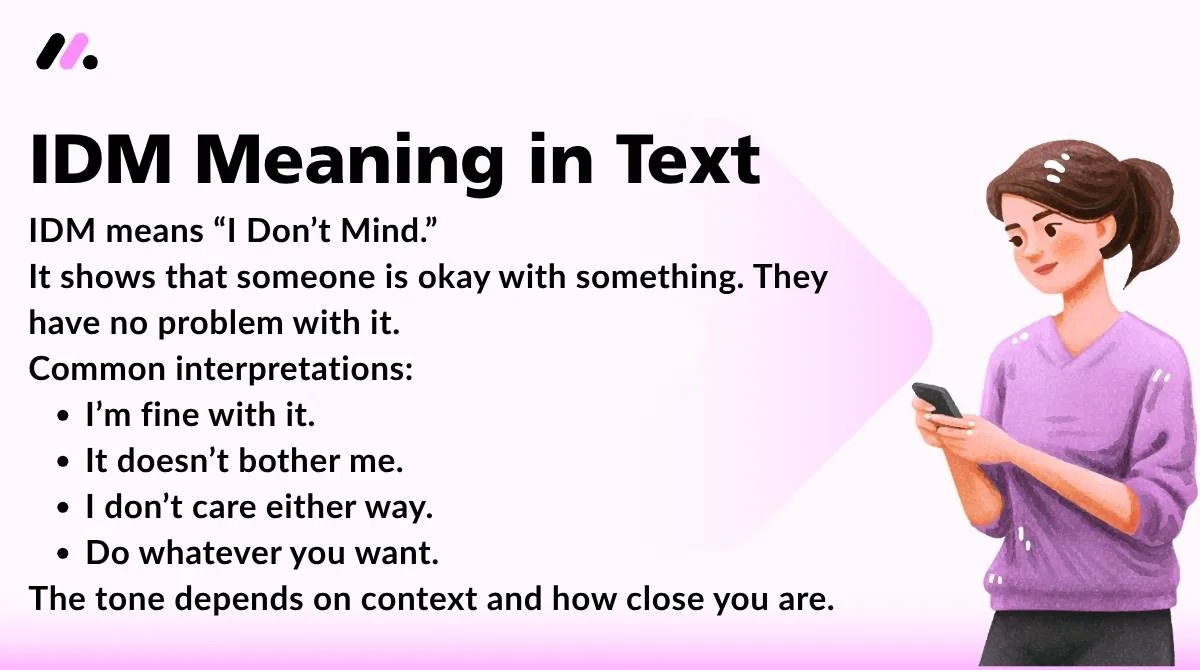
IDM means “I Don’t Mind.”
It shows that someone is okay with something. They have no problem with it.
Common interpretations:
- I’m fine with it.
- It doesn’t bother me.
- I don’t care either way.
- Do whatever you want.
The tone depends on context and how close you are.
The Most Common Meanings of “IDM”
1. I Don’t Mind (Neutral Approval)
This is the most common meaning.
It shows acceptance without strong emotion. The person agrees, but they are not excited.
Example:
- You: “Can we order pizza?”
- Them: “IDM.”
They are okay with pizza.
2. I Don’t Mind (Polite Permission)
Sometimes IDM is used to allow something politely.
Example:
- You: “Is it okay if I leave early?”
- Boss: “IDM.”
That means they allow it.
3. I Don’t Mind (Low Effort / Low Energy Reply)
Sometimes IDM feels dry. It can sound like the person does not care much.
Example:
- You: “Do you want to hang out?”
- Them: “idm.”
Lowercase “idm” can feel less excited.
Tone matters.
4. IDM as “It Doesn’t Matter” (Rare but Possible)
Some people use IDM to mean “It Doesn’t Matter.” This is less common.
Example:
- You: “Should we go now or later?”
- Them: “IDM.”
Here it may mean they don’t care about the choice.
How “IDM” Is Used in Real Conversations
Friends & Casual Texting
Among friends, IDM is relaxed and normal.
It usually means:
- “I’m cool with it.”
- “Your choice.”
- “I’m easy.”
Example:
- “Movie night at my place?”
- “IDM, sounds good.”
With friends, it rarely sounds rude.
Instagram & Snapchat
On social media, IDM is short and quick.
Example:
- “Can I repost this?”
- “IDM.”
It often means permission.
But if someone replies only “idm” without emojis or extra words, it can feel dry.
Tone depends on the chat style.
Dating Apps
On dating apps, IDM can feel risky.
Example:
- “We can meet Friday?”
- “IDM.”
That can sound uninterested.
People on dating apps often prefer energy. A better reply would be:
- “Friday works :)”
- “Yeah, that sounds good!”
IDM may feel lazy in romantic chats.
Gaming & Online Communities
In gaming chats, IDM is very common.
Example:
- “You want to play support?”
- “IDM.”
Here it means flexibility. It shows team spirit.
Gamers use short slang a lot. No one takes it personally.
Work or Professional Chat
In work chats, IDM is risky.
Example:
- “Is it okay if we change the deadline?”
- “IDM.”
It may sound unclear or too casual.
In professional settings, better replies are:
- “That works for me.”
- “I have no objection.”
- “That is fine.”
IDM feels informal in business communication.
Is “IDM” Rude, Flirty, or Offensive?
Tone Analysis
IDM is not rude by itself.
It is neutral.
But tone changes based on:
- Capital letters vs lowercase
- Punctuation
- Relationship
- Situation
“IDM!” feels positive.
“idm.” feels flat.
Context Psychology
People read emotion into short messages.
If someone expects excitement, IDM may feel cold.
If someone expects agreement, IDM feels fine.
Emotion comes from expectation.
When It Feels Positive
- When used among friends
- When used casually
- When used with added words like “IDM, sounds good”
- When used in flexible situations
When It Feels Negative
- In romantic chats
- During emotional talks
- When someone wants reassurance
- When it replaces a real answer
Short replies can feel distant.
How to Respond When Someone Says “IDM”
Casual Replies
- “Cool, let’s do it.”
- “Alright then!”
- “Nice.”
Funny Replies
- “So passionate 😂”
- “Love the energy.”
- “Wow, the excitement!”
Use only with close friends.
Neutral Replies
- “Okay, I’ll decide.”
- “Got it.”
- “Thanks.”
Professional Replies
If someone at work says IDM, you can reply:
- “Great, I’ll proceed.”
- “Thank you for confirming.”
- “Noted.”
Keep it clear and formal.
Common Misunderstandings About “IDM”
1. Thinking It Means “I Don’t Care”
IDM does not always mean they don’t care.
It usually means they are okay with it.
But sometimes it can feel similar.
2. Confusing It With “DM”
Some people mix IDM with “DM” (Direct Message).
They are completely different.
DM means private message.
IDM means I Don’t Mind.
3. Assuming It’s Passive Aggressive
Sometimes people think IDM hides anger.
Most of the time, it does not.
But if the person is upset, IDM may signal emotional distance.
Context matters.
4. Believing It’s Always Polite
In some situations, IDM feels lazy.
Especially in serious or romantic talks.
Similar Slang Terms You Should Know
- IDC – I Don’t Care
- IMO – In My Opinion
- TBH – To Be Honest
- IDK – I Don’t Know
- BRB – Be Right Back
- FYI – For Your Information
- NP – No Problem
- SMH – Shaking My Head
- LMK – Let Me Know
- NVM – Never Mind
These are common in texting culture.
When You Should Avoid Using “IDM”
Professional Settings
Avoid IDM in:
- Emails
- Client messages
- Formal reports
It feels too casual.
Cross-Cultural Chats
Some people do not understand slang.
If English is not their first language, IDM may confuse them.
Use full words instead.
Sensitive Situations
Avoid IDM when:
- Someone shares feelings
- Someone asks serious advice
- Someone needs emotional support
Example:
- “I feel really stressed.”
- “IDM.”
That feels wrong.
Use warmth in emotional talks.
FAQs
What does IDM stand for in texting?
IDM stands for “I Don’t Mind.” It means the person is okay with something.
Is IDM the same as IDC?
No. IDM means “I Don’t Mind.” IDC means “I Don’t Care.” IDC sounds colder.
Can IDM sound rude?
Yes, if used in serious or emotional situations. Tone and context matter.
Is IDM used on Snapchat and Instagram?
Yes. It is common in casual chats on social media.
Does IDM mean yes?
Usually yes. It means they are okay with your idea.
Why does IDM sometimes feel dry?
Because it is short and has no emotion. Short replies can feel distant.
Should I use IDM at work?
It is better to avoid it in professional communication. Use full sentences instead.
Conclusion
Now you fully understand IDM meaning in text.
It mostly means “I Don’t Mind.” It shows agreement without strong emotion. It is casual, simple, and common in modern texting culture.
But tone changes everything.
Among friends, it feels normal.
On dating apps, it can feel low effort.
At work, it feels too informal.
In emotional talks, it can feel cold.
Before using IDM, think about the situation. Think about the relationship. Think about how it might sound.
Texting is short, but meaning is deep.
Use it wisely.

Calvin Merrick is an English language educator and content writer dedicated to making similes and meanings simple, clear, and easy to understand for students worldwide.