You’re texting a friend. Everything feels normal. Then they send: “You shocking mf.”
You pause.
Is that an insult? A joke? A compliment?
This is exactly why so many people search for MF meaning in text. The term shows up in group chats, Instagram comments, memes, gaming lobbies, and even dating apps. Sometimes it feels funny. Other times, it feels aggressive.
The truth? It depends on tone, context, and who says it.
In this guide, you’ll learn exactly what MF means in text, how people use it in 2026, when it’s harmless, when it’s offensive, and how to reply without making things awkward.
No confusion. No guessing. Just clear answers.
What Does “MF Meaning in Text” Mean?
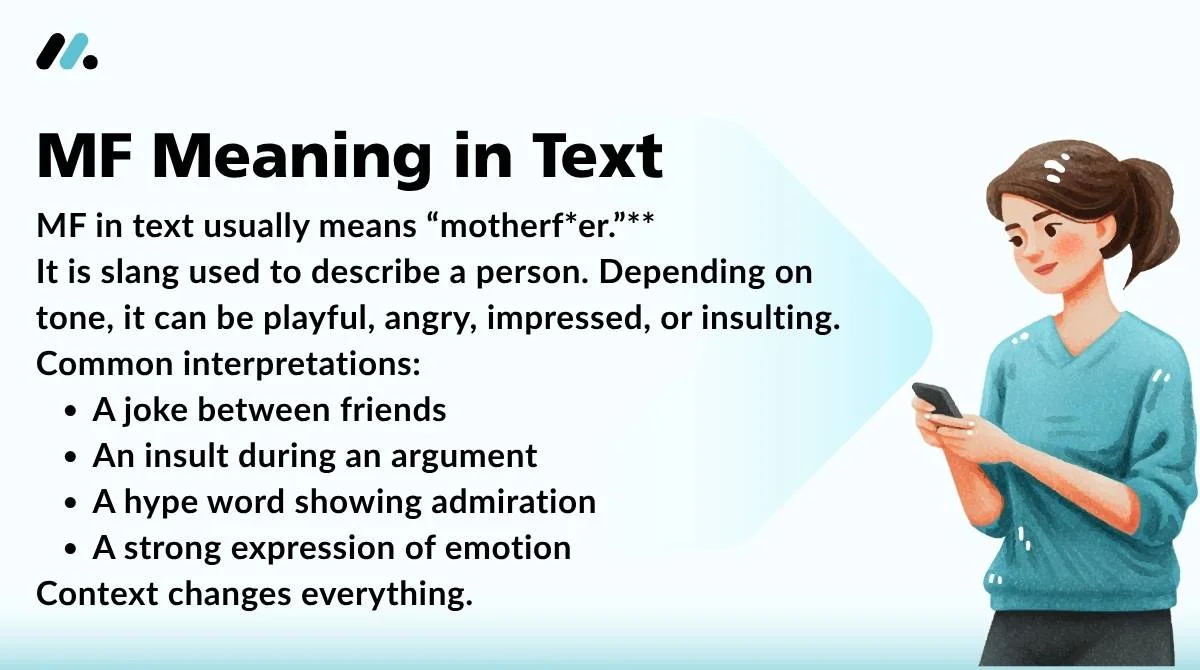
MF in text usually means “motherf*er.”**
It is slang used to describe a person. Depending on tone, it can be playful, angry, impressed, or insulting.
Common interpretations:
- A joke between friends
- An insult during an argument
- A hype word showing admiration
- A strong expression of emotion
Context changes everything.
The Most Common Meanings of “MF”
1. MF as a Playful Nickname
Among close friends, MF can be playful.
Example:
- “You funny mf.”
- “Lucky mf, you won again!”
Here, it’s not serious. It shows comfort and closeness. People use it like teasing.
When it applies:
- Long-time friendships
- Group chats
- Casual banter
Tone: Light, joking.
2. MF as an Insult
In arguments, MF becomes aggressive.
Example:
- “You lying mf.”
- “That mf blocked me.”
Here, the word carries anger. The speaker wants to hurt or show frustration.
When it applies:
- Heated debates
- Breakups
- Online fights
Tone: Negative, harsh.
3. MF as Praise or Hype
Gen Z often flips negative words into hype slang.
Example:
- “He a talented mf.”
- “That mf fast!”
In this case, MF shows strong admiration. It adds energy to the sentence.
When it applies:
- Sports talk
- Music discussions
- Gaming wins
Tone: Intense but positive.
4. MF as Emotional Emphasis
Sometimes MF is just emphasis.
Example:
- “I’m tired as mf.”
- “Cold as mf outside.”
Here, it replaces “very” or “extremely.” It strengthens emotion.
Tone: Dramatic, expressive.
How “MF” Is Used in Real Conversations
Friends & Casual Texting
Among friends, MF usually means comfort and humor.
Examples:
- “You shocking mf.”
- “Smart mf, you figured it out.”
Friends use it to tease, not attack. If the relationship is strong, it feels normal.
But if someone new says it, it may feel disrespectful.
Instagram & Snapchat
On social media, MF appears in captions and comments.
Examples:
- “That mf clean.”
- “Rich mf energy.”
It’s often used for hype. People use it for style, confidence, or humor.
It’s common in meme culture.
Dating Apps
On dating apps, MF can be risky.
Example:
- “You fine mf.”
Some people find it bold and confident.
Others see it as disrespectful.
Tone matters. If the connection is new, it may come off too strong.
Gaming & Online Communities
In gaming chats, MF is very common.
Examples:
- “That mf camping.”
- “Fast mf.”
Gaming culture uses strong slang often. It may not feel personal. It’s part of competitive talk.
Still, in serious matches, it can turn toxic.
Work or Professional Chat
MF does not belong in professional settings.
Using it in Slack, email, or office chats can:
- Damage reputation
- Sound immature
- Be reported
Professional tone avoids strong profanity.
Is “MF” Rude, Flirty, or Offensive?
The answer: it depends.
When It Feels Rude
- Said during anger
- Used toward strangers
- Said without friendly tone
It becomes offensive quickly.
When It Feels Flirty
Sometimes it adds bold energy.
Example:
- “Confident mf.”
In flirty settings, it can sound playful if both people share the vibe.
When It Feels Positive
Among close friends, it feels normal.
Tone psychology:
People judge slang based on:
- Relationship closeness
- Text punctuation
- Past conversations
- Emoji use (if any)
The same word can mean love or hate.
How to Respond When Someone Says “MF”
Your reply should match the tone.
Casual Replies
- “You know it.”
- “That’s me.”
- “Facts.”
Funny Replies
- “Only on weekends.”
- “Certified.”
- “Don’t expose me.”
Neutral Replies
- “What you mean?”
- “Why though?”
- “Relax.”
Professional Replies
If someone uses it in a work setting:
- “Let’s keep it professional.”
- “Please avoid that language.”
Stay calm and direct.
Common Misunderstandings About “MF”
1. Thinking It’s Always an Insult
Not true. Among friends, it can be positive.
2. Confusing It With “My Friend”
Some beginners think MF means “my friend.” It does not in slang culture.
3. Assuming Everyone Is Comfortable With It
Some people dislike profanity, even jokingly.
4. Missing Tone Clues
Text lacks voice tone. Without context, MF may seem harsher than intended.
Similar Slang Terms You Should Know
Here are related slang terms used online:
- AF – Means “as f***,” used for emphasis
- FR – Means “for real”
- ONG – Means “on God”
- TBH – Means “to be honest”
- IDK – Means “I don’t know”
- W – Means “win” or success
- L – Means “loss”
- Lowkey – Slightly or secretly
- Highkey – Obviously or strongly
- Bet – Means okay or agreed
- Bruh – Expression of shock or disbelief
Understanding these helps decode modern texting.
When You Should Avoid Using “MF”
Professional Settings
Emails, interviews, LinkedIn messages — never use it.
Cross-Cultural Chats
Not all cultures use profanity casually. It may offend someone quickly.
Sensitive Situations
Avoid it during:
- Serious talks
- Apologies
- Grief moments
- First impressions
Strong slang can feel disrespectful.
FAQs
What does MF stand for in texting?
It usually stands for “motherf***er,” used as slang for a person.
Is MF always offensive?
No. Among close friends, it can be playful or even positive.
Can MF be a compliment?
Yes. In hype slang, it can show admiration.
Example: “Talented mf.”
Is MF appropriate in school chats?
It depends on rules. Many schools consider it inappropriate language.
Why do people use MF casually now?
Gen Z often softens strong words in friendly spaces. Context changes tone.
Should I use MF on dating apps?
Be careful. Some may find it bold. Others may find it disrespectful.
What’s the difference between MF and AF?
MF refers to a person. AF is used for emphasis, like “very.”
Conclusion
Now you fully understand MF meaning in text.
It usually stands for “motherf***er,” but its meaning shifts based on tone, relationship, and setting.
Among friends, it can feel funny and playful.
In arguments, it becomes harsh.
In hype culture, it can even be praise.
The key is context.
Before using it, ask:
- Who am I talking to?
- What is the vibe?
- Could this be misunderstood?
If you think twice, you’ll avoid awkward moments.
Modern slang moves fast. But clarity always wins.

Calvin Merrick is an English language educator and content writer dedicated to making similes and meanings simple, clear, and easy to understand for students worldwide.