Words can sting. Words can sparkle. And sometimes, words can make people laugh out loud. If you want to describe someone acting foolish without sounding plain or boring, similes are your secret tool.
Similes bring color to writing. They help readers see what you mean instead of just hearing it. Saying someone is “dumb” feels flat. But saying they’re “like a screen door on a submarine”? That paints a picture.
In this guide, you’ll find 20+ similes for dumb that are funny, dramatic, creative, and even poetic. You’ll also learn how to use them well, avoid common mistakes, and create your own powerful comparisons.
Let’s turn dull words into bright images.
What Is a Simile? (Quick Clear Definition)
A simile is a comparison between two different things using the words “like” or “as.”
It helps explain something by linking it to something familiar.
Example:
He was as quiet as a mouse.
Quick List – Most Popular Similes for “Dumb”
- As dumb as a rock
- As dumb as a box of rocks
- As dumb as a doorknob
- As dumb as a brick
- As dumb as a stump
- Like a deer in headlights
- As clueless as a lost tourist
- As slow as molasses
- As sharp as a marble
- Like a broken compass
Complete List of Similes for “Dumb” (Grouped by Meaning)
Funny & Lighthearted
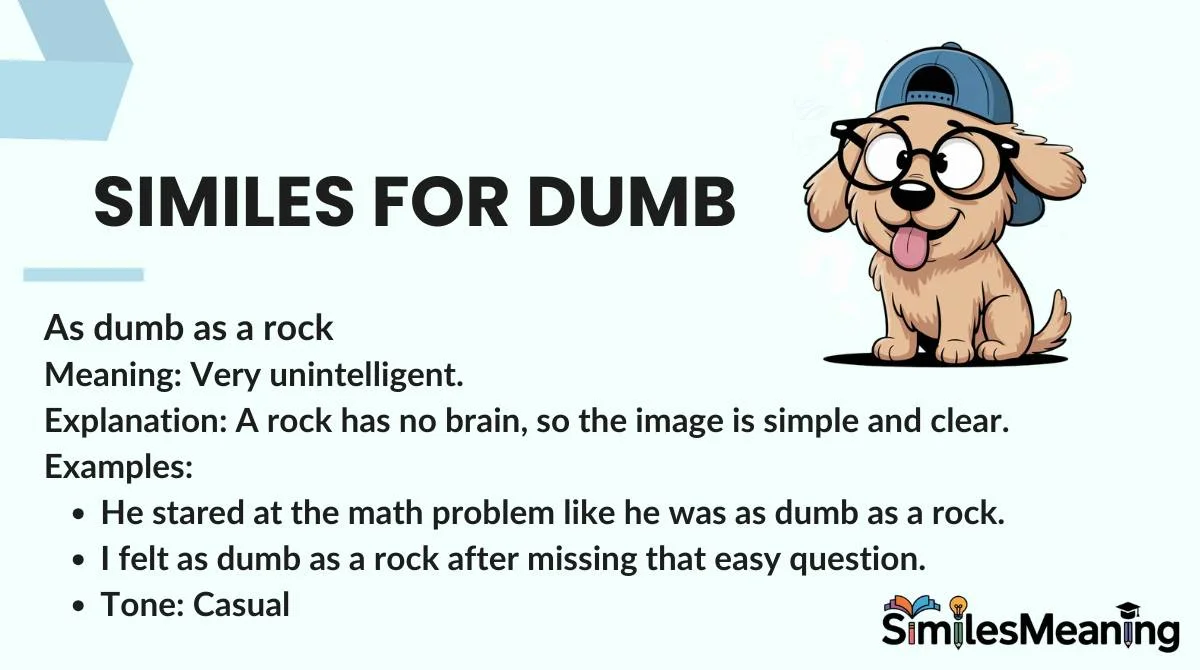
As dumb as a rock
Meaning: Very unintelligent.
Explanation: A rock has no brain, so the image is simple and clear.
Examples:
- He stared at the math problem like he was as dumb as a rock.
- I felt as dumb as a rock after missing that easy question.
Tone: Casual
As dumb as a box of rocks
Meaning: Extremely foolish.
Explanation: One rock isn’t enough—this joke doubles down for humor.
Examples:
- That idea sounds as dumb as a box of rocks.
- He acted as dumb as a box of rocks during the interview.
Tone: Funny
As dumb as a doorknob
Meaning: Lacking sense.
Explanation: A doorknob doesn’t think or move on its own.
Examples:
- I felt as dumb as a doorknob after locking myself out.
- He just stood there, as dumb as a doorknob.
Tone: Casual
As sharp as a marble
Meaning: Not smart at all.
Explanation: Marbles are round, not sharp. It’s playful sarcasm.
Examples:
- Don’t mind him—he’s as sharp as a marble.
- That move was as sharp as a marble.
Tone: Funny
Dramatic & Intense
Like a deer in headlights
Meaning: Frozen and confused.
Explanation: A deer caught in bright lights can’t react quickly.
Examples:
- She looked like a deer in headlights during the quiz.
- He stood there like a deer in headlights.
Tone: Serious
Like a broken compass
Meaning: Completely misguided.
Explanation: A broken compass can’t show direction.
Examples:
- Without help, he’s like a broken compass.
- That decision was like a broken compass pointing nowhere.
Tone: Serious
As clueless as a fish on land
Meaning: Totally unaware.
Explanation: A fish out of water is confused and helpless.
Examples:
- I felt as clueless as a fish on land in that class.
- He was as clueless as a fish on land at the meeting.
Tone: Dramatic
Slow & Monotonous
As slow as molasses
Meaning: Very slow-thinking.
Explanation: Molasses pours thick and slow.
Examples:
- He’s as slow as molasses with simple tasks.
- My brain felt as slow as molasses today.
Tone: Casual
As blank as an empty chalkboard
Meaning: No ideas at all.
Explanation: A clean board shows nothing written.
Examples:
- My mind was as blank as an empty chalkboard.
- He stared back, as blank as an empty chalkboard.
Tone: Neutral
Like a car stuck in neutral
Meaning: Not moving forward mentally.
Explanation: A car in neutral makes noise but goes nowhere.
Examples:
- His thinking was like a car stuck in neutral.
- The plan felt like a car stuck in neutral.
Tone: Casual
Creative & Unique
As bright as a burnt-out bulb
Meaning: Not clever.
Explanation: A bulb that’s burned out gives no light.
Examples:
- That answer was as bright as a burnt-out bulb.
- He looked as bright as a burnt-out bulb.
Tone: Funny
Like a map with no labels
Meaning: Lacking understanding.
Explanation: A map without names is confusing.
Examples:
- His speech was like a map with no labels.
- I felt like a map with no labels during the exam.
Tone: Creative
As useful as a screen door on a submarine
Meaning: Completely useless.
Explanation: A screen door underwater would fail instantly.
Examples:
- That excuse is as useful as a screen door on a submarine.
- His advice felt as useful as a screen door on a submarine.
Tone: Humorous
Like a puzzle missing half its pieces
Meaning: Incomplete understanding.
Explanation: A puzzle without pieces can’t make sense.
Examples:
- He sounded like a puzzle missing half its pieces.
- My thoughts were like a puzzle missing half its pieces.
Tone: Thoughtful
Poetic & Literary
As empty as a hollow shell
Meaning: Lacking thought or depth.
Explanation: A shell without life inside is vacant.
Examples:
- His argument felt as empty as a hollow shell.
- Her eyes looked as empty as a hollow shell.
Tone: Poetic
Like smoke blown by the wind
Meaning: Unsteady thinking.
Explanation: Smoke drifts without direction.
Examples:
- His ideas were like smoke blown by the wind.
- She spoke like smoke blown by the wind.
Tone: Poetic
As silent as an unread book
Meaning: Knowledge unused.
Explanation: A closed book holds wisdom but says nothing.
Examples:
- His mind felt as silent as an unread book.
- She stayed as silent as an unread book.
Tone: Literary
Like a clock without hands
Meaning: No guidance or clarity.
Explanation: A clock with no hands can’t show time.
Examples:
- He seemed like a clock without hands.
- The project ran like a clock without hands.
Tone: Serious
As scattered as leaves in a storm
Meaning: Disorganized thinking.
Explanation: Leaves in wind move without order.
Examples:
- His thoughts were as scattered as leaves in a storm.
- I felt as scattered as leaves in a storm.
Tone: Dramatic
Fresh and Unique Similes You Won’t Hear Every Day
Here are 5 original similes with strong imagery:
- As aware as a shadow at midnight – A shadow disappears in deep darkness.
- Like a ladder missing its rungs – You can’t climb without steps.
- As thoughtful as a paused video – No motion, no progress.
- Like a pen out of ink during a test – No ideas when needed most.
- As clear as fogged glass in winter – Vision blocked and cloudy.
Each one uses everyday images to show confusion or lack of thought in a creative way.
How to Use These Similes in Writing
In Essays
Use similes to explain behavior clearly. Instead of saying “He was confused,” write:
He stood there like a deer in headlights.
This paints a picture.
In Stories
Similes bring characters to life. They show personality and mood. They also add humor or drama without long explanation.
How to Create Your Own Similes (Mini Writing Guide)
Step-by-Step Method
- Pick a trait (confused, slow, unaware).
- Think of an object that shows that trait.
- Connect them with “like” or “as.”
- Keep it simple.
- Read it out loud.
5 Practical Tips
- Use common objects for clarity.
- Avoid overused clichés.
- Match tone with context.
- Keep comparisons short.
- Make the image easy to picture.
3 Transformation Examples
Plain: He was confused.
Better: He was like a broken compass.
Plain: I felt foolish.
Better: I felt as blank as an empty chalkboard.
Plain: She didn’t understand.
Better: She stood there like a puzzle missing half its pieces.
Common Mistakes When Using Similes
Overuse
Too many similes in one paragraph feel heavy.
Clichés
“As dumb as a rock” is common. Use fresh ones for impact.
Tone Mismatch
Don’t use funny similes in serious scenes unless it fits.
Practice Exercise
Fill in the blanks:
- He looked as dumb as a ________.
- She stood there like a ________ in headlights.
- My brain felt as blank as a ________.
- He was as slow as ________.
- That plan was like a broken ________.
- She seemed like a clock without ________.
- His thoughts were as scattered as ________.
- I felt like a map with no ________.
- That idea was as bright as a ________.
- He acted like a puzzle missing half its ________.
- She looked as clear as ________.
- He stood there as clueless as a fish on ________.
Answers
- rock
- deer
- chalkboard
- molasses
- compass
- hands
- leaves in a storm
- labels
- burnt-out bulb
- pieces
- fogged glass
- land
FAQs
What is a polite simile for dumb?
You can say “like a deer in headlights” or “as blank as a chalkboard.” These sound softer.
Are similes rude?
They can be. It depends on tone and context.
Can I use similes in formal writing?
Yes, but keep them simple and not insulting.
What’s the difference between simile and metaphor?
A simile uses “like” or “as.” A metaphor does not.
How many similes should I use in one paragraph?
One or two is usually enough.
Why are creative similes better than clichés?
Fresh similes surprise readers and feel original.
Final Thoughts
Similes turn flat writing into vivid storytelling. They add humor, drama, and emotion in just a few words. Whether you choose classic lines or create your own, the key is clarity and creativity.
Now you have 20+ similes for dumb—funny, poetic, dramatic, and unique. Use them wisely. Paint pictures. Make readers smile. And most of all, keep your writing bright and alive.

Calvin Merrick is an English language educator and content writer dedicated to making similes and meanings simple, clear, and easy to understand for students worldwide.