Hot weather is something everyone understands. The blazing sun, sticky air, and sweating faces can make even simple tasks feel exhausting.
Writers often struggle to describe this heat in ways that feel vivid and fresh. That is where similes become powerful tools.
Similes help readers see, feel, and imagine what the heat is like. Instead of saying “It was very hot,” you can say “It was as hot as a frying pan.” Suddenly the scene becomes more alive.
This guide will give you 26 creative similes for hot weather that you can use in stories, essays, and everyday writing. Some are funny, some dramatic, and some poetic.
You will also learn how to create your own similes, avoid common mistakes, and practice using them naturally.
By the end, you will have a collection of vivid expressions that make your writing shine—even on the hottest day.
What Is a Simile? (Quick Clear Definition)
A simile is a comparison between two things using the words “like” or “as.”
It helps describe something in a more vivid way.
Example:
The sun was as bright as a spotlight.
Quick List – Most Popular Similes for “Hot Weather”
- As hot as a desert at noon
- As hot as a frying pan
- As hot as an oven
- As hot as burning coal
- As hot as summer in the tropics
- As hot as boiling water
- As hot as a sauna
- As hot as the midday sun
- As hot as fire
- As hot as a volcano
Complete List of Similes for “Hot Weather” (Grouped by Meaning)
Funny & Lighthearted
As hot as a pizza straight from the oven
Meaning: Extremely hot and fresh.
Explanation: Just like pizza burns your mouth when it first comes out, the weather feels too hot to handle.
Examples
The sidewalk was as hot as a pizza straight from the oven.
By noon, the playground felt as hot as a pizza fresh from the oven.
Tone: Funny / Casual
As hot as a toaster on high
Meaning: Uncomfortably warm.
Explanation: A toaster heats up quickly and gives off strong heat, similar to a sudden hot day.
Examples
The tiny room felt as hot as a toaster on high.
After the power cut, the house became as hot as a toaster.
Tone: Casual
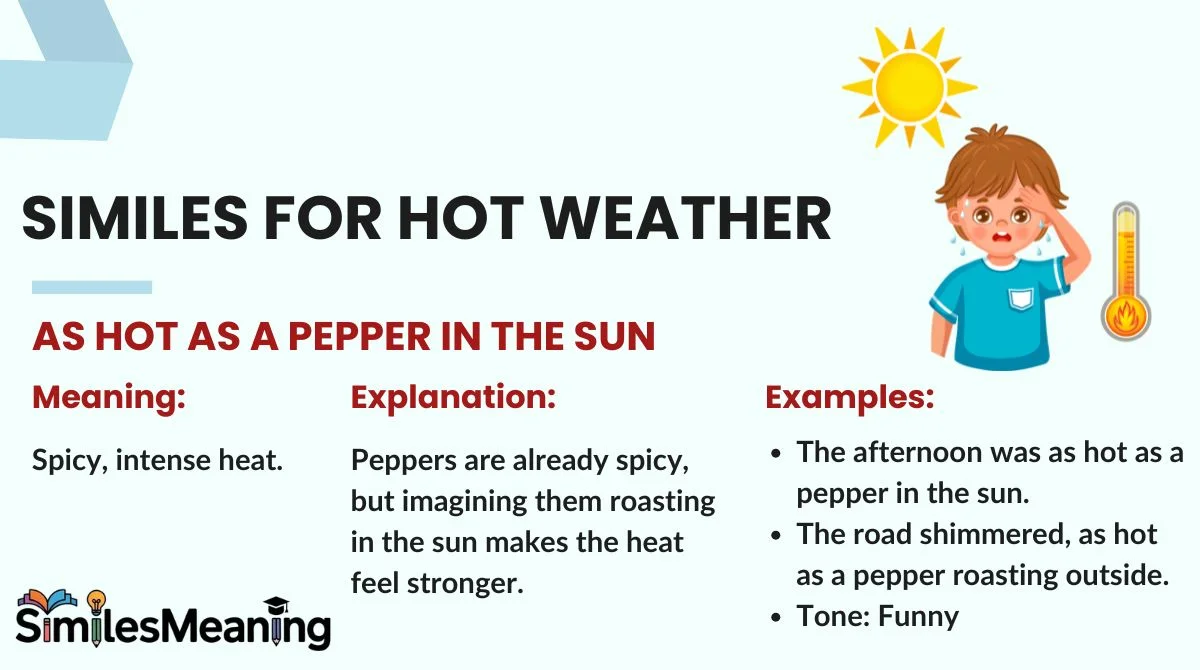
As hot as a pepper in the sun
Meaning: Spicy, intense heat.
Explanation: Peppers are already spicy, but imagining them roasting in the sun makes the heat feel stronger.
Examples
The afternoon was as hot as a pepper in the sun.
The road shimmered, as hot as a pepper roasting outside.
Tone: Funny
As hot as a dog on a summer walk
Meaning: Exhausting and sweaty heat.
Explanation: Dogs often pant heavily on hot walks, showing how uncomfortable the heat is.
Examples
The air felt as hot as a dog on a summer walk.
After a few minutes outside, I felt as hot as a dog in July.
Tone: Lighthearted
Emotional & Deep
As hot as a restless summer night
Meaning: Heavy and suffocating heat.
Explanation: Some nights stay warm and humid, making sleep difficult.
Examples
The room was as hot as a restless summer night.
The evening air stayed as hot as a sleepless July night.
Tone: Serious
As hot as the sun’s breath
Meaning: Extremely intense heat.
Explanation: Imagining the sun breathing heat onto the earth creates a strong image.
Examples
The desert wind felt as hot as the sun’s breath.
At noon, the air was as hot as the sun breathing down.
Tone: Poetic
As hot as a burning memory
Meaning: Emotionally intense heat.
Explanation: A burning memory feels powerful and painful, just like harsh weather.
Examples
The afternoon felt as hot as a burning memory.
The wind carried heat as sharp as a painful memory.
Tone: Poetic
As hot as anger in July
Meaning: Fierce, overwhelming heat.
Explanation: Anger can feel explosive, similar to summer heat waves.
Examples
The city streets were as hot as anger in July.
The sun burned down like pure anger.
Tone: Serious
Dramatic & Intense
As hot as a desert at noon
Meaning: Extremely hot.
Explanation: Deserts reach intense temperatures during midday.
Examples
The sand was as hot as a desert at noon.
The road looked as hot as the Sahara at midday.
Tone: Dramatic
As hot as a blazing furnace
Meaning: Dangerous, overwhelming heat.
Explanation: A furnace produces powerful heat used for melting metal.
Examples
The factory yard felt as hot as a blazing furnace.
The afternoon sun turned the town into a furnace.
Tone: Serious
As hot as burning coal
Meaning: Very intense heat.
Explanation: Coal burns with steady, strong heat.
Examples
The metal bench felt as hot as burning coal.
The stones were as hot as glowing coals.
Tone: Dramatic
As hot as molten lava
Meaning: Extreme, almost unbearable heat.
Explanation: Lava is one of the hottest natural substances.
Examples
The desert floor felt as hot as molten lava.
The wind blew like lava across the land.
Tone: Intense
As hot as a dragon’s breath
Meaning: Fierce and fiery heat.
Explanation: Dragons in stories breathe flames, making this image dramatic.
Examples
The wind felt as hot as a dragon’s breath.
The valley burned under heat like dragon fire.
Tone: Dramatic / Fantasy
Slow & Monotonous Heat
As hot as a still summer afternoon
Meaning: Slow, heavy heat.
Explanation: Still afternoons feel quiet but extremely warm.
Examples
The village sat as hot as a still summer afternoon.
The air hung as hot as a quiet August day.
Tone: Calm
As hot as a parked car in July
Meaning: Trapped, suffocating heat.
Explanation: Cars heat up quickly when parked in sunlight.
Examples
The room felt as hot as a parked car in July.
The bus became as hot as a locked car.
Tone: Casual
As hot as a blanket of summer air
Meaning: Warm and covering heat.
Explanation: The heat feels like a thick blanket surrounding everything.
Examples
The town was wrapped in heat like a summer blanket.
The night stayed warm like a heavy cover.
Tone: Soft
As hot as a slow-burning fire
Meaning: Gradual but strong heat.
Explanation: Fires that burn slowly still produce intense warmth.
Examples
The afternoon was as hot as a slow-burning fire.
The valley simmered like a quiet flame.
Tone: Serious
Creative & Unique
As hot as a sidewalk frying eggs
Meaning: Extremely hot ground.
Explanation: The idea of cooking eggs on a sidewalk shows extreme heat.
Examples
The pavement was as hot as a sidewalk frying eggs.
Kids jumped quickly across the street, avoiding the heat.
Tone: Funny
As hot as a kettle about to whistle
Meaning: Rising, powerful heat.
Explanation: A kettle builds heat until it whistles loudly.
Examples
The day grew as hot as a kettle ready to whistle.
By noon the air felt like boiling water.
Tone: Creative
As hot as a glowing campfire
Meaning: Warm and intense heat.
Explanation: Campfires glow bright and radiate warmth.
Examples
The sand felt as hot as a glowing campfire.
The beach burned under the sun.
Tone: Casual
As hot as a blazing spotlight
Meaning: Direct, focused heat.
Explanation: A spotlight shines strongly in one place, like the sun overhead.
Examples
The sun felt like a spotlight over the field.
The players sweated under heat like stage lights.
Tone: Dramatic
As hot as a mirror catching sunlight
Meaning: Sharp, reflected heat.
Explanation: Mirrors reflect sunlight intensely.
Examples
The windows flashed as hot as mirrors in the sun.
The city shimmered with reflected heat.
Tone: Creative
Poetic & Literary
As hot as the heart of summer
Meaning: Peak seasonal heat.
Explanation: The “heart of summer” represents the hottest days.
Examples
The garden baked in the heart of summer heat.
The afternoon felt like summer’s fiery center.
Tone: Poetic
As hot as golden sunlight
Meaning: Bright, glowing warmth.
Explanation: Golden sunlight symbolizes intense sunshine.
Examples
The fields glowed as hot as golden sunlight.
The sky poured golden heat onto the land.
Tone: Poetic
As hot as a flame dancing in the wind
Meaning: Lively but strong heat.
Explanation: Flames move constantly while giving off heat.
Examples
The desert air flickered like dancing flames.
The wind carried heat like fire.
Tone: Literary
As hot as summer’s blazing crown
Meaning: The strongest point of heat.
Explanation: The crown symbolizes the peak of summer’s power.
Examples
The sun wore summer’s blazing crown.
The day ruled the sky with burning heat.
Tone: Poetic
Fresh and Unique Similes You Won’t Hear Every Day
Here are five original similes designed to sound new and vivid.
As hot as sunlight trapped in glass
The heat feels stuck and intense, like sunlight magnified through glass.
As hot as a road melting under tires
This image shows extreme heat strong enough to soften asphalt.
As hot as a kettle forgotten on the stove
The heat builds slowly but becomes dangerously strong.
As hot as a sandcastle under noon sun
The sun beats down on soft sand until it almost burns.
As hot as a metal swing in July
Many people remember touching a hot playground swing.
How to Use These Similes in Writing
In Essays
Similes help essays become clearer and more engaging.
Example:
Instead of writing: The weather was extremely hot.
Write: The playground felt as hot as a frying pan.
This creates a stronger mental picture.
In Stories
Similes make scenes more vivid.
Example:
The desert stretched ahead, as hot as molten lava, while the sun burned above them.
Readers can almost feel the heat.
How to Create Your Own Similes (Mini Writing Guide)
Step-by-Step Method
- Think about the feeling you want to describe
- Find an object that shares that feeling
- Connect them with like or as
- Keep the comparison simple
- Test if the image feels clear
5 Practical Tips
- Use objects people know
- Keep sentences short
- Avoid overused comparisons
- Focus on strong imagery
- Read the sentence aloud
3 Transformation Examples
Plain sentence:
The day was very hot.
Improved with simile:
The day was as hot as a blazing furnace.
Plain sentence:
The sand burned my feet.
Simile version:
The sand was as hot as burning coal.
Plain sentence:
The sun felt strong.
Simile version:
The sun felt like a dragon breathing fire.
Common Mistakes When Using Similes
Overuse
Too many similes can overwhelm the reader. Use them only when needed.
Clichés
Common phrases like “hot as the sun” may feel boring. Try fresh comparisons.
Tone Mismatch
A funny simile may not fit a serious story. Always match the tone of your writing.
Practice Exercise
Fill in the blanks with a suitable simile.
- The pavement was as hot as ______
- The desert wind felt like ______
- The playground slide was as hot as ______
- The day burned like ______
- The sand felt as hot as ______
- The air hung like ______
- The afternoon burned like ______
- The metal bench felt like ______
- The sun felt like ______
- The city streets were as hot as ______
- The beach sand was like ______
- The wind felt like ______
Answers
- a frying pan
- a dragon’s breath
- molten lava
- a blazing furnace
- burning coal
- a blanket of summer air
- a slow-burning fire
- glowing coal
- a blazing spotlight
- a desert at noon
- a glowing campfire
- the sun’s breath
FAQs
What are similes for hot weather?
Similes for hot weather compare heat to familiar things like ovens, deserts, or fire. They help readers imagine how intense the heat feels.
Why should writers use similes?
Similes make descriptions clearer, stronger, and more interesting. They help readers visualize scenes easily.
What is the difference between a simile and a metaphor?
A simile uses like or as to compare things, while a metaphor states the comparison directly.
Example:
Simile – The sun was like fire.
Metaphor – The sun was fire.
Are similes good for children’s writing?
Yes. Similes are simple and visual, making them perfect for children and beginner writers.
How many similes should I use in a paragraph?
Usually one or two similes are enough. Too many comparisons can confuse readers.
Can similes improve storytelling?
Yes. Similes help build atmosphere, emotion, and strong imagery in stories.
Final Thoughts
Hot weather can be described in many ways, but similes bring those descriptions to life. A simple comparison can turn an ordinary sentence into something vivid and memorable.
The 26+ similes in this guide give you plenty of ideas to make your writing stronger. Some are playful, some dramatic, and others poetic. You can use them in essays, stories, or creative projects.
Even better, once you understand how similes work, you can create your own unique comparisons. With practice, describing heat—or anything else—becomes easier and far more exciting.

Calvin Merrick is an English language educator and content writer dedicated to making similes and meanings simple, clear, and easy to understand for students worldwide.