Fear is a strong feeling. It makes your heart race. It makes your hands shake. But saying “It was scary” feels flat. Boring. Weak.
That’s where similes help.
Similes paint pictures in the mind. They turn simple writing into something vivid and alive. Instead of telling readers something is scary, you show them how scary it feels.
In this guide, you’ll discover 20+ powerful similes for scary — from funny and light to dark and intense. You’ll also learn how to use them in stories, essays, and creative writing. Plus, you’ll get a mini writing lesson and a practice quiz.
Let’s make your writing unforgettable.
What Is a Simile? (Quick Clear Definition)
A simile compares two things using “like” or “as.”
It helps readers imagine something clearly.
Example:
The night was as dark as ink.
Quick List – Most Popular Similes for “Scary”
- As scary as a horror movie
- Like a ghost in the dark
- As frightening as a nightmare
- Like a scream in silence
- As scary as thunder at midnight
- Like a shadow that moves
- As chilling as icy wind
- Like footsteps behind you
- As terrifying as a haunted house
- Like eyes watching in the dark
Complete List of Similes for “Scary” (Grouped by Meaning)
Funny & Lighthearted
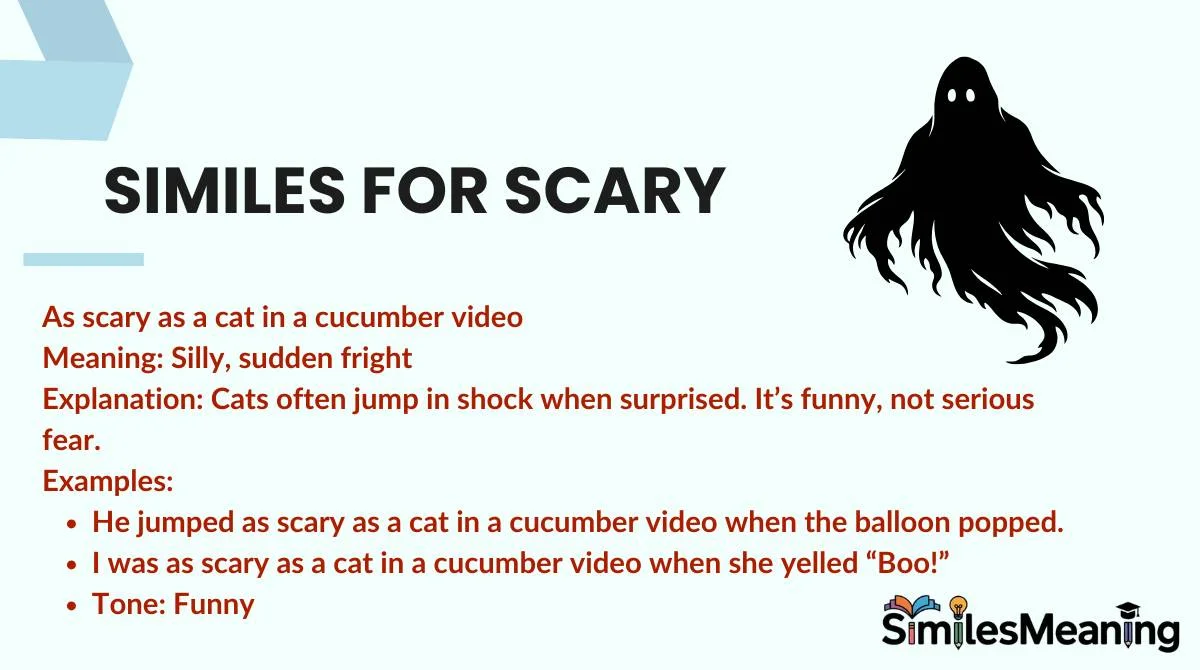
As scary as a cat in a cucumber video
Meaning: Silly, sudden fright
Explanation: Cats often jump in shock when surprised. It’s funny, not serious fear.
Examples:
- He jumped as scary as a cat in a cucumber video when the balloon popped.
- I was as scary as a cat in a cucumber video when she yelled “Boo!”
Tone: Funny
Like a kid afraid of the dark
Meaning: Childlike fear
Explanation: Simple, innocent fear of darkness.
Examples:
- He clung to the flashlight like a kid afraid of the dark.
- I felt like a kid afraid of the dark during the power cut.
Tone: Casual
As scary as a spider on your pillow
Meaning: Sudden unpleasant shock
Explanation: Finding a spider near your face can cause instant panic.
Examples:
- The loud crash was as scary as a spider on your pillow.
- That text from my boss felt as scary as a spider on my pillow.
Tone: Funny
Emotional & Deep
Like a nightmare that won’t end
Meaning: Ongoing fear
Explanation: Some fears feel long and never-ending.
Examples:
- The storm felt like a nightmare that won’t end.
- The exam week was like a nightmare that wouldn’t end.
Tone: Serious
As frightening as losing your way in a forest
Meaning: Deep fear and confusion
Explanation: Being lost brings fear and helplessness.
Examples:
- The silence was as frightening as losing your way in a forest.
- Moving to a new city felt as frightening as losing your way in a forest.
Tone: Serious
Like standing alone in the dark ocean
Meaning: Fear mixed with isolation
Explanation: The ocean at night feels huge and unknown.
Examples:
- Waiting for the results felt like standing alone in the dark ocean.
- I felt like I was standing alone in the dark ocean after the news.
Tone: Poetic
Dramatic & Intense
As terrifying as a scream in an empty house
Meaning: Sharp and shocking fear
Explanation: A sudden scream in silence is chilling.
Examples:
- The crash was as terrifying as a scream in an empty house.
- Her whisper felt as terrifying as a scream in an empty house.
Tone: Dramatic
Like footsteps behind you at midnight
Meaning: Suspicious, tense fear
Explanation: Hearing steps when alone creates tension.
Examples:
- The noise sounded like footsteps behind you at midnight.
- That email felt like footsteps behind me at midnight.
Tone: Serious
As scary as thunder shaking the sky
Meaning: Loud, powerful fear
Explanation: Thunder feels strong and overwhelming.
Examples:
- His shout was as scary as thunder shaking the sky.
- The explosion sounded as scary as thunder shaking the sky.
Tone: Dramatic
Like a shadow that moves on its own
Meaning: Creepy, mysterious fear
Explanation: Shadows that move feel unnatural.
Examples:
- The shape looked like a shadow that moves on its own.
- The rumor spread like a shadow that moves on its own.
Tone: Poetic
Creative & Unique
As scary as silence before bad news
Meaning: Fear of what’s coming
Explanation: Silence can build tension.
Examples:
- The room felt as scary as silence before bad news.
- That pause was as scary as silence before bad news.
Tone: Serious
Like a candle flickering in a storm
Meaning: Fragile and fearful
Explanation: A weak flame in wind shows danger.
Examples:
- My voice shook like a candle flickering in a storm.
- She stood there like a candle flickering in a storm.
Tone: Poetic
As frightening as a door creaking open slowly
Meaning: Slow-building fear
Explanation: Slow sounds create suspense.
Examples:
- The sound was as frightening as a door creaking open slowly.
- The wait felt as frightening as a door creaking open slowly.
Tone: Dramatic
Like cold fingers running down your spine
Meaning: Sudden chill of fear
Explanation: Fear often feels like a physical chill.
Examples:
- The whisper felt like cold fingers running down my spine.
- I felt cold fingers running down my spine.
Tone: Serious
Poetic & Literary
As dark as a moonless graveyard
Meaning: Deep, heavy fear
Explanation: Graveyards symbolize death and mystery.
Examples:
- The alley was as dark as a moonless graveyard.
- His mood turned as dark as a moonless graveyard.
Tone: Poetic
Like a wolf howling at your door
Meaning: Threat close by
Explanation: A wolf near your home feels dangerous.
Examples:
- The wind sounded like a wolf howling at the door.
- The danger felt like a wolf howling at our door.
Tone: Dramatic
As chilling as frost on bare skin
Meaning: Sharp and cold fear
Explanation: Frost on skin creates instant shock.
Examples:
- Her words were as chilling as frost on bare skin.
- The news hit me as chilling as frost on bare skin.
Tone: Serious
Like a cracked mirror in candlelight
Meaning: Uneasy and distorted fear
Explanation: A cracked mirror gives strange reflections.
Examples:
- The room looked like a cracked mirror in candlelight.
- The dream felt like a cracked mirror in candlelight.
Tone: Poetic
As scary as a storm trapped in a bottle
Meaning: Contained but powerful fear
Explanation: The idea of trapped power feels tense.
Examples:
- His anger was as scary as a storm trapped in a bottle.
- The silence felt as scary as a storm trapped in a bottle.
Tone: Dramatic
Like ink spilling across white paper
Meaning: Fear spreading quickly
Explanation: Ink spreads fast and cannot be undone.
Examples:
- Panic spread like ink spilling across white paper.
- The rumor moved like ink spilling across white paper.
Tone: Poetic
Fresh and Unique Similes You Won’t Hear Every Day
Here are 5 creative similes that feel new:
- As scary as a heartbeat echoing in a silent cave
- Imagery: Loud heartbeat in still silence feels tense.
- Like a lantern dying in thick fog
- Imagery: Light fading into unknown danger.
- As frightening as a map with no roads
- Imagery: No clear direction brings fear.
- Like glass cracking under your feet
- Imagery: Sudden danger below you.
- As scary as a smile that doesn’t reach the eyes
- Imagery: Hidden threat behind calm face.
How to Use These Similes in Writing
In Essays
- Use them in narrative essays.
- Add them to descriptive paragraphs.
- Avoid using more than one per paragraph.
Example:
The silence before the announcement was as scary as silence before bad news.
In Stories
- Use similes to build tension.
- Place them near emotional moments.
- Combine with sensory details.
Example:
The wind howled like a wolf at the door, and she froze.
How to Create Your Own Similes (Mini Writing Guide)
Step-by-Step Method
- Pick the feeling (fear).
- Think of objects linked to fear (dark, cold, storms).
- Choose strong sensory images.
- Connect using “like” or “as.”
- Test if it feels vivid.
5 Practical Tips
- Use simple words.
- Think about sound, sight, touch.
- Avoid clichés.
- Match tone to audience.
- Keep it short and clear.
3 Transformation Examples
Plain: The house was scary.
Better: The house was as dark as a moonless graveyard.
Plain: I felt scared.
Better: I felt like cold fingers were running down my spine.
Plain: The noise frightened me.
Better: The noise was like footsteps behind me at midnight.
Common Mistakes When Using Similes
Overuse
Too many similes make writing messy.
Clichés
Avoid tired lines like “as scary as a ghost” unless you add a twist.
Tone Mismatch
Do not use funny similes in serious horror scenes.
Practice Exercise
Fill in the blanks:
- The forest was as dark as _______.
- The whisper felt like _______.
- The pause was as scary as _______.
- His anger was like _______.
- The alley looked as frightening as _______.
- The wind sounded like _______.
- Her words were as chilling as _______.
- The rumor spread like _______.
- I felt like _______ in the ocean.
- The silence was as scary as _______.
- The noise was like _______ at midnight.
- The night felt as terrifying as _______.
Answers
- a moonless graveyard
- cold fingers running down my spine
- silence before bad news
- a storm trapped in a bottle
- a door creaking open slowly
- a wolf howling at the door
- frost on bare skin
- ink spilling across white paper
- standing alone
- a heartbeat echoing in a silent cave
- footsteps behind you
- a nightmare that won’t end
FAQs
What are good similes for scary scenes?
Strong choices include “like footsteps behind you at midnight” and “as chilling as frost on bare skin.”
How many similes should I use in one paragraph?
One or two is enough. Too many can distract readers.
Are similes good for horror writing?
Yes. They build mood and help readers imagine fear clearly.
What is the difference between a simile and a metaphor?
A simile uses “like” or “as.” A metaphor says something is something else.
Can kids use similes in school essays?
Yes. Similes make writing more descriptive and engaging.
How do I avoid cliché similes?
Create fresh images from real life instead of copying common phrases.
Final Thoughts
Fear is powerful. But plain words make it weak.
Using strong similes for scary moments helps your readers feel the chill, hear the silence, and see the shadows. Whether you are writing a short story, school essay, or horror scene, the right simile can turn simple writing into something unforgettable.
Now it’s your turn.
Create one new simile today — and make it bold.

Calvin Merrick is an English language educator and content writer dedicated to making similes and meanings simple, clear, and easy to understand for students worldwide.