You send a long message. Maybe you explain something important. Maybe you’re excited. Then the reply comes back:
“K.”
That’s it.
No emoji. No extra words. Just one letter.
Now you’re stuck thinking… are they mad? bored? done talking?
This is exactly why so many people search for “K meaning in text.” It looks simple, but it can carry very different feelings depending on how it’s used. In modern texting, especially with Gen Z style, even one letter can change the whole mood.
In this guide, you’ll get a clear, no-confusion breakdown of what “K” really means, how people use it today, and how you should respond in different situations. No guessing. Just straight answers.
What Does “K Meaning in Text” Mean?
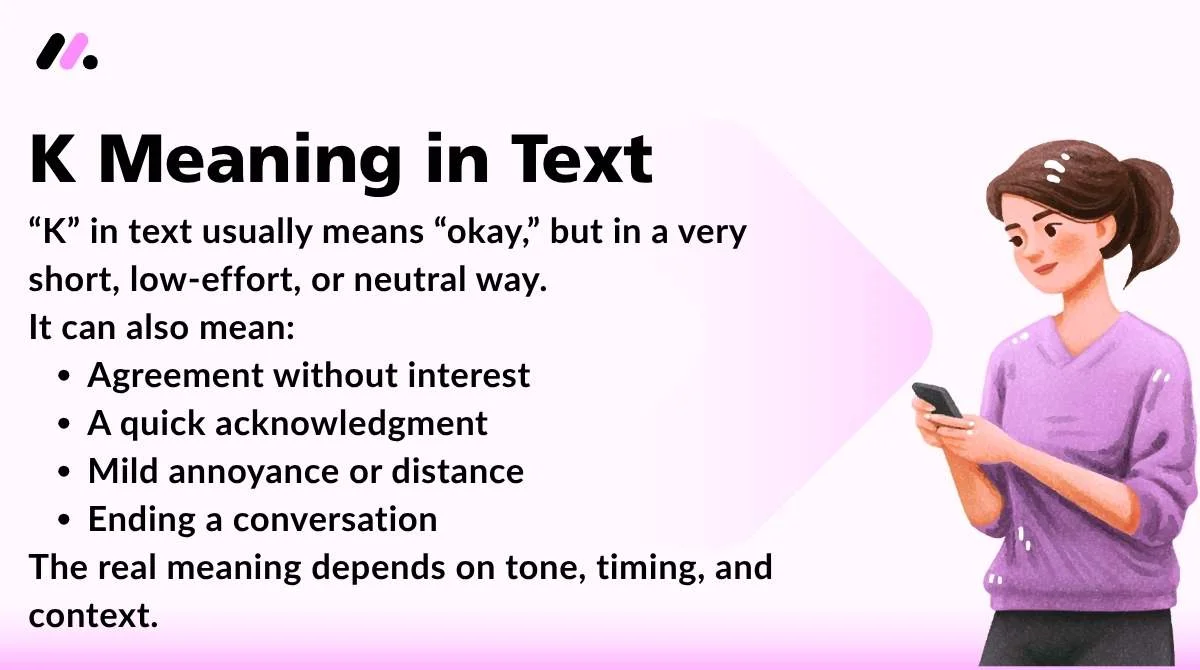
“K” in text usually means “okay,” but in a very short, low-effort, or neutral way.
It can also mean:
- Agreement without interest
- A quick acknowledgment
- Mild annoyance or distance
- Ending a conversation
The real meaning depends on tone, timing, and context.
The Most Common Meanings of “K”
1. Simple “Okay”
This is the most basic meaning.
Used when someone just wants to confirm they understood.
Example:
- “Meet at 5?”
- “K”
No emotion. Just acceptance.
2. Low Effort Reply
Sometimes “K” shows the person doesn’t want to talk much.
It feels shorter than “ok” or “okay,” so it can seem lazy.
Example:
- “Did you finish the work?”
- “K”
Here, it might feel like they didn’t care to respond fully.
3. Annoyed or Irritated
This is where “K” gets tricky.
When someone is upset, they often use very short replies.
Example:
- “Sorry I forgot”
- “K”
This version can feel cold or passive-aggressive.
4. Conversation Ender
“K” is often used to close a chat.
It signals: “Nothing more to say.”
Example:
- “I’ll text you later”
- “K”
That’s usually the end.
5. Neutral Acknowledgment
Sometimes it’s not emotional at all.
Just quick confirmation.
Example:
- “I sent the file”
- “K”
No hidden meaning.
How “K” Is Used in Real Conversations
Friends & Casual Texting
Among friends, “K” can be normal, but tone matters a lot.
- Close friends may use it casually without meaning anything
- But if someone usually types full replies, “K” can feel off
Example:
- “Come over?”
- “K”
Fine.
But:
- “I really need to talk”
- “K”
Feels distant.
Instagram & Snapchat
On social apps, short replies are common.
“K” here usually means:
- Seen your message
- Not much to say
- Keeping things light
But if you’re having a deep chat, it can feel dismissive.
Dating Apps
This is where “K” can be a red flag.
In dating:
- It often shows low interest
- Or lack of effort
Example:
- “I had a great time yesterday”
- “K”
That usually isn’t a good sign.
Gaming & Online Communities
In gaming chats, “K” is fast and practical.
- Used to confirm actions
- No emotional meaning
Example:
- “Defend base”
- “K”
Totally normal.
Work or Professional Chat
In work settings, “K” can feel too short.
It might come across as:
- Rude
- Unprofessional
- Disengaged
Better to say:
- “Okay”
- “Got it”
- “Thanks”
Is “K” Rude, Flirty, or Offensive?
It Depends on Context
“K” is not automatically rude.
But it can feel rude depending on:
- Message length before it
- Relationship
- Tone history
When It Feels Positive
- Quick agreement
- Casual chat
- Fast-paced conversations
Example:
- “See you soon”
- “K”
When It Feels Negative
- After emotional messages
- During arguments
- When tone suddenly changes
Example:
- “Why are you ignoring me?”
- “K”
That feels cold.
Is It Flirty?
Rarely.
“K” is not used for flirting.
It usually does the opposite — it kills the vibe.
Is It Offensive?
Not directly.
But it can feel dismissive, which can hurt more than direct words.
How to Respond When Someone Says “K”
Casual Replies
Keep it simple.
- “Cool”
- “Alright”
- “See ya”
Funny Replies
Add humor to break the dryness.
- “Wow, full sentence today”
- “K what? Ketchup?”
- “That’s a strong K”
Neutral Replies
If you don’t want drama:
- “Got it”
- “Okay then”
- “Talk later”
Professional Replies
If this happens at work:
- “Thanks for confirming”
- “Understood”
- “Appreciate it”
Stay polite and clear.
Common Misunderstandings About “K”
1. Thinking It Always Means Anger
Not true.
Sometimes it’s just fast typing.
2. Confusing It With “Ok”
“Ok” feels more neutral and polite.
“K” feels shorter and colder.
3. Assuming Everyone Uses It the Same Way
Different people, different styles.
Some always type short.
Others only use “K” when annoyed.
4. Ignoring Context
Context is everything.
Same word, different feeling.
5. Overthinking Every “K”
Not every “K” is deep.
Sometimes it really is just “okay.”
Similar Slang Terms You Should Know
- Ok – Normal agreement, more polite than “K”
- Okayy – Slightly playful or stretched tone
- KK – Friendly version of “K”
- Bet – Means “okay” or “I agree”
- Aight – Casual way to say “alright”
- Sure – Neutral agreement
- Yup – Positive confirmation
- Nah – Casual no
- Ight – Short for “alright”
- Cool – Relaxed agreement
- Fine – Can sound neutral or annoyed
- Gotcha – Shows understanding
When You Should Avoid Using “K”
Professional Settings
Avoid it in:
- Emails
- Work chats
- Client messages
It can seem careless.
Cross-Cultural Chats
Not everyone understands tone in short texts.
“K” may feel rude to others.
Emotional Conversations
If someone is sharing feelings, never reply with “K.”
It can seem dismissive and hurtful.
Important Discussions
When clarity matters, use full words.
“K” can create confusion.
FAQs
What does “K” mean from a girl?
It usually means “okay,” but tone matters. It can be neutral or show low interest depending on the situation.
What does “K” mean from a guy?
Same meaning—“okay.” Some guys use short replies often, so it may not mean anything negative.
Is “K” rude in texting?
It can feel rude if used in serious or emotional conversations, especially if it replaces a longer reply.
Why do people reply with just “K”?
To save time, show quick agreement, or end a conversation.
Is “K” worse than “ok”?
Yes, slightly. “K” feels shorter and colder than “ok.”
What should I reply to “K”?
Depends on context. You can keep it simple, ignore it, or add humor.
Does “K” mean someone is mad?
Not always. But in certain contexts, it can signal annoyance.
Conclusion
“K” is one of the smallest replies in texting, but it carries a lot of meaning.
At its core, it simply means “okay.” But in modern texting culture, tone matters more than the word itself. A single letter can feel neutral, cold, or even slightly rude depending on how and when it’s used.
The key is context. Look at the conversation, the person, and their usual texting style before jumping to conclusions.
If you’re unsure, don’t overthink it—but also don’t ignore patterns. If “K” keeps showing up in serious conversations, it might be saying more than just “okay.”
Use it carefully, read it wisely, and you’ll never get confused by it again.

Calvin Merrick is an English language educator and content writer dedicated to making similes and meanings simple, clear, and easy to understand for students worldwide.