Have you ever met someone who seemed determined to make every conversation unpleasant? Whether it’s a rude classmate, a grumpy neighbor, or a villain in a story, describing mean behavior can be tricky if you keep using the same words over and over.
That’s where similes come in. Similes make writing more colorful, vivid, and memorable by comparing one thing to another using the words “like” or “as.”
Instead of simply saying someone is mean, you can paint a clear picture in your reader’s mind.
In this guide, you’ll discover 26 powerful similes for mean, ranging from funny and playful comparisons to dramatic and poetic ones.
You’ll also learn how to use them in essays, stories, conversations, and creative writing. By the end, you’ll have a toolbox full of fresh expressions that make your writing stronger and more engaging.
What Is a Simile? (Quick Clear Definition)
A simile is a figure of speech that compares two different things using the words “like” or “as.”
It helps readers imagine a person, feeling, or situation more clearly.
Example:
He was as busy as a bee.
This comparison helps readers quickly understand that he was very active and hardworking.
Quick List – Most Popular Similes for “Mean”
- As mean as a snake
- As mean as a hornet
- As mean as a junkyard dog
- As mean as a rattlesnake
- As mean as vinegar
- As mean as a storm cloud
- As mean as a bully on a playground
- As sharp as a thorny rose stem
- Like ice on a winter morning
- Like a cactus in a hug contest
Complete List of Similes for “Mean”
Funny & Lighthearted Similes
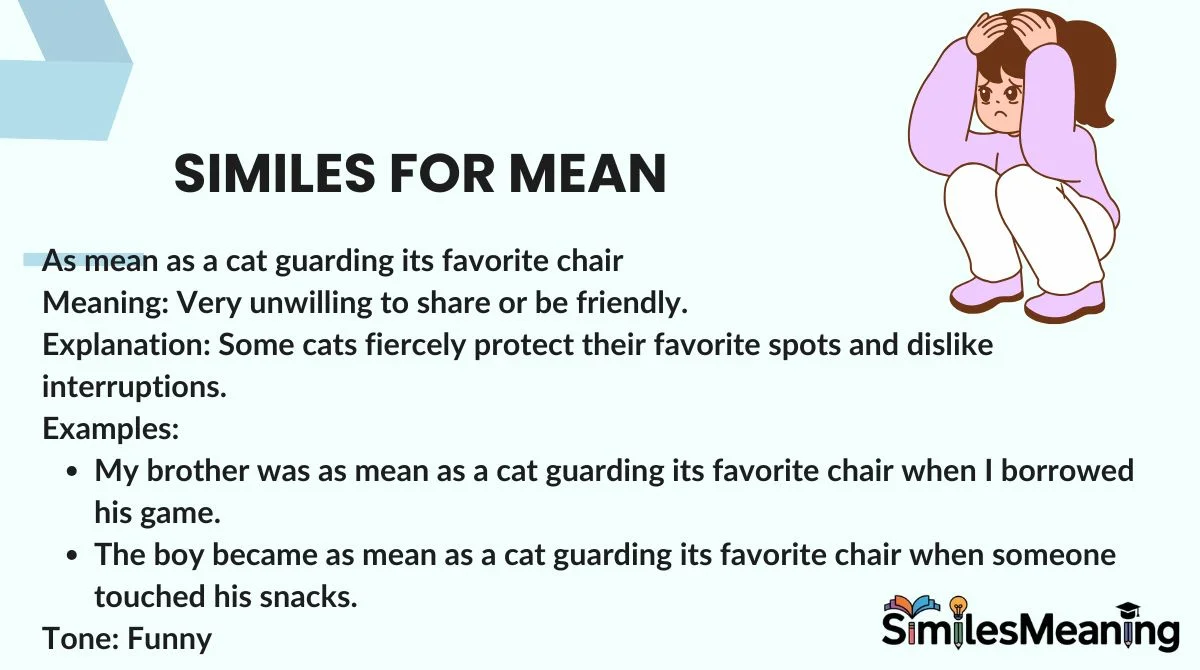
As mean as a cat guarding its favorite chair
Meaning: Very unwilling to share or be friendly.
Explanation: Some cats fiercely protect their favorite spots and dislike interruptions.
Examples:
- My brother was as mean as a cat guarding its favorite chair when I borrowed his game.
- The boy became as mean as a cat guarding its favorite chair when someone touched his snacks.
Tone: Funny
Like a cactus in a hug contest
Meaning: Unfriendly and difficult to approach.
Explanation: A cactus and hugs do not mix well, creating a humorous image.
Examples:
- She acted like a cactus in a hug contest during the group project.
- The coach looked like a cactus in a hug contest after the team lost.
Tone: Funny
As mean as a seagull stealing fries
Meaning: Rudely taking what belongs to others.
Explanation: Seagulls often swoop down and snatch food unexpectedly.
Examples:
- He was as mean as a seagull stealing fries from a tourist.
- The older kid acted as mean as a seagull stealing fries at lunch.
Tone: Funny
Like a porcupine at a pillow party
Meaning: Difficult to be around.
Explanation: A porcupine would make any pillow party uncomfortable.
Examples:
- She seemed like a porcupine at a pillow party today.
- The customer acted like a porcupine at a pillow party when speaking to staff.
Tone: Casual
As mean as a goat protecting a bucket of treats
Meaning: Aggressively protective.
Explanation: Goats can become surprisingly stubborn around food.
Examples:
- He was as mean as a goat protecting a bucket of treats.
- The child became as mean as a goat protecting a bucket of treats when sharing candy.
Tone: Funny
Emotional & Deep Similes
Like ice on a winter morning
Meaning: Cold and uncaring.
Explanation: Ice feels lifeless and distant, much like unkind behavior.
Examples:
- Her words felt like ice on a winter morning.
- He sounded like ice on a winter morning when he rejected the idea.
Tone: Serious
As mean as a locked door in a rainstorm
Meaning: Refusing help when it is needed.
Explanation: A locked door offers no comfort during trouble.
Examples:
- The manager was as mean as a locked door in a rainstorm.
- She seemed as mean as a locked door in a rainstorm when her friend needed support.
Tone: Serious
Like a shadow that blocks the sun
Meaning: Bringing negativity wherever one goes.
Explanation: Shadows can hide warmth and brightness.
Examples:
- His attitude was like a shadow that blocks the sun.
- The bully felt like a shadow that blocks the sun in the classroom.
Tone: Poetic
As mean as a broken promise
Meaning: Deeply hurtful.
Explanation: Broken promises often cause emotional pain.
Examples:
- Her comment was as mean as a broken promise.
- The insult felt as mean as a broken promise.
Tone: Serious
Like cold rain on a happy parade
Meaning: Ruining a joyful moment.
Explanation: Rain can spoil a celebration unexpectedly.
Examples:
- His criticism was like cold rain on a happy parade.
- She arrived like cold rain on a happy parade and ruined the mood.
Tone: Serious
Dramatic & Intense Similes
As mean as a rattlesnake
Meaning: Dangerous and hostile.
Explanation: Rattlesnakes are often associated with threat and aggression.
Examples:
- The villain was as mean as a rattlesnake.
- He sounded as mean as a rattlesnake during the argument.
Tone: Dramatic
As mean as a hornet
Meaning: Aggressive and quick to attack.
Explanation: Hornets are known for their painful stings.
Examples:
- She became as mean as a hornet after the mistake.
- The coach was as mean as a hornet after the loss.
Tone: Intense
As mean as a junkyard dog
Meaning: Fiercely hostile.
Explanation: Junkyard dogs are often pictured as aggressive guards.
Examples:
- The guard looked as mean as a junkyard dog.
- He acted as mean as a junkyard dog toward strangers.
Tone: Dramatic
Like thunder before a storm
Meaning: Warning of trouble ahead.
Explanation: Thunder often signals approaching danger.
Examples:
- His voice was like thunder before a storm.
- The principal’s expression was like thunder before a storm.
Tone: Serious
As mean as a wildfire in dry grass
Meaning: Destructively harsh.
Explanation: Wildfires spread quickly and cause damage.
Examples:
- The rumor was as mean as a wildfire in dry grass.
- Her words spread as mean as a wildfire in dry grass.
Tone: Dramatic
Creative & Unique Similes
As mean as a pencil with no eraser
Meaning: Unforgiving.
Explanation: Mistakes cannot be corrected without an eraser.
Examples:
- He was as mean as a pencil with no eraser.
- The teacher seemed as mean as a pencil with no eraser about late homework.
Tone: Creative
Like a staircase missing a step
Meaning: Unexpectedly unpleasant.
Explanation: Missing a step can catch people off guard.
Examples:
- His reply was like a staircase missing a step.
- The comment felt like a staircase missing a step.
Tone: Creative
As mean as a key that fits no lock
Meaning: Unhelpful and frustrating.
Explanation: A useless key serves no purpose.
Examples:
- She acted as mean as a key that fits no lock.
- The customer was as mean as a key that fits no lock.
Tone: Creative
Like sandpaper on a sunburn
Meaning: Extremely irritating.
Explanation: The image creates an immediate feeling of discomfort.
Examples:
- His jokes were like sandpaper on a sunburn.
- The teasing felt like sandpaper on a sunburn.
Tone: Intense
As mean as a clock that never stops ticking
Meaning: Constantly bothersome.
Explanation: Endless ticking can become irritating.
Examples:
- He was as mean as a clock that never stops ticking.
- The critic sounded as mean as a clock that never stops ticking.
Tone: Creative
Poetic & Literary Similes
Like a thorn hidden in a flower
Meaning: Hurtful beneath a pleasant appearance.
Explanation: Something beautiful may hide pain.
Examples:
- Her smile was like a thorn hidden in a flower.
- The character seemed like a thorn hidden in a flower.
Tone: Poetic
As mean as a winter wind
Meaning: Harsh and unforgiving.
Explanation: Winter winds feel cold and severe.
Examples:
- His words were as mean as a winter wind.
- She sounded as mean as a winter wind.
Tone: Poetic
Like a storm cloud over a picnic
Meaning: Bringing gloom to a happy place.
Explanation: Storm clouds symbolize trouble and sadness.
Examples:
- He arrived like a storm cloud over a picnic.
- Her mood was like a storm cloud over a picnic.
Tone: Poetic
As mean as a thorn bush on a narrow path
Meaning: Difficult and painful to deal with.
Explanation: A thorn bush blocks the way and causes discomfort.
Examples:
- The neighbor was as mean as a thorn bush on a narrow path.
- The bully acted as mean as a thorn bush on a narrow path.
Tone: Serious
Like frost on a blooming garden
Meaning: Destroying kindness or joy.
Explanation: Frost can damage beautiful flowers overnight.
Examples:
- His remarks were like frost on a blooming garden.
- The criticism felt like frost on a blooming garden.
Tone: Poetic
As mean as vinegar
Meaning: Bitter and unpleasant.
Explanation: Vinegar’s sharp taste symbolizes harshness.
Examples:
- The old man was as mean as vinegar.
- Her reply sounded as mean as vinegar.
Tone: Casual
Fresh and Unique Similes You Won’t Hear Every Day
As mean as a bookmark that hides your favorite page
This suggests someone who ruins enjoyment just when things are going well.
Like a lantern that refuses to shine
This represents a person who withholds kindness when it is needed most.
As mean as a bridge that ends halfway
This symbolizes disappointment and lack of support.
Like a paintbrush that only paints gray
This describes someone who brings negativity into every situation.
As mean as a map that leads nowhere
This imagery suggests frustration, confusion, and unhelpful behavior.
How to Use These Similes in Writing
Essays
Use similes to make descriptions more vivid and memorable.
Example:
The bully was as mean as a hornet and scared many students.
Stories
Similes help readers picture characters instantly.
Example:
The villain smiled like a thorn hidden in a flower, appearing friendly while planning trouble.
Conversations
A good simile can make everyday speech more colorful.
Example:
He’s as mean as vinegar today.
How to Create Your Own Similes (Mini Writing Guide)
Step 1: Identify the trait
Choose the quality you want to describe, such as meanness, kindness, or bravery.
Step 2: Find a matching image
Think of an object, animal, or situation that shows the same quality.
Step 3: Build the comparison
Use “like” or “as.”
Step 4: Test the image
Make sure readers can easily understand it.
Step 5: Keep it memorable
The best similes create strong mental pictures.
5 Practical Tips
- Use familiar images.
- Avoid overly complicated comparisons.
- Match the tone to the situation.
- Be original when possible.
- Read the simile aloud.
Transformation Examples
Plain: He was mean.
Better: He was as mean as a junkyard dog.
Plain: Her comment hurt.
Better: Her comment was like frost on a blooming garden.
Plain: The bully scared everyone.
Better: The bully was as mean as a rattlesnake.
Common Mistakes When Using Similes
Overuse
Too many similes can distract readers.
Clichés
Try not to rely only on common comparisons. Mix in fresh ideas.
Tone Mismatch
Funny similes may not fit serious writing, and serious similes may feel strange in humorous stories.
Practice Exercise
Fill in the blanks with suitable similes.
- The bully was as mean as a _______.
- Her words felt like _______ on a winter morning.
- The villain smiled like a _______ hidden in a flower.
- He acted as mean as a _______ dog.
- The criticism felt like _______ on a blooming garden.
- She was as mean as _______.
- His attitude was like a _______ that blocks the sun.
- The neighbor was as mean as a _______ bush on a narrow path.
- The coach became as mean as a _______.
- The reply felt like sandpaper on a _______.
- He arrived like a storm cloud over a _______.
- She acted like a cactus in a _______ contest.
Answers
- rattlesnake
- ice
- thorn
- junkyard
- frost
- vinegar
- shadow
- thorn
- hornet
- sunburn
- picnic
- hug
FAQs
What is the best simile for a mean person?
“As mean as a rattlesnake” is one of the most popular and vivid choices.
Are similes useful in essays?
Yes. They make descriptions clearer and more engaging.
Can similes be funny?
Absolutely. Comparisons like “like a cactus in a hug contest” add humor.
What is the difference between a simile and a metaphor?
A simile uses “like” or “as,” while a metaphor makes a direct comparison.
Should children use similes in writing?
Yes. Similes help young writers create stronger descriptions.
How can I make my similes original?
Combine everyday objects, emotions, and situations in unexpected but clear ways.
Final Thoughts
Similes are powerful tools that turn ordinary descriptions into memorable images. When describing someone who is mean, you don’t have to repeat the same adjectives again and again.
Instead, you can compare that person to a rattlesnake, a winter wind, a thorn hidden in a flower, or even a cactus in a hug contest.
The 26 similes in this guide provide a mix of funny, dramatic, emotional, poetic, and creative comparisons suitable for essays, stories, conversations, and creative writing.
Experiment with them, adapt them to your own style, and create new ones of your own. The more vivid your comparisons, the more unforgettable your writing becomes.

Calvin Merrick is an English language educator and content writer dedicated to making similes and meanings simple, clear, and easy to understand for students worldwide.