Have you ever received a message that simply said “STFU” and wondered whether the person was joking, angry, or just being sarcastic?
You’re not alone. Many people search for STFU meaning in text because this short internet slang can have very different meanings depending on the situation.
On social media, in gaming chats, group conversations, and even private messages, STFU appears often. Sometimes it is used playfully between friends. Other times, it can sound rude or offensive.
Understanding the meaning behind STFU is important because context changes everything. The same word can be interpreted as a joke in one conversation and an insult in another.
This guide explains exactly what STFU means, how people use it in texting, whether it is offensive, how to respond to it, common misunderstandings, related slang terms, and situations where you should avoid using it.
By the end, you’ll know exactly how to interpret STFU whenever you see it online.
What Does “STFU” Mean in Text?
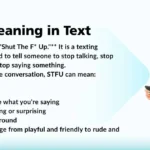
STFU stands for “Shut The F* Up.”** It is a texting abbreviation used to tell someone to stop talking, stop complaining, or stop saying something.
Depending on the conversation, STFU can mean:
- Be quiet
- Stop talking
- I can’t believe what you’re saying
- That’s shocking or surprising
- Stop joking around
The tone can range from playful and friendly to rude and aggressive.
The Most Common Meanings of “STFU”
1. Be Quiet
The most direct meaning is a request for someone to stop talking.
Example:
Person A: “You’ve told that story five times.”
Person B: “STFU, it’s a good story.”
In this case, it is being used casually.
2. Expression of Shock
Sometimes people use STFU when they hear surprising news.
Example:
Friend: “I just won free concert tickets.”
You: “STFU! No way!”
Here, STFU doesn’t literally mean “be quiet.” It expresses surprise.
3. Friendly Teasing
Close friends often use STFU while joking with each other.
Example:
Friend: “I’m clearly the smartest person here.”
You: “STFU.”
The meaning is playful rather than hostile.
4. Annoyance or Frustration
STFU can also show irritation.
Example:
Person A: “I already explained this three times.”
Person B: “STFU.”
This usage is much more negative and may start an argument.
5. Reaction to Exciting News
Many people use STFU when something sounds unbelievable.
Example:
Friend: “I met my favorite celebrity today.”
You: “STFU, that’s amazing!”
In this context, the phrase means “I can’t believe it.”
6. Gaming Trash Talk
Online gamers sometimes use STFU during competitive matches.
Example:
Player 1: “Your team got lucky.”
Player 2: “STFU and play.”
This version is often meant as an insult.
How “STFU” Is Used in Real Conversations
Friends & Casual Texting
Among friends, STFU is often used as a joke.
Examples:
Friend: “I ate an entire pizza.”
You: “STFU.”
Friend: “I got a perfect score.”
You: “STFU, seriously?”
The phrase usually expresses surprise, amusement, or playful disbelief.
Instagram & Snapchat
On Instagram and Snapchat, STFU commonly appears in comments and direct messages.
Examples:
- “STFU that’s so cute.”
- “STFU I’m obsessed with this.”
- “STFU you actually met them?”
In these cases, users are reacting emotionally rather than telling someone to be quiet.
Dating Apps
Dating app conversations sometimes include STFU when flirting or reacting to surprising information.
Examples:
Person A: “I make homemade pizza every weekend.”
Person B: “STFU that’s attractive.”
Or:
Person A: “I speak four languages.”
Person B: “STFU, really?”
Here the phrase often shows excitement or admiration.
Gaming & Online Communities
Gaming culture uses STFU frequently.
Examples:
- “STFU and focus.”
- “STFU, you’re wrong.”
- “STFU, let’s start the match.”
Gaming environments are often more direct, making STFU appear harsher.
Work or Professional Chat
Using STFU at work is usually inappropriate.
Even if intended as a joke, it can appear disrespectful.
Instead of saying STFU, professional alternatives include:
- Let’s stay focused.
- Please allow others to speak.
- Let’s move on.
- Can we continue the discussion?
Professional communication should remain respectful and clear.
Is “STFU” Rude, Flirty, or Offensive?
The answer depends entirely on context.
When STFU Is Rude
STFU feels rude when:
- Used during arguments
- Directed at strangers
- Used to insult someone
- Sent aggressively
- Written in all caps during conflict
Example:
“STFU. Nobody cares.”
Most people would consider this offensive.
When STFU Is Playful
Among close friends, STFU can be harmless.
Example:
Friend: “I just got front-row tickets.”
You: “STFU!”
The reaction shows excitement rather than hostility.
When STFU Is Flirty
In modern texting culture, STFU sometimes appears in playful flirting.
Example:
Person A: “I baked cookies for everyone.”
Person B: “STFU, that’s adorable.”
The phrase expresses attraction or admiration.
Understanding Tone Psychology
People interpret messages based on:
- Relationship closeness
- Conversation history
- Capitalization
- Punctuation
- Overall mood
Compare:
- “stfu lol”
- “STFU!!!”
- “stfu that’s amazing”
Each creates a different emotional reaction.
Context matters more than the actual letters.
How to Respond When Someone Says “STFU”
Casual Replies
If the person is joking:
- “Make me.”
- “No chance.”
- “Not happening.”
- “You know you love my stories.”
These responses keep the conversation light.
Funny Replies
Humorous responses include:
- “I’ll consider it.”
- “That’s a strong opinion.”
- “Too late.”
- “I just got started.”
These work best with friends.
Neutral Replies
When you’re unsure about tone:
- “Okay.”
- “What do you mean?”
- “Are you serious?”
- “Got it.”
Neutral replies avoid conflict.
Professional Replies
If someone uses STFU in a professional environment:
- “Let’s keep the discussion respectful.”
- “I’d appreciate professional communication.”
- “Let’s focus on the topic.”
Professional responses help de-escalate tension.
Common Misunderstandings About “STFU”
Assuming It Is Always Offensive
Many people think STFU is always an insult.
In reality, younger internet users often use it as an expression of excitement or disbelief.
Ignoring Context
The same phrase can mean very different things.
Example:
- “STFU that’s amazing.”
- “STFU you’re annoying.”
The first is positive.
The second is negative.
Misreading Humor
Friends often communicate differently than strangers.
What sounds rude to an outsider may be normal within a close friendship.
Confusing Tone Across Cultures
Not every culture uses direct slang the same way.
Some people may find STFU highly offensive regardless of intent.
Reading Too Much Into Capital Letters
Capital letters can signal:
- Excitement
- Shock
- Anger
You must consider the full conversation before judging tone.
Similar Slang Terms You Should Know
OMG
Means “Oh My God.”
Used to express surprise.
WTF
Shows confusion, shock, or disbelief.
FR
Means “For Real.”
Used to confirm honesty.
NGL
Means “Not Gonna Lie.”
Introduces an honest opinion.
IDC
Means “I Don’t Care.”
Shows indifference.
IMO
Means “In My Opinion.”
Shares a personal viewpoint.
TBH
Means “To Be Honest.”
Adds honesty to a statement.
SMH
Means “Shaking My Head.”
Shows disappointment or disbelief.
LMFAO
Represents strong laughter.
BRB
Means “Be Right Back.”
Indicates a temporary absence.
IDK
Means “I Don’t Know.”
Expresses uncertainty.
AFK
Means “Away From Keyboard.”
Common in gaming communities.
When You Should Avoid Using “STFU”
Professional Settings
Avoid STFU in:
- Work emails
- Business chats
- Client conversations
- School communications
It may damage professional relationships.
Cross-Cultural Conversations
Not everyone understands internet slang.
Some people may interpret STFU literally and feel offended.
Sensitive Situations
Never use STFU when discussing:
- Personal struggles
- Family issues
- Serious conflicts
- Emotional conversations
The phrase can appear insensitive.
Conversations With Strangers
Strangers may not understand your intended tone.
What feels funny to you may feel hostile to them.
Customer Service Interactions
Using STFU with customers, clients, or support staff is generally inappropriate and unprofessional.
Formal Communities
Formal online groups often discourage aggressive slang.
Choosing respectful language creates better communication.
FAQs
What does STFU stand for in texting?
STFU stands for “Shut The F*** Up.” It is a common internet abbreviation used in texts and online chats.
Is STFU always rude?
No. It can be playful, funny, shocked, or offensive depending on the context.
What does STFU mean on Snapchat?
On Snapchat, STFU often expresses surprise, excitement, or disbelief rather than a literal command to be quiet.
Can STFU be used as a compliment?
Indirectly, yes. People sometimes use it when reacting positively to exciting or impressive news.
Is STFU appropriate at work?
No. It is generally considered unprofessional and should be avoided in workplace communication.
Why do friends say STFU to each other?
Friends often use it jokingly to express surprise, disbelief, or playful teasing.
How should I respond to STFU?
Your response should depend on the tone. You can reply humorously, casually, neutrally, or professionally based on the situation.
Conclusion
Understanding the STFU meaning in text is simple once you know the context. While the phrase literally means “Shut The F*** Up,” modern internet users often use it to show shock, excitement, disbelief, or playful humor.
The key is reading the situation carefully. Between close friends, STFU may be harmless and funny. In professional or sensitive conversations, it can sound rude and inappropriate.
Knowing when and where to use it helps you communicate more effectively and avoid unnecessary misunderstandings online.

Calvin Merrick is an English language educator and content writer dedicated to making similes and meanings simple, clear, and easy to understand for students worldwide.